


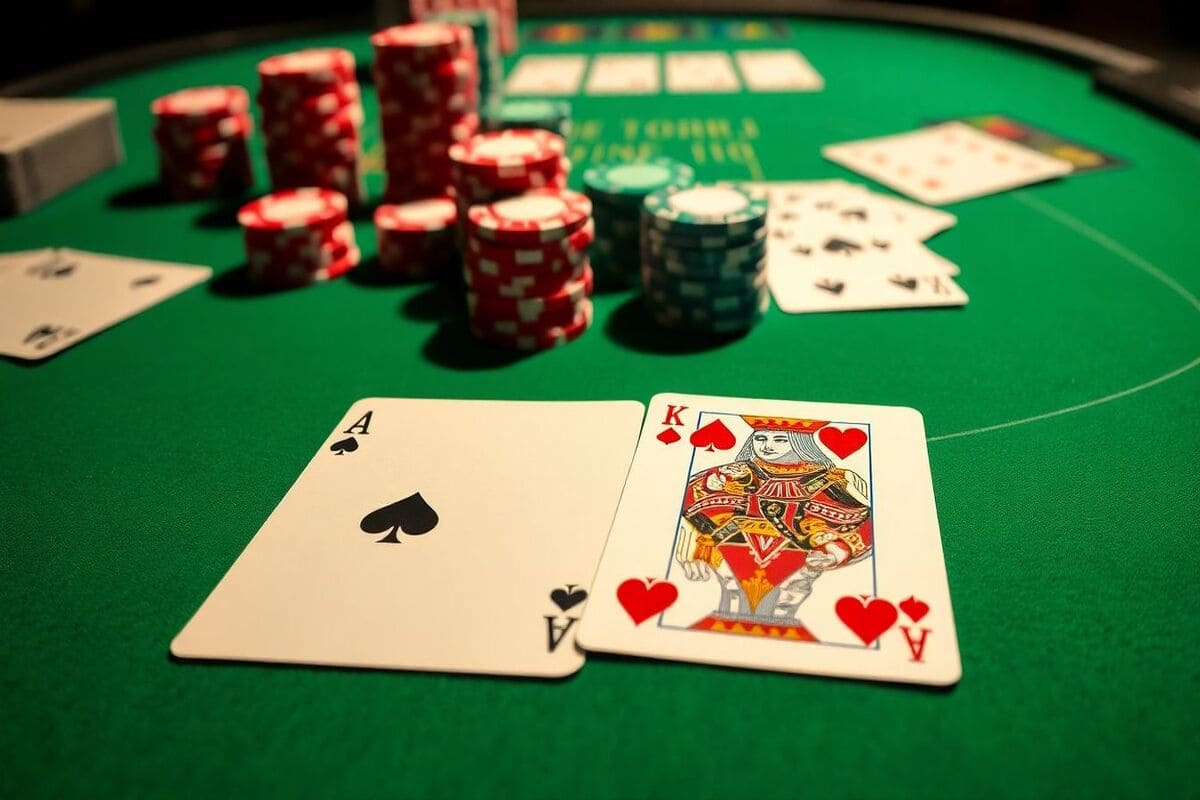
Blackjack offers one of the lowest house edges among casino games, making it ideal for advantage gambling. Unlike pure-chance games, it blends probability and strategy. Casual players rely on instinct, while seasoned players use knowledge and discipline. Advanced techniques can reduce the house edge from ~0.5% with basic strategy to near-zero or slightly positive.
For example, basic strategy wins ~48–49% of hands. With many tens left in the deck, doubling down on 11 instead of hitting increases expected value, an opportunity missed by basic players.
At its core, blackjack is a game of odds. This guide covers advanced strategies, including card counting, betting systems, deck composition analysis, and optimal decision-making. Mastering these methods improves both win rate and disciplined, strategic play.
The Foundation: Mastering Basic Strategy
Before using card counting or betting systems, master basic strategy. It dictates the optimal action for every hand vs. the dealer’s upcard, forming the mathematical baseline for play.
Strategy charts, built from millions of simulated hands, cover hard hands (no ace or ace = 1), soft hands (ace = 11), and pairs (for splitting). Consistent use reduces the house edge to ~0.5%.
Memorize rules using color-coded charts or apps, focusing on patterns like always splitting aces or never splitting 10s. Without this foundation, advanced techniques won’t work—like running before you can walk.
Blackjack Strategy Charts Explained
A blackjack strategy chart is your cheat code for gameplay. It tells you the mathematically optimal decision—whether to hit, stand, double down, split, or surrender—based on your playing cards and the dealer’s upcard. Using a chart reduces guesswork, keeps emotions in check, and maximizes your expected value at the table.
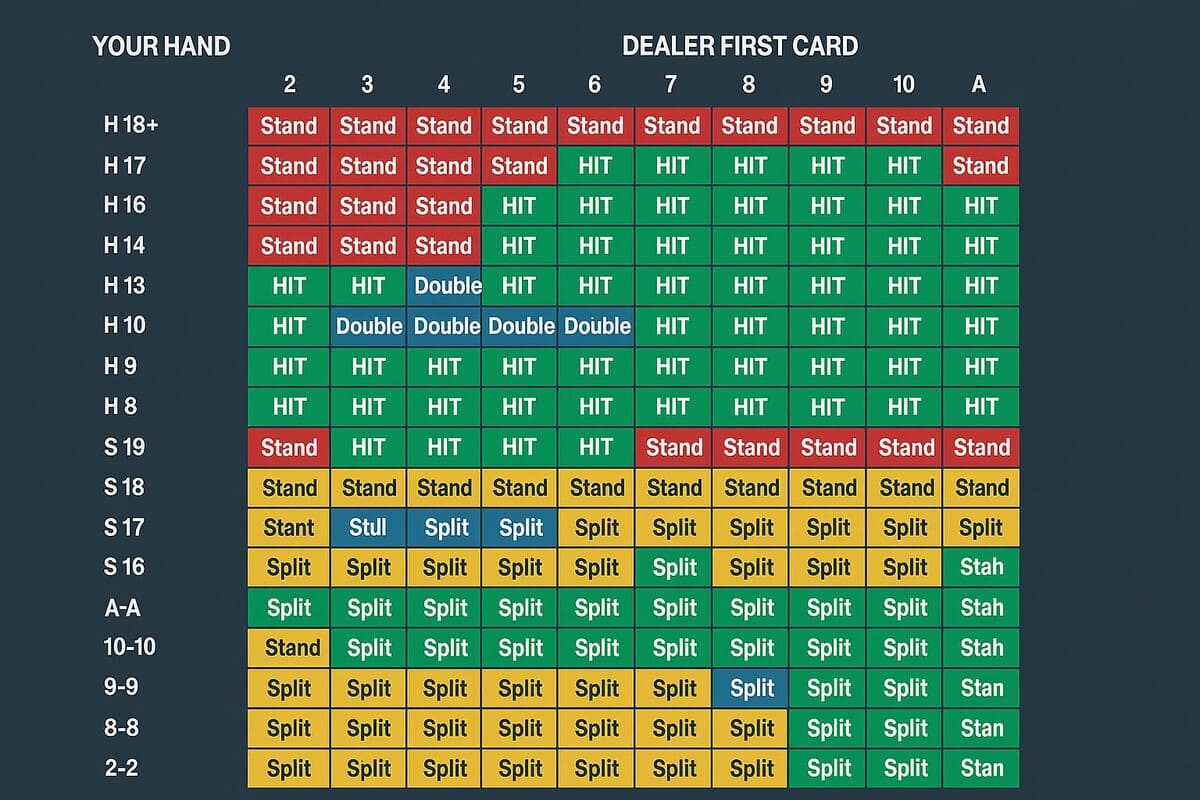
There are three main types of charts:
- Hard hands — hands without an ace or where the ace counts as 1.
- Soft hands — hands where the ace counts as 11.
- Pairs — two playing cards of the same value.
Charts use letters or colors to simplify decisions:
- H (Red) = Hit
- S (Green) = Stand
- D (Blue) = Double if allowed, otherwise hit
- Ds (Blue/Green) = Double if allowed, otherwise stand
- P (Yellow) = Split
- R (Gray) = Surrender if allowed, otherwise hit
Basic Strategy Quick Reference
| Your Hand | Dealer Upcard | Recommended Action | Color |
| 12–16 (hard) | 2–6 | Stand | Green |
| 12–16 (hard) | 7–A | Hit | Red |
| 11 | 2–10 | Double | Blue |
| Pair of 8s | 2–A | Split | Yellow |
Strategy charts vary by rules: single vs. multi-deck, dealer hitting soft 17, and surrender options. For example, doubling 10 has slightly higher EV in single-deck than 8-deck games.
Memorization tips: Start with high-frequency hands (hard 12–16 vs dealer 2–6), use color cues, flashcards, or apps. Patterns become automatic with practice.
Advanced Decision-Making: When to Double Down, Split, and Surrender
In advanced blackjack, knowing when to double down, split, or surrender can cut the house edge 1–2% beyond basic strategy. Decisions rely on probability and EV. Rules vary by casino. See detailed strategy subsections below.
EV Decision Framework
- Evaluate the probability of improving your hand versus the dealer’s likely outcome.
- Compare potential gains and losses to determine the optimal move.
- Always prioritize actions that maximize Expected Value over instinct or emotion.
Double Down
Doubling down lets you double your initial bet in exchange for committing to take only one more card. Optimal situations include:
| Your Hand | Dealer Upcard | Reason |
| Hard 9 | 3–6 | Dealer likely to bust |
| Hard 10 or 11 | <10 | High EV (+0.55 for 11 vs 6) |
| Soft 16–18 | 4–6 | Flexible hand with favorable odds |
For example, 11 vs dealer 6 has an expected value of +0.55 units, making doubling highly profitable. Decisions also depend on deck composition—more tens remaining increase EV. Monte Carlo simulations are used to calculate these optimal plays. Avoid doubling in high-risk hands or against strong dealer upcards.
Split Pairs
Splitting pairs lets you turn one hand into two, increasing potential wins while adding randomness to outcomes. Key strategies:
- Always split Aces (e.g., Ace of Spades + Ace) — Each hand has a strong chance of forming 21, maximizing EV.
- Always split 8s — 16 is a weak hand; splitting gives two chances to improve.
- Never split 10s — A strong 20 already has high EV (~+0.5), splitting reduces expected value.
- Split 2s, 3s, 6s, 7s if shown weak cards.
Advanced considerations:
- Resplitting: Some casinos allow splitting a second time, increasing EV in favorable card counts.
- Card count influence: More high cards remaining boosts the benefit of splitting.
Why Never Split 10s: A 20 is already a premium hand. Splitting reduces the expected value and increases exposure to dealer wins.
Splitting strategically is essential for maximizing long-term profits and controlling risk in advanced blackjack play.
Surrender
Surrendering lets you forfeit half your bet on a poor hand, reducing losses. Many players avoid it due to the “giving up” mindset, but proper gambling discipline shows it’s a math-based choice.
Early vs. Late Surrender: Some casinos allow surrender before the dealer checks for blackjack (early), increasing EV slightly, while others only permit it after dealer checks (late).
Optimal surrender situations:
| Your Hand | Dealer Upcard | Notes |
| Hard 16 | 9–A | EV ≈ -0.54 units if played, better to surrender |
| Hard 15 | 10 | High likelihood of loss |
| Hard 16 | 10 | Late surrender recommended if allowed |
Surrender decisions depend on the dealer’s upcard, deck composition, and overall game flow. Executing them correctly reduces risk while maintaining an informed, probability-based approach to blackjack.
When to Take Insurance in Blackjack
Insurance is a side bet when the dealer shows an Ace, paying 2:1 if the dealer has blackjack. For basic players, it’s usually negative EV—breakeven requires 33.3% tens, but a standard shoe has ~30.7%.
Exception: With a true count ≥ +3, insurance can be profitable. “Even money” (1:1) only works when the count favors it.
Example: In a 6-deck shoe with 24 tens remaining out of 78 cards, EV = +0.12 units, making insurance +EV.
| True Count | EV per Unit Bet | Decision |
| -2 | -0.08 | Avoid |
| 0 | -0.03 | Avoid |
| +3 | +0.12 | Take |
Warning: Insurance is Usually a Bad Bet
Insurance Breakeven Math:
EV = 2 × P(dealer blackjack) − 1 (profitable only if P ≥ 0.333)
Card Counting Techniques for Intermediate Players
Card counting is a key blackjack advantage, tracking high-to-low card ratios. It focuses on probabilities, not memorizing every card, allowing players to adjust bets and deviate from basic strategy as the odds shift.
Popular Counting Systems:
| System | Values | Complexity | Notes |
| Hi-Lo | 2–6 = +1, 7–9 = 0, 10–A = -1 | Low | Best for beginners |
| Zen Count | 2–7 = +1, 8–9 = 0, 10–A = -2 | Medium | More precise EV calculations |
| Omega II | 2,3,7 = +1, 4–6 = +2, 10–A = -2 | High | Complex but accurate |
| KO | 2–7 = +1, 8–10 = 0, A = -1 | Low | Unbalanced, easier true count conversion |
Key Concepts:
- Running count → True count: Divide running count by decks remaining. Example: RC = +8 in 2 decks → True Count = +4.
- Deck penetration: The deeper into the shoe you count, the more accurate your predictions. Shuffling resets advantage; advanced players sometimes track shuffle patterns to improve odds.
5-Step Practice Start:
- Begin with a single deck, counting cards as they are dealt.
- Convert running count to true count after each round.
- Practice with 2–6 decks and varying penetration.
- Introduce betting spreads based on true count.
- Use blackjack simulators or real shuffled decks to reinforce speed and accuracy.
Counting Milestones: Track Your Progress
Set goals: e.g., 95% accuracy over 1 deck in under 30 seconds per hand. Track wins, errors, and betting efficiency.
Other card games like baccarat and certain poker variants can also benefit from counting techniques, but blackjack remains the primary arena for advantage play.
Advanced Betting Strategies and Bankroll Management
Blackjack betting requires systems, discipline, and risk management. Advanced players boost gains and limit losses. Methods work with randomness but don’t alter the house edge. Casual players play for fun; advantage players apply math.
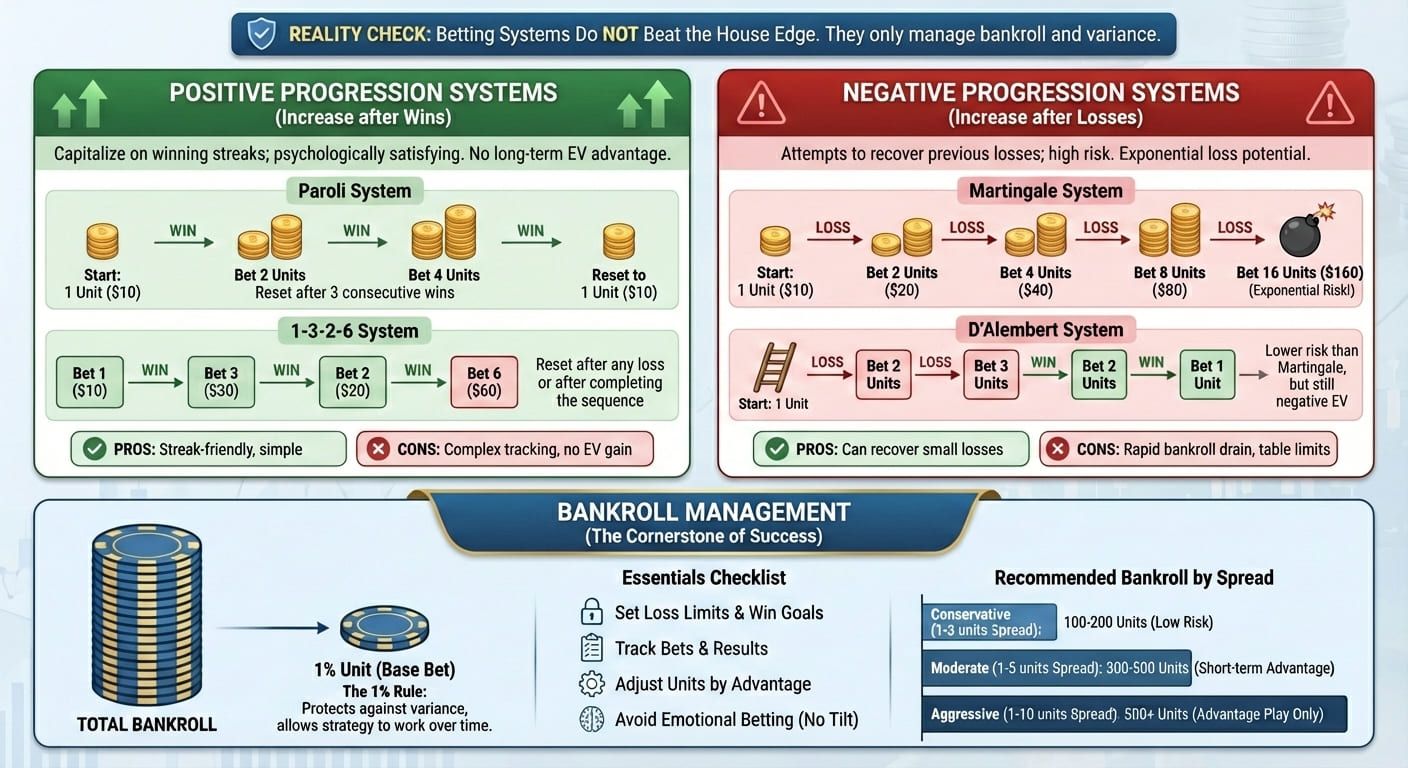
Reality Check: Betting Systems Don't Beat House Edge
No betting system can overcome the built-in house advantage; they only help manage bankroll and variance.
Positive Progression Systems
Positive progression systems increase bets after wins to capitalize on streaks, but they do not change the house edge—they’re psychologically satisfying, not mathematically advantageous.
- Paroli System: Double your bet after each win, resetting after three consecutive wins. Example: Start $10 → win → $20 → win → $40 → win → reset to $10.
- 1-3-2-6 System: A four-step sequence where you adjust bets as $10 → $30 → $20 → $60. Limits losses while seeking to win four bets in a row.
| System | Strategy | Pros | Cons |
| Paroli | Double after win, reset 3 wins | Simple, streak-friendly | No long-term EV gain |
| 1-3-2-6 | Structured 4-bet progression | Limits losses, controlled | Complex to track under pressure |
These approaches are similar to sportsbook betting progressions, where wager size changes after wins, emphasizing momentum over true advantage.
Negative Progression Systems
Negative progression systems increase bets after losses to recover previous losses, but they carry exponential risk.
- Martingale System: Double your bet after each loss. Example over 5 losses starting $10: $10 → $20 → $40 → $80 → $160. A single win recovers all losses, but a losing streak can wipe out a bankroll.
- D’Alembert System: Safer alternative, increase by one unit after a loss, decrease after a win—slower recovery, lower risk.
| Loss # | Bet | Cumulative Loss |
| 1 | $10 | $10 |
| 2 | $20 | $30 |
| 3 | $40 | $70 |
| 4 | $80 | $150 |
| 5 | $160 | $310 |
Long losing streaks can quickly drain bankrolls. Unlike slots, negative progression interacts with odds but carries exponential risk. Safer alternatives like Labouchere allow structured recovery with lower exposure.
Bankroll Management
Proper bankroll management is the cornerstone of long-term success in blackjack.
The probability of losing your entire bankroll. Keeping bet sizes conservative minimizes this risk.
Unit Sizing: Base bets are typically 1% of total bankroll for recreational play; advantage players may adjust units based on true count. Increase stakes only when statistical edge is favorable.
Bankroll Management Essentials:
- Set loss limits and win goals.
- Track bets and results for accurate record keeping.
- Adjust units according to advantage and deck conditions.
- Avoid emotional betting; stick to the plan.
Recommended Bankroll by Betting Spread:
| Betting Spread | Suggested Bankroll | Notes |
| 1–3 units | 100–200 units | Conservative, low-risk |
| 1–5 units | 300–500 units | Moderate, short-term advantage |
| 1–10 units | 500+ units | Aggressive, advantage play only |
Expert Tip: The 1% Rule Explained
Betting 1% per hand protects against variance, letting your strategy work over thousands of hands, especially online where speed and penetration differ. Advanced players adjust bets and plays as odds shift, often using Monte Carlo simulations to calculate EV.
Key Bust Probabilities:
| Player Hand | Probability of Bust |
| 12 | 31% |
| 13 | 39% |
| 14 | 56% |
| 15 | 58% |
| 16 | 62% |
| 17 | 69% |
Specific scenarios:
- Hitting 12 vs dealer 2 → bust probability ~31%, EV slightly negative.
- Hitting 13 vs dealer 2 → bust probability ~39%, EV more negative, better to stand if following basic strategy.
EV Example: Standing on 12 vs dealer 6 has EV ≈ +0.14 units; hitting 16 vs dealer 10 has EV ≈ -0.54 units.
Deck composition affects these numbers: more high cards remaining increase player blackjack chances and bust probability.
Rule Variations and Their Strategic Impact
Understanding rule variations is key to choosing favorable blackjack tables, as small changes can shift odds and house edge. For example, 6:5 payouts add ~1.4% edge versus 3:2, sharply reducing expected returns. RED FLAG: Avoid 6:5 tables.
Other key rule impacts:
- Dealer hits soft 17 (+0.2% house edge) → alters double-down and standing strategy.
- Number of decks: single-deck slightly reduces house edge compared to multi-deck games.
- Double after split (DAS) → increases expected value on hands like 8s and Aces.
- Surrender variations → early surrender lowers house edge by ~0.08%, late surrender less effective.
- Continuous shuffling machines (CSM) → make card counting impossible, removing advantage.
Rule Variations House Edge Impact:
| Rule Variation | House Edge Impact |
| 6:5 Blackjack Payout | +1.39% |
| Dealer Hits Soft 17 | +0.22% |
| No DAS | +0.13% |
| Late Surrender Only | +0.08% |
| Multi-Deck vs Single Deck | +0.15% |
Ideal Blackjack Table Characteristics:
- 3:2 blackjack payout
- Dealer stands on soft 17
- DAS allowed
- Early surrender available
- Minimum decks (preferably single or double deck)
By knowing these rules, players can select tables with the lowest house edge and maximize expected value in both live and online casino environments.
Practical Application: Playing in Casino Environments
You’ve learned the theory—now apply it in real casinos. Online play offers speed and digital tools; brick-and-mortar provides live cues. Upcoming sections cover table choice, bet execution, dealer reading, and managing psychology.
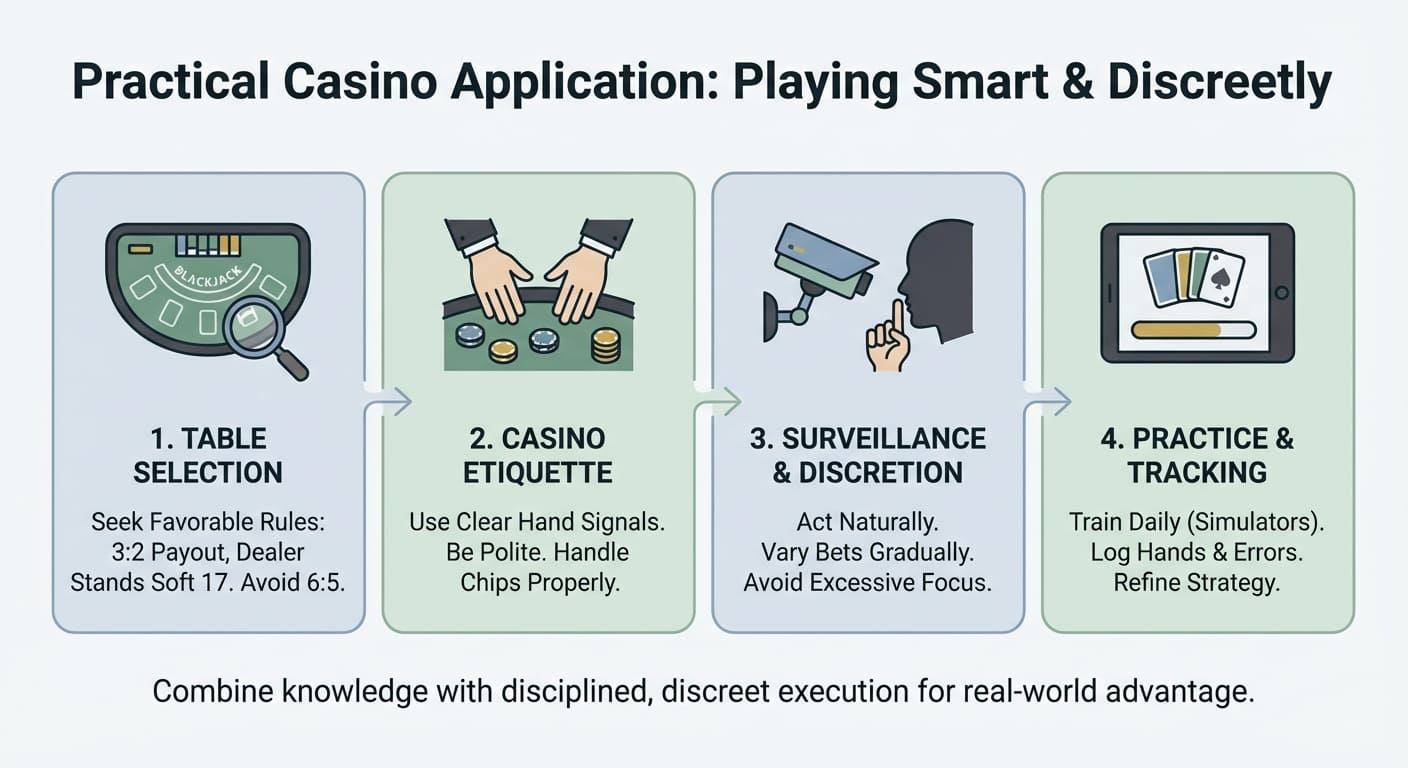
Table Selection
Choosing the right table is key to optimizing play and minimizing the house edge. Counters seek deep penetration and slower dealers; basic players prioritize favorable rules and comfortable stakes. Leave if penetration, dealer speed, or rules are unfavorable.
Table Evaluation System:
- Dealer stands on soft 17
- Double after split allowed (DAS)
- Minimum decks / penetration suitable for your strategy
- Low minimum bets for bankroll management
- Reasonable crowd and dealer speed
- Avoid 6:5 blackjack or other bad rule variations
Prioritize tables that maximize expected value, allow smooth decision-making, and align with your playing style, whether counting cards or following basic strategy.
Casino Etiquette
Proper casino etiquette improves your experience and gameplay. Use hand signals for hits, stands, or doubles, handle chips carefully, tip appropriately, communicate politely, and avoid distracting the table or touching others’ bets.
Hand Signals Quick Reference:
- Tap table = Hit
- Wave hand horizontally = Stand
- Place additional chips = Double/Increase bet
| DO's | DON'Ts |
| Be polite and courteous | Stall or slow the game |
| Tip the dealer | Touch other players’ chips |
| Use proper hand signals | Argue over routine decisions |
| Keep distractions minimal | Speak loudly or curse |
Following these etiquette standards fosters respect, helps gameplay flow, and supports a positive casino culture.
Surveillance and Discretion
Casinos use cameras, facial recognition, and behavior tracking to spot advantage play. Red flags include drastic bet swings, long winless sessions, and excessive focus on cards or the dealer.
Red Flags That Attract Casino Heat:
- Rapid bet increases after wins/losses
- Watching dealer or shuffle patterns closely
- Avoiding casual conversation with the table
Camouflage Techniques:
- Vary bets gradually, not dramatically
- Mix wins and losses naturally
- Engage in light table conversation
- Avoid drawing attention to counting methods
Legally, players cannot be arrested for card counting, but casinos can ask you to leave.
Practice
Start with beginner drills at home or online, then advance to tracking EV, true count, and bets. Observe dealer upcards and card flow, refine discipline, and gradually transition to live tables.
Practice Essentials:
- Start with single-deck exercises at home
- Use online blackjack simulators
- Track running and true counts
- Practice bet spreads and bankroll control
- Simulate different dealer behaviors
- Review mistakes and adjust strategies
Track Your Progress: Key Metrics
Monitor accuracy, speed, bet efficiency, win/loss ratio, and adherence to strategy charts to ensure measurable improvement before live play.
Common Mistakes to Avoid in Advanced Play
Even experienced players fall into traps.
| Mistake | Example / Consequence | Prevention Tip |
| Emotional decisions | Chasing losses, tilt (~30% frequency) | Pause, take deep breaths, stick to plan |
| Inconsistent application | Freelancing on basic/advanced plays (~25%) | Follow strategy charts rigorously |
| Incomplete knowledge | Using counting without mastering basics (~20%) | Master fundamentals first |
| Poor bankroll management | Betting above limits (~15%) | Use strict unit sizing |
| Overconfidence | Splitting 10s on “feeling lucky” (~10%) | Trust math, not intuition |
| Playing impaired | Alcohol or fatigue impacting decisions | Avoid distractions, stay sharp |
| Ignoring conditions | Changing rules, dealer, or deck counts | Assess table conditions each session |
| Over-analyzing / hesitation | Slow play, tipping off surveillance | Stay focused and confident |
Recognize tilt, respect gambling discipline, and reset mindset as needed. Consistent, rational play wins in the long run.
Tools and Resources for Continued Improvement
Your blackjack journey doesn’t end at the table. Embrace a philosophy of continuous learning, reviewing hands, refining strategies, and mastering new techniques. Stay updated with the latest insights, apps, and simulations to sharpen skills every day.
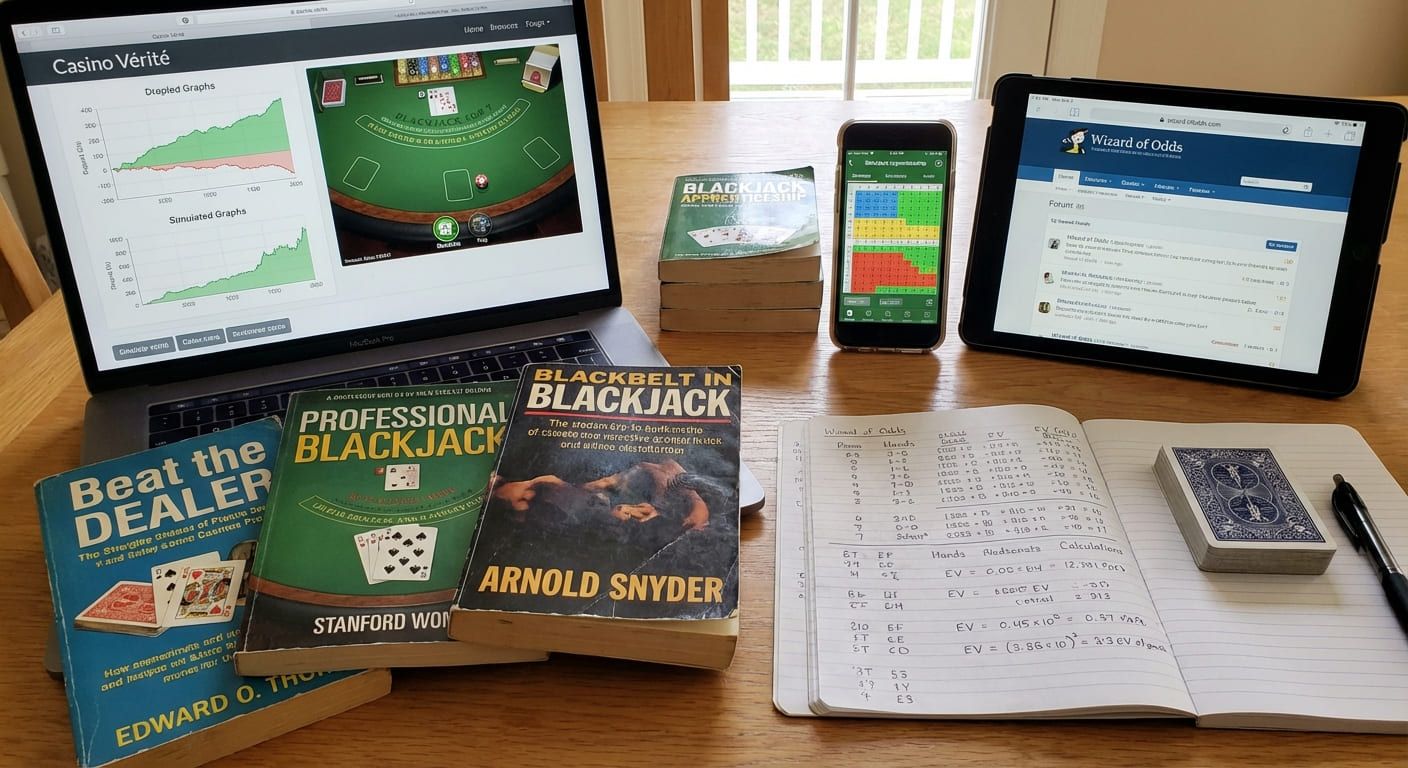
Training Tools
Enhancing your blackjack skills requires structured practice and the right resources.
Software & Apps:
- CVData and Casino Vérité allow detailed simulation of hands and tracking of advanced techniques.
- Apps like Blackjack Apprenticeship and BJ Trainer help memorize basic and advanced strategy; many offer free trials, with paid versions unlocking analytics.
Books (Essential Reading List):
- Edward Thorp – Beat the Dealer
- Stanford Wong – Professional Blackjack
- Arnold Snyder / Julian Schlesinger – Blackbelt in Blackjack
Online Resources & Communities:
- Blackjack Apprenticeship Forum, Wizard of Odds offer strategy discussions and calculators.
- Engage with forums for insights, cross-apply poker probability concepts, and compare hands with other players.
Track your play at home or on online casino platforms, analyze results, and refine strategies. Free vs paid tools vary in depth, but structured, consistent practice is key to measurable improvement.
Conclusion
Advanced blackjack turns casual play into advantage gambling. Master basic strategy, card counting, and bankroll management to lower the house edge. Success demands discipline, patience, and consistent practice.
Your Next Steps:
- Start practicing daily with drills and simulations.
- Track your progress and refine strategy decisions.Explore additional tips and tools at PLG.BET to continue learning and improving your advantage play.
