Ancient callouts in CS2 name every key location on the Ancient map. Teams use them to report enemy positions, trigger rotations, and run strategies in real time.
The key zones split across four areas. Mid holds Snipers Nest and Xbox. B Site holds Ramp, Lamp Room, Dark, House, and Pillar. A Site holds Plat, Long, Big Box, and Triple Box. Ancient leans on elevation changes, mid-control, and several entry angles at once.
What Are CS2 Ancient Callouts and Why Do They Matter?
A callout names a fixed spot on the map in two or three words. Players use callouts to tell teammates where enemies sit, where utility lands, and where a rotation needs to happen. Ancient demands more precision than simpler maps. The CT-sided design, narrow chokepoints, and a constant mid battle punish vague calls inside one round.
How Callouts Function During a Live CS2 Round
A callout carries three pieces of information at once: enemy position, count, and threat type. When a teammate says "two in Lamp Room pushing Dark," you read it instantly. B has pressure, A can wait, the rotation starts now.
The whole team reads the call in one breath. Five clean callouts beat fifteen vague ones.
Why Ancient's Layout Makes Callout Knowledge More Critical
Ancient asks more from your callout vocabulary than Dust2 does:
- Elevation layers stack vertically (Heaven, Top Mid, Lamp Room), so a single "B" call hides the real threat
- Mid touches both sites directly, so Mid information drives A and B decisions at once
- Narrow chokepoints (Doors, Connector, House entry) reward attackers who name the exact angle
- Callout names on Ancient have not fully settled, so teams that agree on terminology hold a small edge
The gap between "Window" and "Nest" decides whether your teammate trades or dies.
Complete Ancient Callouts Reference Map
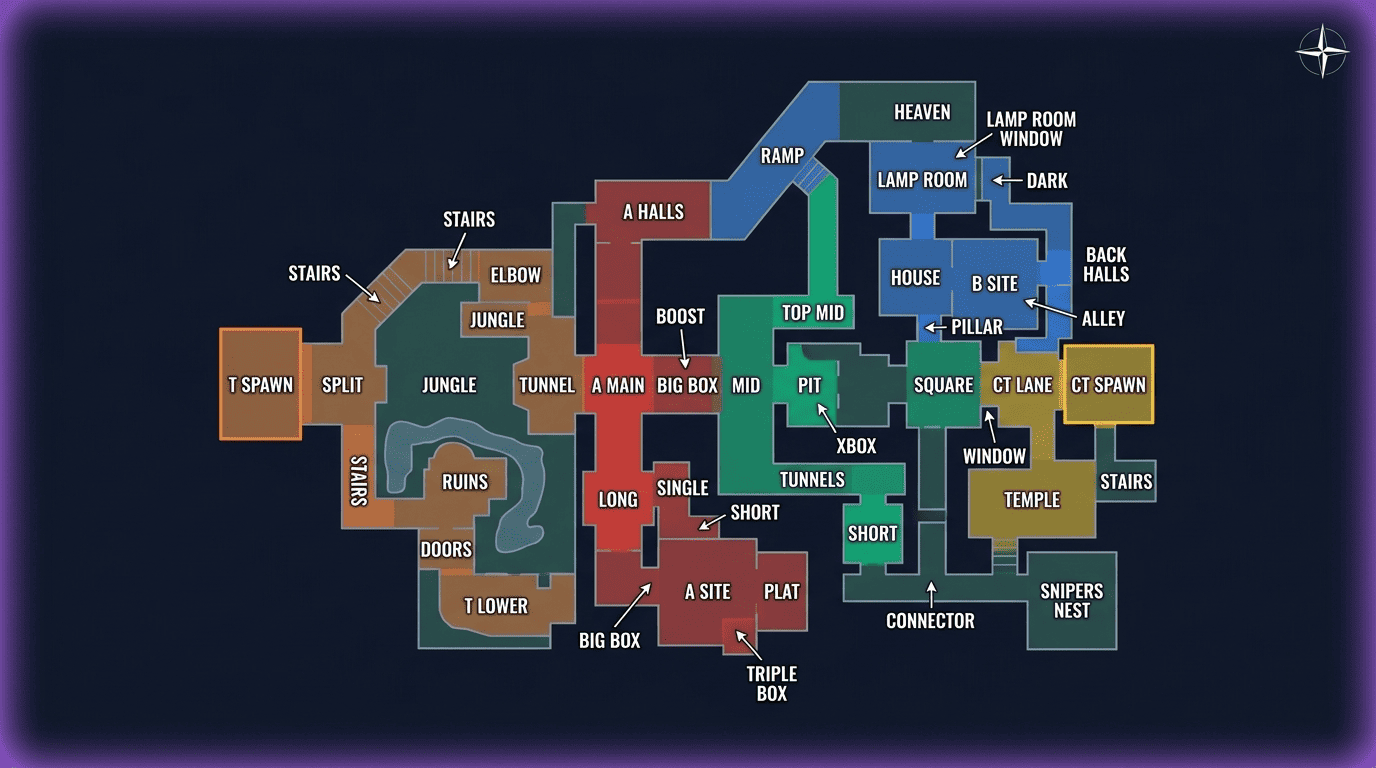
Keep the annotated overhead map open in a second tab while you read. The visual covers every callout zone, color-coded by side. T-side routes show orange, A Site shows red, B Site shows blue, Mid shows green, and CT side shows yellow.
T Side Ancient Callouts – Spawn, Routes, and Key Positions
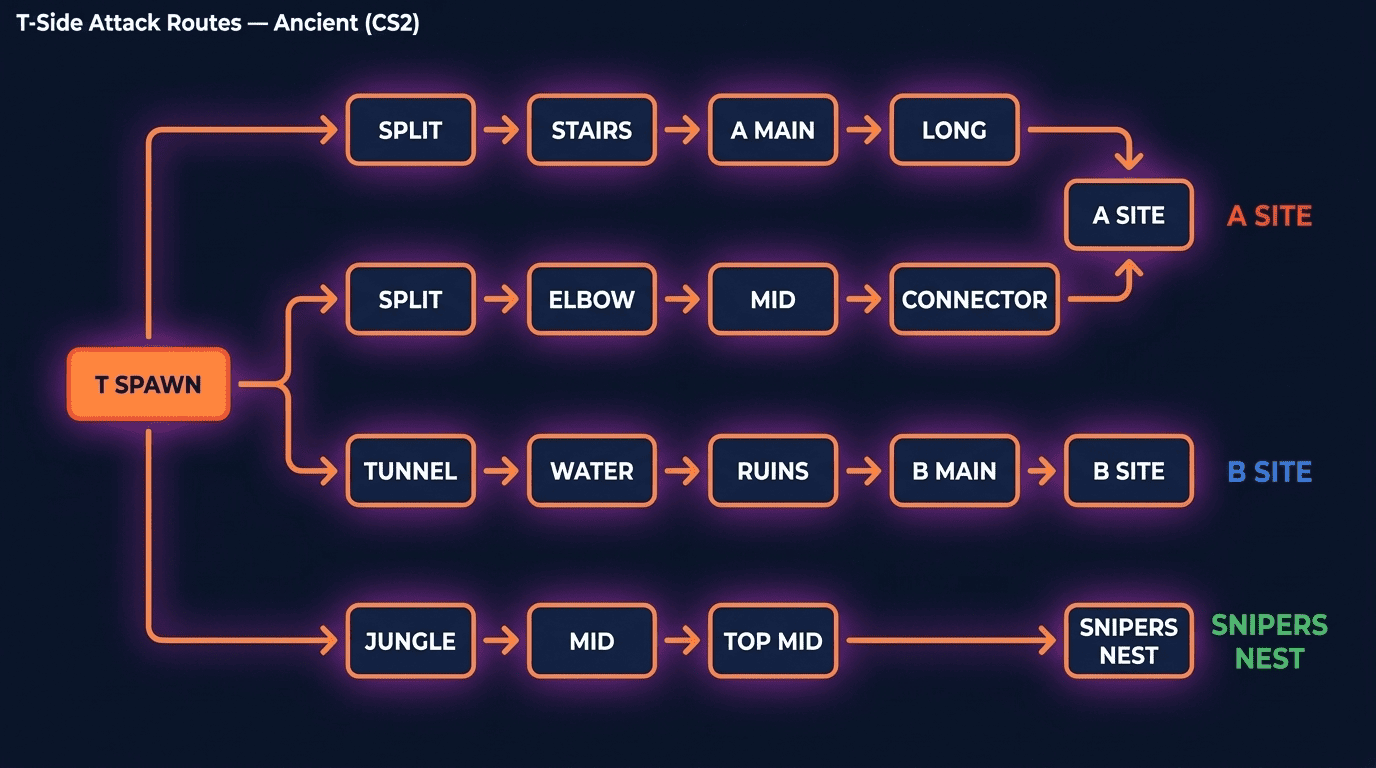
T side runs on three main routes out of T Spawn. One heads to A through Stairs. The second pushes Mid through Elbow or Jungle. The third runs B through Tunnel and Water.
T Lower remains the most misused part of T side. New players treat it as passive ground, but it anchors B-side timing.
How T-Side Routes Connect Through Callouts – A Navigation Primer
Read the T-side callouts as four chained attack paths:
- T Spawn → Split → Stairs → A Main → Long → A Site
- T Spawn → Split → Elbow → Mid → Connector → A Site
- T Spawn → Tunnel → Water → Ruins → B Main → B Site
- T Spawn → Jungle → Mid → Top Mid / Snipers Nest
The map stops feeling like a vocabulary test once the routes click.
T Spawn, Tunnel, Water, Ruins, and Doors
T Spawn sits at the round-start hub where the team picks a route. Tunnel runs toward B and stays enclosed.
Water sits at the far end of Tunnel, past the choke. A call of "Water" tells your team you cleared the choke. A call of "B" leaves the position vague.
Ruins covers the transition between Water and B Main with broken stone. Doors names the double-door chokepoint. CTs pre-aim Doors every round, so your entry fragger needs a flash through first.
Split, Stairs, Elbow, and Jungle
Split sits at the fork right after T Spawn where the team commits to A or Mid. Stairs runs to A Main. Elbow anchors T-side Mid and hosts the most common AWP duel.
Jungle opens the stone-column zone toward Mid without committing to Tunnel. Most players read it as a hallway. The stone column actually creates three peek angles toward Mid, and a smart T cycles them instead of holding one.
A Site Ancient Callouts – Every Location Explained
A Site on Ancient reads cleaner than B Site at first glance. The entries look obvious: A Main, A Short through Connector, Mid push. But Plat and Triple Box turn A into a fortress against a sloppy execute.
A Halls, A Main, Long, and Boost
A Halls runs as the T lurk corridor that delays CT pushes toward Mid. A Main sits at the primary T entrance onto A Site.
Long holds the final dueling chokepoint where most A executes win or die. Boost names the elevated CT spot above Long. The angle it covers wins rounds for any AWPer who holds it.
Smoke or flash Boost before committing Long. That step ranks as the most common A-site entry error in matchmaking.
Big Box, Single, Plat, and Triple Box
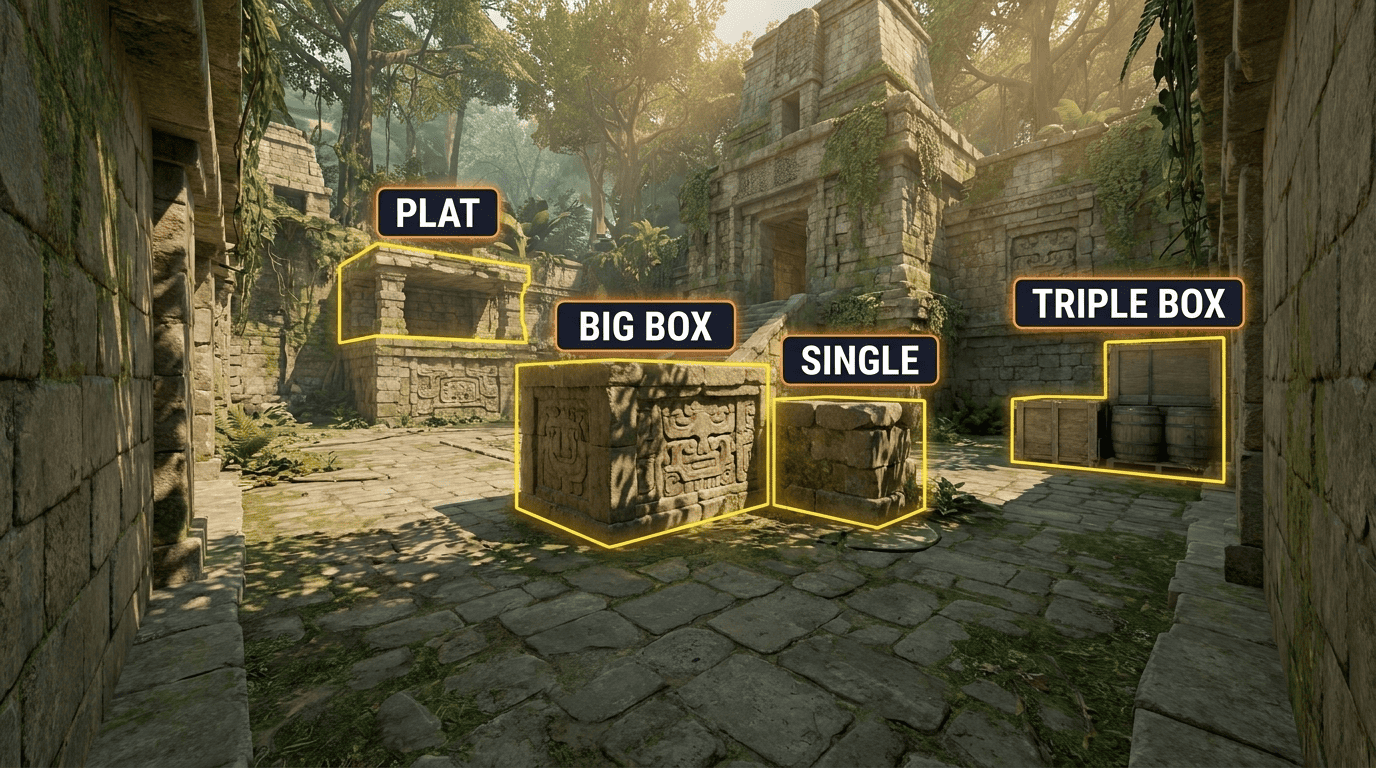
Big Box stands as the large cover structure in the open zone. Single sits next to Big Box as a smaller cover piece.
Plat holds the elevated CT platform. A rifler with utility there controls A Site almost single-handedly. Triple Box offers the safest post-plant position, tucked away from CT Lane's quick defuse line.
Plat earns a molotov on every A execute. One CT with a rifle there stops a sloppy push every round.
CT Lane and A Site Bomb Zone
The A Site Bomb Zone sits between Big Box, Plat, and Triple Box. CT Lane runs CT rotation into A at street level. A Triple Box plant pulls CTs away from a fast CT Lane defuse, which shifts the entire retake math.
Deposit your CS2 skins and play Roulette or Crash on PLG.bet. No mandatory KYC to start playing. Get started.
Mid Ancient Callouts – The Map's Strategic Center
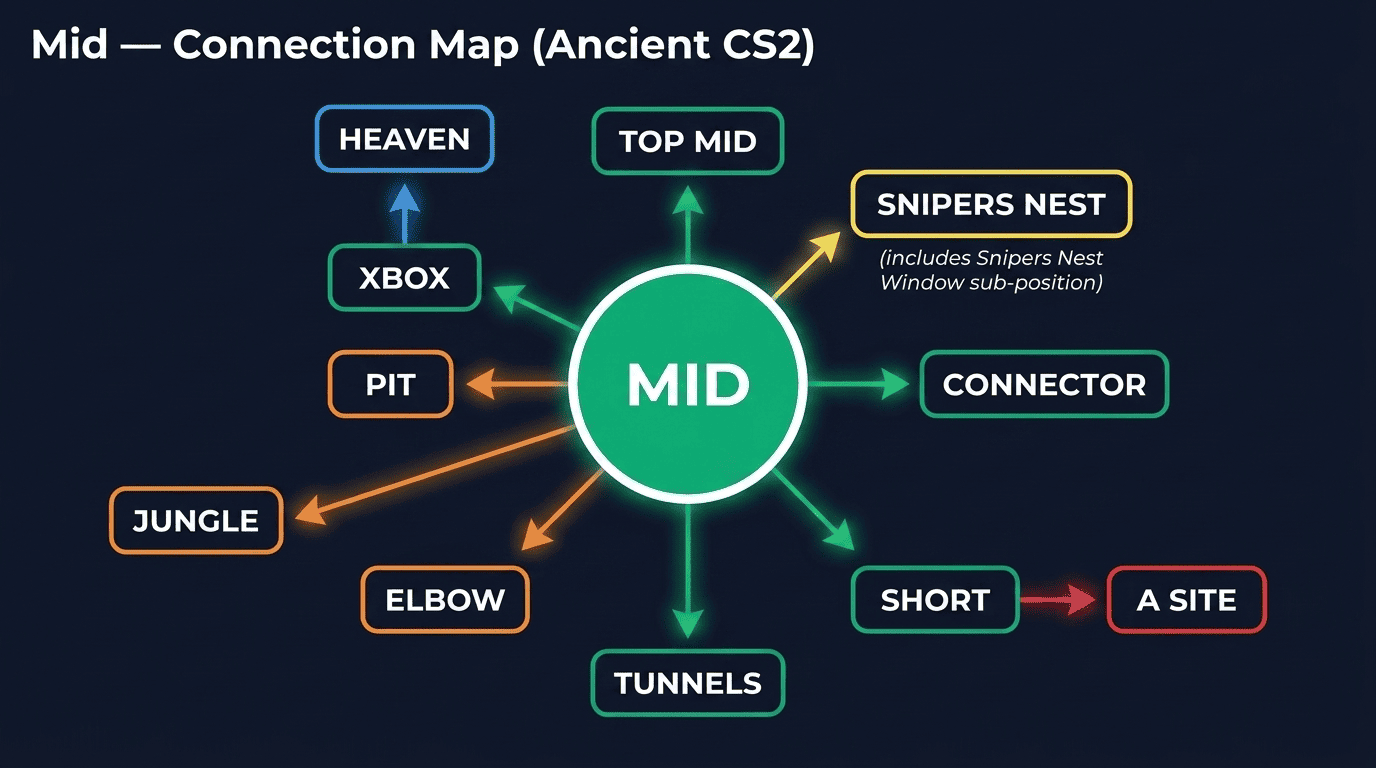
Mid on Ancient holds the round. The zone connects to A Site through Connector and Short. It links to B Site through Heaven, and back to T Spawn through Elbow and Jungle.
Pro analysts treat Mid control as a leading indicator across a series. CS2 fans on PLG.bet read the same signal.
Mid, Elbow, Top Mid, Pit, and Xbox
Mid opens the central area: high traffic, high risk, high reward. Elbow anchors T-side Mid. Top Mid sits at the elevated stairs connector.
Pit holds the T-side information cubby. One player there reads CT Mid aggression cheaply.
Xbox names the jump-up access point from Mid to Heaven. The mechanic stays non-obvious for new players, which turns Xbox into a rotation surprise tool.
Tunnels, Short, and Connector
Tunnels runs from Mid toward A with substantial construction cover. The community also calls it Donut or Tomb.
Short runs as the direct A Site entry out of Tunnels. The worst miscommunication on Ancient comes from conflating Tunnels with Short. They sit adjacent but expose different angles.
Connector runs as the narrow passage linking Mid to A Site and House to Snipers Nest. Solo queue rarely uses it; organized teams call it constantly.
Snipers Nest
Snipers Nest holds the CT primary Mid-control position. A double-door vantage with wide Mid sight lines, connected to Top Mid and CT Spawn. The position belongs to the AWP. A skilled CT AWPer in Snipers Nest stops an entire T Mid-push strategy alone.
Snipers Nest Window
Snipers Nest Window sits as a distinct sub-position. The window opening creates a different angle profile from the passive door hold. "Nest Window" reads as an active peek; "Nest" reads as a passive hold.
B Site Ancient Callouts – Routes, Entries, and Site Positions
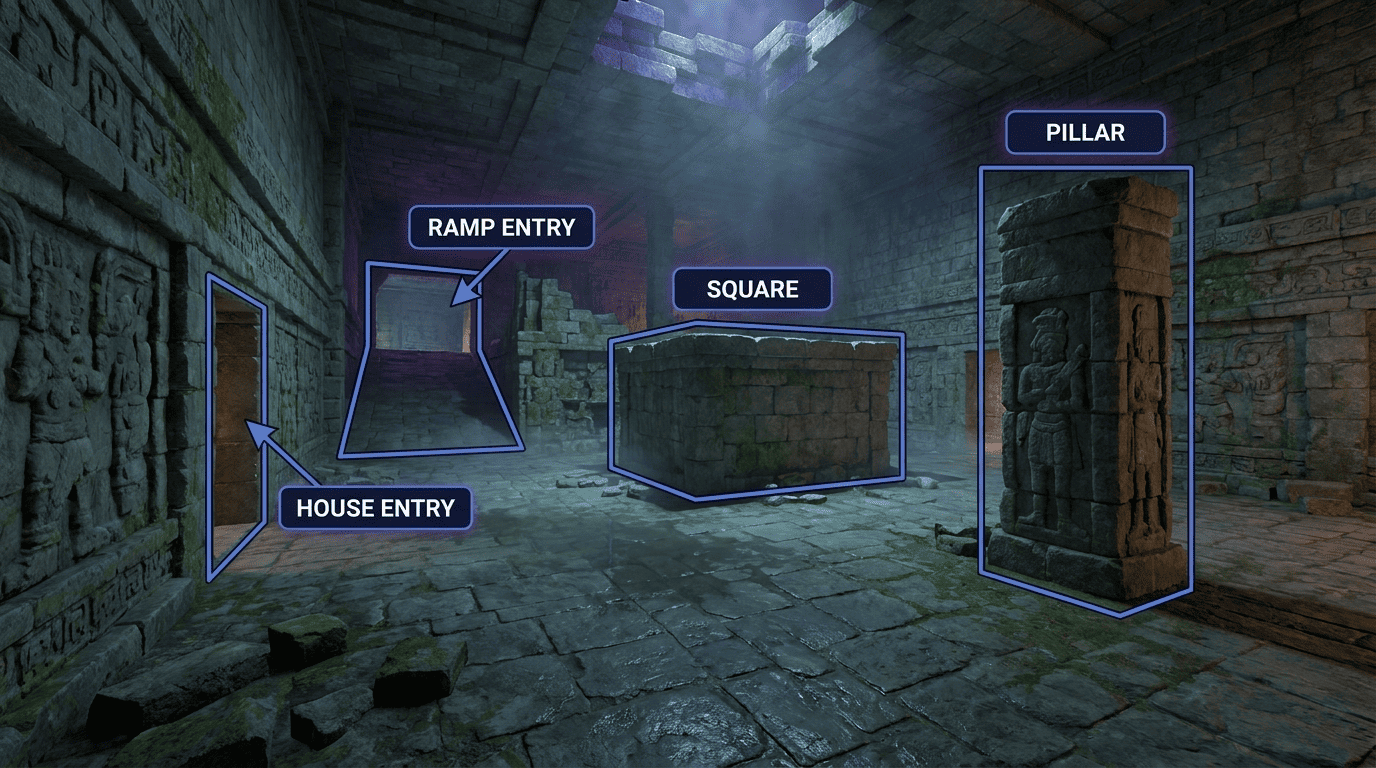
B Site turns rounds unpredictable. Multiple entries (Ramp, House, Heaven drop) demand real-time coordination, and one missed call collapses the execute. CT defenders gain from the same complexity: Pillar, Dark, and House give three independent off-angle holds.
T Lower, Ramp, and Heaven
T Lower sits at the lowest elevation zone between Ramp and Heaven. Ramp opens the fastest B entry slope for grouped rushes. Heaven works as the elevated connector to Lamp Room and Mid, not just a high-ground perch.
A Ramp rush works best with a simultaneous flash through House. The rush succeeds because it splits CT attention between two entries.
Lamp Room, Dark, and House
Lamp Room (alternate names: Cheetah, Cat Room) connects Heaven to Dark. Dark holds the CT cubby between Lamp Room and House. A held-angle Dark CT wins rounds against teams that skip the utility clear.
House (alternate name: Cave) connects Dark to B Site through a narrow doorway choke. House opens as a secondary B entry when Ramp gets smoked. Clear Pillar with utility before the push.
Lamp Room Window
Lamp Room Window sits as a distinct sub-position within Lamp Room. A "Window" call tells your team the threat is at the upper opening, not on the floor. One swing cannot clear both angles.
B Site, Pillar, Square, Back Halls, and Alley
B Site sits between Ramp, House, and Square. Pillar stands as the strongest CT defensive structure on B, the same role Plat plays on A. One disciplined CT there with a rifle stops most B executes alone.
Square opens two flanking lanes through Back Halls: one cut to Alley, one loop toward CT Spawn. Back Halls runs as the CT route to B. Alley connects CT Spawn to Back Halls.
A T team that cuts Alley after planting forces the CT rotation into one lane. That callout wins post-plants.
CT Side Ancient Callouts – Spawn and Defensive Positions
CT Spawn starts every defensive round. Knowledge of the CT branches matters as much as knowledge of the T-side routes. A poorly positioned CT team loses information and site control at the same time.
CT Spawn, Temple, CT Lane, and Snipers Nest
CT Spawn branches into four paths. Temple runs to A with a longer, deeper angle.
CT Lane runs to A faster at street level. Snipers Nest holds Mid. Alley runs to B through Back Halls.
The CT Lane and Temple pinch stands as the strongest default A setup. One CT on CT Lane covers the close angle. A teammate on Temple covers the deeper angle. Any T who pushes Long faces both at once.
One player on early Snipers Nest CT side pays off every round. The Mid intent read alone justifies the position.
Alternative and Community Callout Names on Ancient
Ancient joined the Active Duty pool in May 2021. Its callout vocabulary has not fully standardized yet. Some names carry over from CS:GO community usage (Donut for Tunnels). Others reference visual landmarks inside the map (Cheetah for Lamp Room, named after the cheetahs painted on the wall).
Pick standard names as your primary vocabulary. Learn the alternates passively.
Why Alternate Names Exist and Full Reference Table
Newer Active Duty maps take two or three competitive seasons before callout names settle globally. The CS2 community spans EU, NA, CIS, and SEA regions. Each one inherits slightly different terminology from local CS:GO scenes. Use the table below as a translation key.
|
Standard Callout Name |
Common Alternate Name(s) |
|
Lamp Room |
Cheetah, Cat Room |
|
House |
Cave |
|
Tunnels |
Donut, Tomb |
|
T Lower |
Lower |
|
Ruins |
Water Ruins |
|
Back Halls |
Back Alley |
|
CT Lane |
Street, Lane |
|
Snipers Nest |
Nest, Sniper's |
|
Triple Box |
Boxes, Back Box |
|
Jungle |
Open Mid Approach |
How to Use Ancient Callouts Effectively in Competitive Play
Step one is knowing the callouts. Step two is using them well under pressure, and most players stall here. Live callouts under fire need to land in three words or fewer.
Calling Positions Clearly, Coordinating Mid, and Avoiding Common Mistakes
Use the format [Number] at [Location] with [Weapon if known]. For example: "Two pushing Ramp, AWP." The weapon detail changes how your team reacts. "AWP at Nest" reads as a stop-and-utility call. "Rifle at Nest" reads as a green-light push call.
My best Mid take this season ran on three callouts in under ten seconds: "Nest clear." "Go Elbow." "Heaven in." Three players, one clean Mid take.
Six common Ancient callout mistakes to drop:
- Vague "B" call instead of Water, Ruins, Tunnel, or Doors
- Conflation of Tunnels and Short (adjacent but tactically different)
- Weapon type skipped when it matters
- Lamp Room call when the threat sits at Window
- Connector forgotten as a rotation tool
- Long sentences mid-fight
Best Weapons for Key Ancient Callout Positions
Ancient mixes long sight lines, narrow chokes, and elevation. Each zone rewards a different weapon.
|
Callout Position |
Recommended Weapon(s) |
Reason |
|
Snipers Nest / Mid |
AWP |
Long sight lines, one-tap potential, information role |
|
Long / Boost |
SG 553, AUG |
Scoped rifles handle the long duel without an AWP slot |
|
Ramp / Pillar |
AK-47, M4A4 |
Standard mid-range engagements |
|
House / Dark (eco) |
USP-S, Dualies |
Close angles, high pistol fragging potential |
|
Plat / A Site defense |
M4A1-S |
Quiet first shot, suppression friendly |
|
Jungle / Mid approach |
Rifle plus movement |
Open angles, peek-shift heavy |
I run the SG 553 on CT side holding Long. The scope wins my Boost-to-Long duels, and the team keeps the AWP slot for someone who needs it more.
Callout fluency multiplies any weapon's value. The right weapon at each callout position multiplies that advantage again. That same map-reading skill helps you watch matches better. Viewers who follow CS2 markets on PLG.bet read rounds the way the players do.
Conclusion – Building Callout Fluency on Ancient
Ancient rewards preparation more than any other map in the Active Duty pool. Three tactics beat rote drilling. Start with Mid callouts and work outward. Drill workshop maps like Yprac. Anchor each callout to its visual landmark. Lamp Room has the lamp, Xbox has the platform, Pillar has the column.
Within your team, consistency beats universal standardization. Agree on names, drill them, and the rest of the map opens up.
Ready to put your CS2 instincts to work beyond matchmaking? Open PLG.bet and place your first CS2 match bet alongside a Roulette or Crash session. Sign in with Steam and skip the long registration form. No mandatory KYC to start playing.
FAQ
What are map callouts in CS2?
Why are Ancient callouts important in CS2?
Why is Ancient so popular in CS2?
How can I quickly learn and memorize Ancient callouts?
How do I use all Ancient callouts effectively in competitive play?
Where can I find a visual map with all Ancient callouts?
Are Ancient callouts standard across all CS2 communities?
Have Ancient callouts changed significantly from CS:GO to CS2?
What are common strategies associated with key Ancient callouts?
What are the best weapons for Ancient callout positions in CS2?
Sources verified June 2026: Liquipedia, Counter-Strike Wiki, Hotspawn map pool history. Ancient joined Active Duty on May 3, 2021 and remains in the June 2026 Active Duty pool.