Call of Duty: Black Ops Cold War Zombies delivers one of the most structured and story-driven Zombies experiences in the franchise. Across six total maps spread over three gameplay modes, players confront a single escalating menace: the Dark Aether, an unstable dimension bleeding into the real world.
Released in November 2020 and developed by Treyarch, the Zombies content was expanded entirely through free DLC, making progression accessible to all players. Chronologically, the narrative unfolds between November 1983 and October 1985, giving each map a clear place in the more exhaustive Black Ops timeline.
Supporting 1 - 4 players in cooperative play and offering full cross-platform support, the mode balances solo tension with team-based strategy. Critically, it earned a respectable Metacritic score of 7.6/10, reflecting its solid mechanics and lore depth.
This guide breaks down all Cold War Zombies maps, explains how Call of Duty Cold War Zombies maps fit together, and presents the full lineup of black ops cold war zombies maps in proper order.
All Cold War Zombies Maps Overview
At launch and through post-release updates, Call of Duty: Black Ops Cold War introduced a total of six Zombies maps, clearly answering the common question: how many zombie maps are there in Cold War? This Cold War Zombies maps list is divided across three distinct mode structures, each designed to support different playstyles while advancing a unified narrative.
The core experience consists of four round-based maps, built around escalating enemy waves, traditional perk progression, and Easter egg quests. These maps fall under the operational command of Requiem, a covert task force tasked with containing supernatural outbreaks. Opposing them is Omega Group, whose reckless experiments intensify the global crisis.
Beyond round-based play, all Cold War Zombies maps also include one large-scale Outbreak map experience, emphasizing open-world objectives, and one competitive survival mode known as Onslaught. Together, these define the primary zombies map types available.
All modes support 1-4 player cooperative gameplay, feature full cross-platform functionality, and were co-developed by Treyarch in collaboration with Raven Software, ensuring consistent design across every map.
Cold War Zombies Maps in Chronological Order
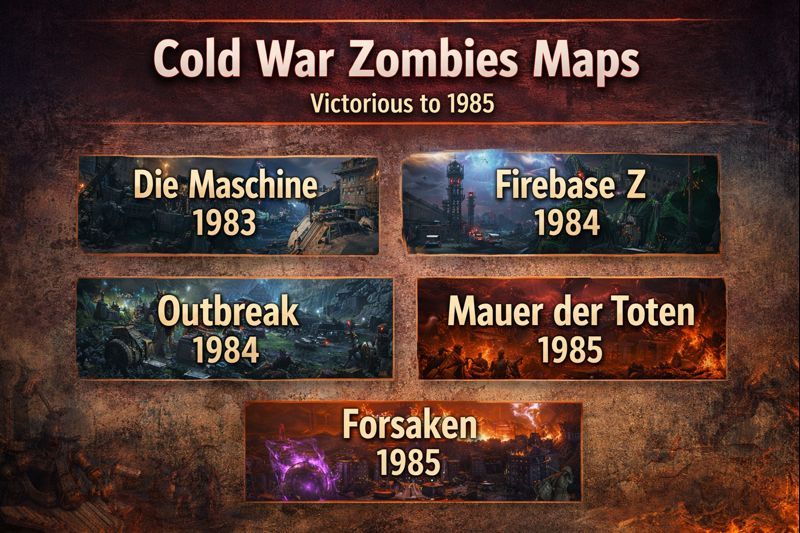
The narrative of Black Ops Cold War Zombies follows a clear Dark Aether storyline, ensuring tight story progression across maps. When arranged as Cold War zombie maps in order, the timeline begins in November 1983 with Die Maschine, where a failed experiment tears reality open using a Soviet particle accelerator.
Events continue through Firebase Z, expand globally in Outbreak, escalate in Mauer der Toten, and conclude with Forsaken in October 1985. This sequence represents the definitive Cold War zombies maps in order, linking every outbreak through cause and consequence.
Timeline Chart:
1983 (Die Maschine) → 1984 (Firebase Z / Outbreak) → 1985 (Mauer der Toten → Forsaken)
Die Maschine (November 1983)
Die Maschine is the launch map for Black Ops Cold War Zombies, set in Morasko Poland, during November 1983. The operation centers on Projekt Endstation, a secret facility where a Nazi-era particle accelerator first ruptured reality and unleashed the Dark Aether.
Under Requiem’s orders, players investigate the site, restore power, and ultimately extract Samantha Maxis, whose survival becomes critical to containment efforts. As the primary boss, the Megaton introduces a unique split mechanic, dividing into two hostile variants that pressure teamwork.
Considered beginner-friendly, the main quest involves activating power, assembling Pack-A-Punch, stabilizing anomalies, and securing Aetherium crystals for upgrades.
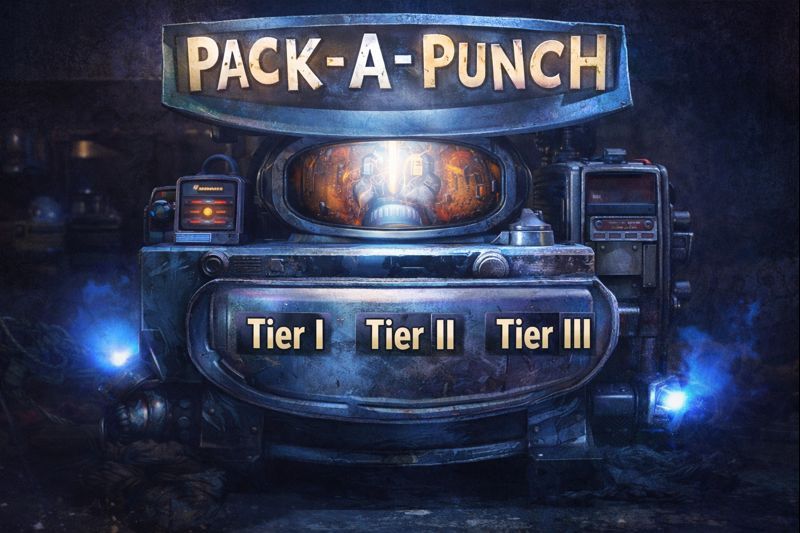
The Pack-A-Punch machine sits in the underground particle chamber, unlocked after powering the facility and opening dimensional rifts. Its clear structure makes it ideal for learning core systems and early survival strategies before progressing deeper into Cold War Zombies narrative maps.
Firebase Z (June 1984)
Firebase Z shifts the narrative to Southeast Asia, placing players in the A Shau Valley and expanding the scope of Vietnam zombies encounters. Set seven months after Die Maschine, the map reveals an Omega Group facility focused on Aetherium weaponization, escalating the global threat.
A key narrative figure is Sergei Ravenov, an Omega officer who defects and aids Requiem from within. Combat intensity rises with aggressive special enemies, including shape-shifting Mimic units and heavily armored Manglers. The standout threat is the Orda boss, a towering world boss with an enormous health pool that demands coordinated firepower.
The main quest centers on extracting Ravenov and stabilizing Aetherium containment, while faster spawn rates and layered objectives mark Firebase Z as an intermediate-difficulty step forward in Cold War Zombies progression.
Outbreak (July 1984)
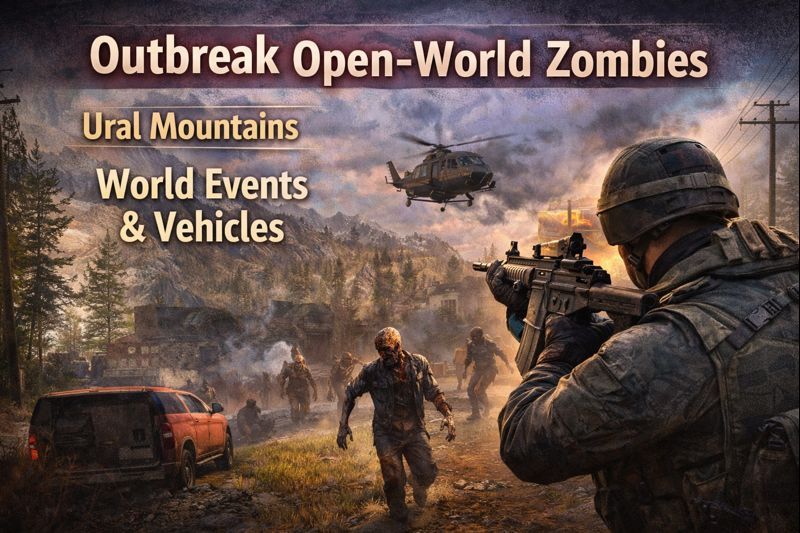
Outbreak answers the question of which Call of Duty has open-world Zombies by introducing a large-scale, objective-driven experience unlike traditional survival. Set across the Ural Mountains, the mode repurposes Fireteam maps into sprawling combat zones, making it the largest map scale in Cold War Zombies.
Instead of rounds, players complete rotating World Events, warp between regions, and face steadily rising difficulty from Region 1 to 10+, where zombie health multipliers sharply increase. The open world zombies structure emphasizes mobility, vehicles, and tactical pacing. An exfil mechanic allows teams to extract early, though failure escalates enemy density.
Boss encounters recur, including Orda, reinforcing long-term pressure. Alongside combat, Outbreak encourages intel collection, expanding Dark Aether lore, and advancing world events tied directly to the broader Zombies narrative.
Mauer der Toten (February 1985)
Mauer der Toten arrived in February 1985, placing players within a divided Berlin shaped by the Berlin Wall and rising Dark Aether instability. Set in Berlin, Germany, the map emphasizes vertical traversal, ziplines, and underground passages as reality fractures.
Combat escalates with the Krasny Soldat, a mechanized heavy unit wielding a shoulder-mounted minigun and heavy armor that punishes poor positioning. Additional pressure comes from the Tempest enemy, which disrupts movement through long-range electrical attacks.
A standout feature is Klaus, an autonomous robotic companion that can clear obstacles, stun enemies, and assist with progression. Considered an advanced-difficulty map, dense spawn rates, layered objectives, and a complex Easter egg demand coordination.
Frequent dimensional rifts force side-switching between worlds, highlighting Omega’s accelerating exploitation of Dark Aether technology eight months after previous global outbreaks. Player survival depends on awareness, teamwork, timing, positioning, and upgrades management.
Forsaken (October 1985)
Forsaken serves as the final zombies map, concluding the Dark Aether storyline in October 1985 at the secretive Projekt Jericho. Designed with expert difficulty, it features the highest enemy health scaling and one of the most complex main quests in Cold War Zombies history, often taking 60-90 minutes to complete.
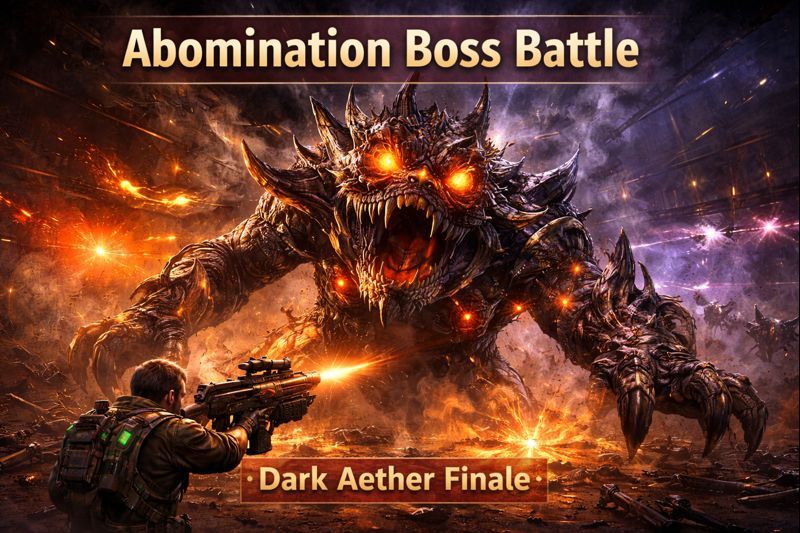
The primary threat is the Abomination, a multi-phase monster whose rotating weak points and devastating attacks test positioning and coordination. Additional pressure comes from Disciple units, which teleport, drain player health, and empower nearby zombies.
Narratively, Requiem succeeds in sealing the Dark Aether permanently, neutralizing Omega’s ambitions and closing all active rifts. A unique arcade-style pizza perk reward system reinforces the map’s climactic tone while delivering a definitive end to the Cold War Zombies saga.
Onslaught (PlayStation Exclusive)
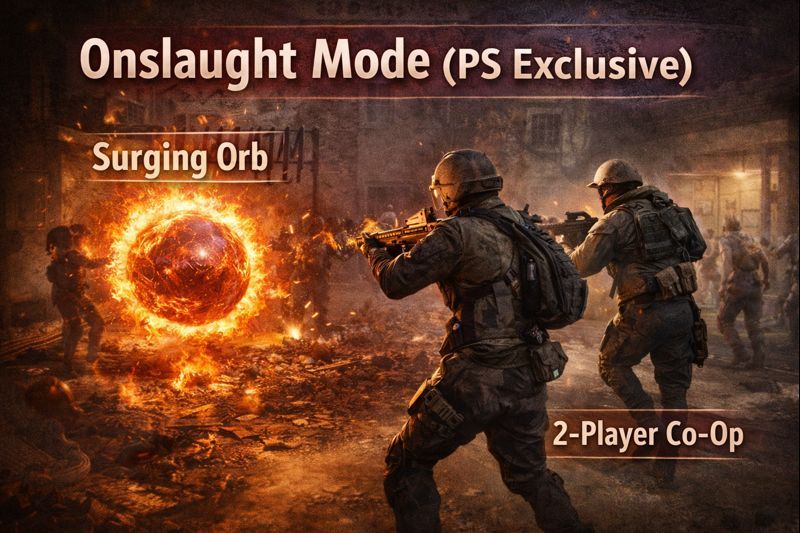
Onslaught is a fast-paced survival mode initially released as a PlayStation exclusive, built around wave-based combat on standard multiplayer maps. Instead of traditional rounds, players fight within a shrinking zone anchored to a moving Surging orb, forcing constant movement and aggressive pacing.
Unlike the usual four-player setup, Onslaught is limited to two-player co-op, emphasizing quick coordination over long-term strategy. The mode launched with timed platform restriction, remaining PlayStation-only for one year before becoming available on other platforms in November 2021.
Designed for accessibility, it avoids complex Easter eggs and remains largely separate from the Dark Aether narrative, making it ideal for casual, short-session play.
- Common – 1×
- Uncommon – 1.5×
- Rare – 2×
- Epic – 3×
- Legendary – 4×
- Ultimate – 6×
Core Gameplay Systems
Cold War Zombies introduces a streamlined progression loop that answers the question ‘How does the new mode work’, through several interconnected systems. At the foundation is the Rarity System, which standardizes weapon power across all maps. Weapons are divided into six weapon tiers, each with precise damage scaling that rewards long-term investment.
Rarity Damage Multipliers
Alongside rarity upgrades sits the Pack-A-Punch, which allows each weapon to be enhanced up to three times, dramatically increasing damage and ammo capacity. Long-term progression is powered by Aetherium, specifically Aetherium Crystals, which permanently upgrade skills such as Perk-a-Cola abilities, field upgrades, and weapon classes. Perks follow a progressive pricing model, increasing by 500 Essence with each purchase.
Resource management is rounded out by Salvage, used to craft tactical equipment, lethal items, and armor. The armor system adds depth to survivability, making smart upgrades essential at higher rounds.
Weapon Rarity and Effectiveness
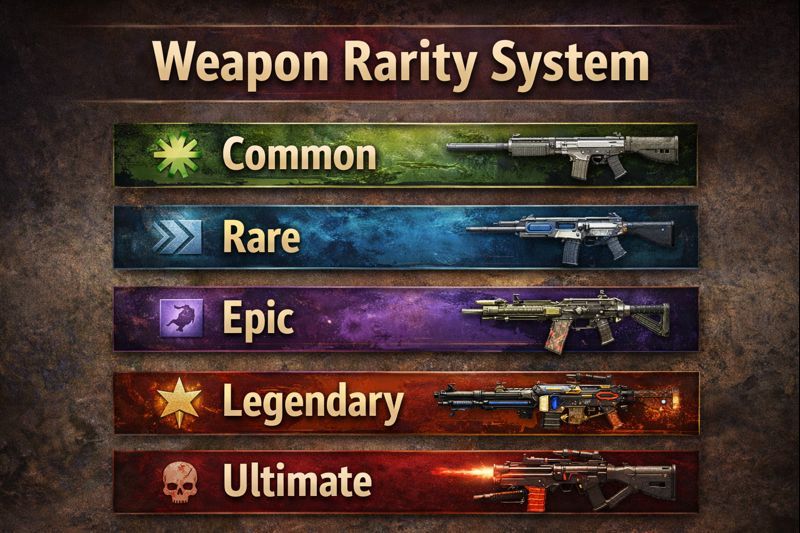
Weapon performance in Cold War Zombies is governed by Weapon rarity, which directly determines weapon damage through fixed damage multipliers. Rarity progresses from Common (1×) through color-coded tiers to Legendary tier (4×) and the Ultimate tier (6×).
For players searching for the best weapons zombies strategy, high-rarity guns combined with a triple Pack-A-Punch upgrade can reach an effective 18×-24× damage output. Weapons are typically upgraded through Wall Buys, Trials, or the Mystery Box.
At the top of the hierarchy sit legendary weapons like the Ray Gun and D.I.E., which outperform standard firearms even before upgrades.
Multiplayer and Crossplay Features
Cold War Zombies is built around flexible zombies multiplayer design, supporting 1-4 players across nearly all modes. This setup directly answers the can you play with two players question, yes, 2-player co-op zombies is fully supported within the four-player maximum.
One of the mode’s strongest features is Cold War Zombies crossplay, allowing seamless cross platform matchmaking between PlayStation, Xbox, and PC players. Friends can party up regardless of hardware with shared progression intact.
Players also choose Operators from NATO or Warsaw Pact factions, adding light customization without gameplay imbalance. Console users benefit from local split-screen support, making couch co-op viable. While most features work online, offline play requires an initial authentication to unlock progression systems.
With full cross-platform play unifying the Call of Duty community, competitive interest naturally extends beyond co-op sessions. Platforms like plg.bet reflect this ecosystem, offering markets where teamwork mirrors Zombies' coordination, reinforcing how shared mechanics connect casual co-op play with competition globally.
Reception and Competitive Position
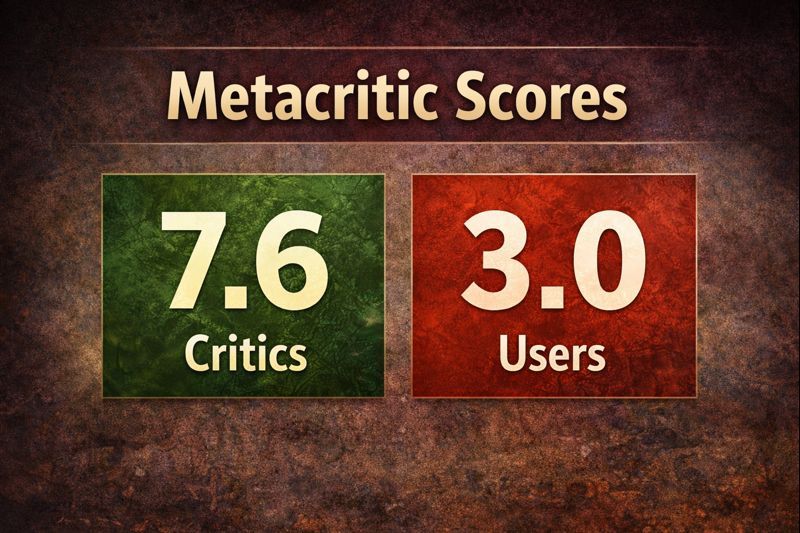
A balanced Cold War Zombies review places the mode firmly in the middle-to-upper tier of the franchise. On Metacritic, it holds a 7.6/10 critic score alongside a more polarized 3.0/10 user score, highlighting the divide in community reception.
While many fans still rank Black Ops 3 as the best COD zombies experience, Cold War earns recognition for modernizing systems rather than relying on nostalgia. Key positives include free DLC maps, unlimited perk acquisition, Operator-based characters, and the open-world Outbreak mode, features absent from earlier paid-season models.
Treyarch described it as their “largest Zombies offering,” emphasizing accessibility and scale. Official age ratings reflect its tone, with ESRB listing it as Mature 17+ and PEGI rating it 18.
Conclusion
Overall, this Cold War Zombies maps summary confirms six maps delivered across multiple modes, offering a complete all maps overview for every playstyle. From November 1983 to October 1985, the Dark Aether storyline unfolds in clear chronological order, ending decisively as Requiem completes Dark Aether closure.
Free DLC drops, full cross-platform support, and the weapon rarity system distinguish Cold War from earlier entries. Treyarch’s design encourages new players to start with Die Maschine before progressing forward. For returning fans, exploring every DLC map remains the best way to experience the narrative.