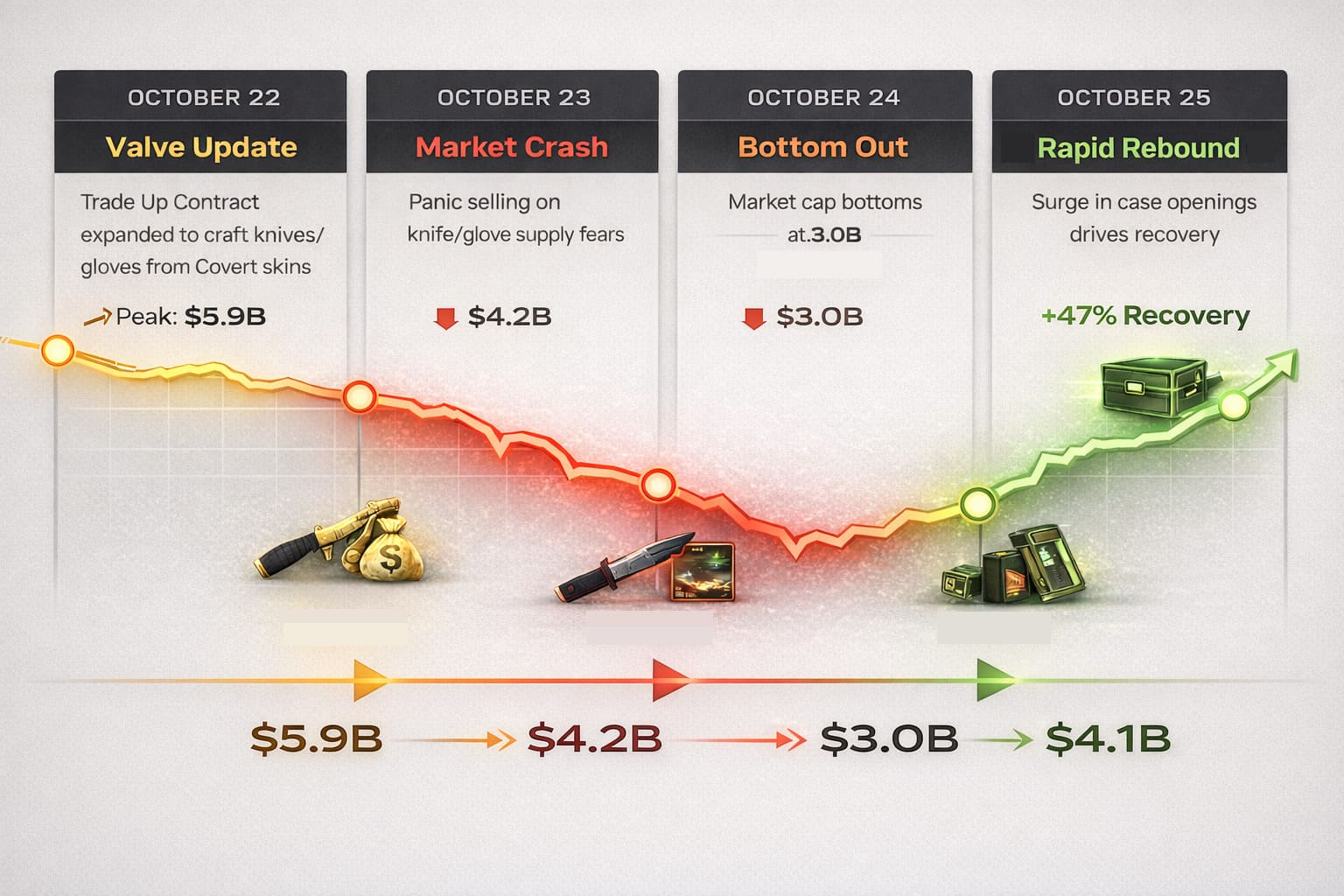
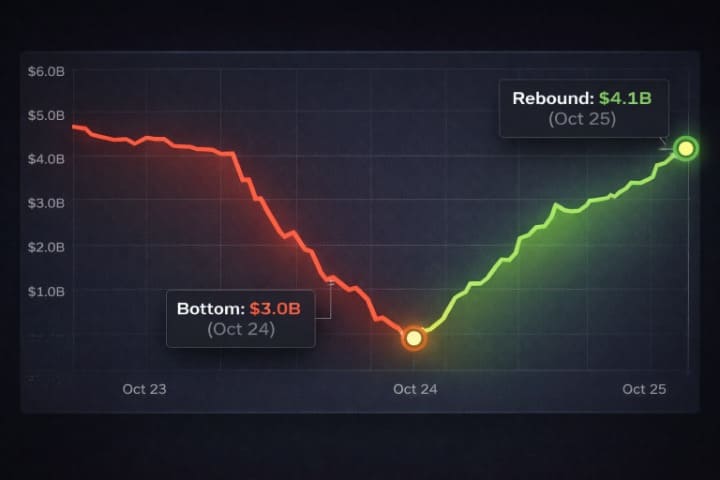
Imagine waking up to find your digital investment portfolio slashed by 70% overnight. That's exactly what happened to thousands of Counter-Strike 2 players on October 23, 2025. The CS2 market crash wiped out $1.7 billion in market capitalization within hours, plummeting from $5.9 billion to $4.2 billion before hitting a devastating low of $3.0 billion. Yet what followed surprised even seasoned traders: a 47% recovery in just 24 hours, reaching $4.1 billion and demonstrating the extreme volatility of gaming economies controlled by centralized platforms.
Former YouTube gaming executive Ryan Wyatt captured the essence of the crisis: "Valve can, and will, unilaterally make decisions that can wipe billions in market cap." This wasn't just a price correction. It was a trust crisis that exposed fundamental flaws in digital asset ownership within gaming ecosystems. This guide examines what triggered the crash, which investors lost fortunes, how the market bounced back, and what lessons emerge for anyone treating virtual items as investments.
Understanding the CS2 Skins Economy Before the Crash
Want to understand how billions evaporated overnight? You need to grasp the artificial scarcity system that made CS2 skins valuable in the first place. The CS2 skins economy operates on color-coded rarity tiers that determine value: grey and blue items are common, while red Covert skins represent premium weapon designs. At the pinnacle sit gold-tier items – knives and gloves – that could only be obtained through case openings with a 0.26% drop rate or expensive marketplace purchases.
This artificial scarcity created genuine economic value. Players bought, traded, and resold skins on Steam's marketplace and third-party sites, treating rare items as investments. Before the crash, CS2's market capitalization exceeded $5.9 billion, rivaling some publicly traded companies. Certain knives sold for thousands of dollars, with the rarest patterns fetching five or even six figures. Collectors and traders built substantial portfolios, viewing digital assets as reliable stores of value that would appreciate over time.
The system resembled other digital economies like NFTs or in-game currencies in Roblox, World of Warcraft, and Eve Online. However, CS2's economy had one critical vulnerability: centralized control. Unlike blockchain-based assets, CS2 skins exist entirely within Valve's ecosystem. Players don't own these items – they license them. Valve maintains unilateral authority to modify game mechanics, adjust drop rates, or implement any system changes without notice or recourse. This centralized platform risk would prove catastrophic.
How the CS2 Market Collapsed: The Trade Up Contract Update
October 22, 2025, seemed like another routine patch day. The Valve update included gameplay tweaks, the return of Retakes mode, and technical improvements. Buried in patch notes was a seemingly innocent change: "Extended functionality of the Trade Up Contract to allow exchanging 5 items of Covert quality."
Before this update, the Trade Up Contract system let players exchange 10 lower-tier skins for one item of slightly higher rarity. The mechanism excluded gold-tier items entirely – knives and gloves remained obtainable only through lucky case openings or marketplace purchases. This exclusion maintained their extreme scarcity and astronomical prices. The new system shattered that foundation completely.
Here's how the updated Trade Up Contract works:
- Exchange 5 regular Covert skins for 1 knife or gloves from the same collection.
- Trade 5 StatTrak™ Covert items for 1 StatTrak™ knife.
- Items become instantly tradeable with no waiting period.
- Collection determines which knife or gloves you receive.
- Craft resources (Covert skins) suddenly became essential commodity.
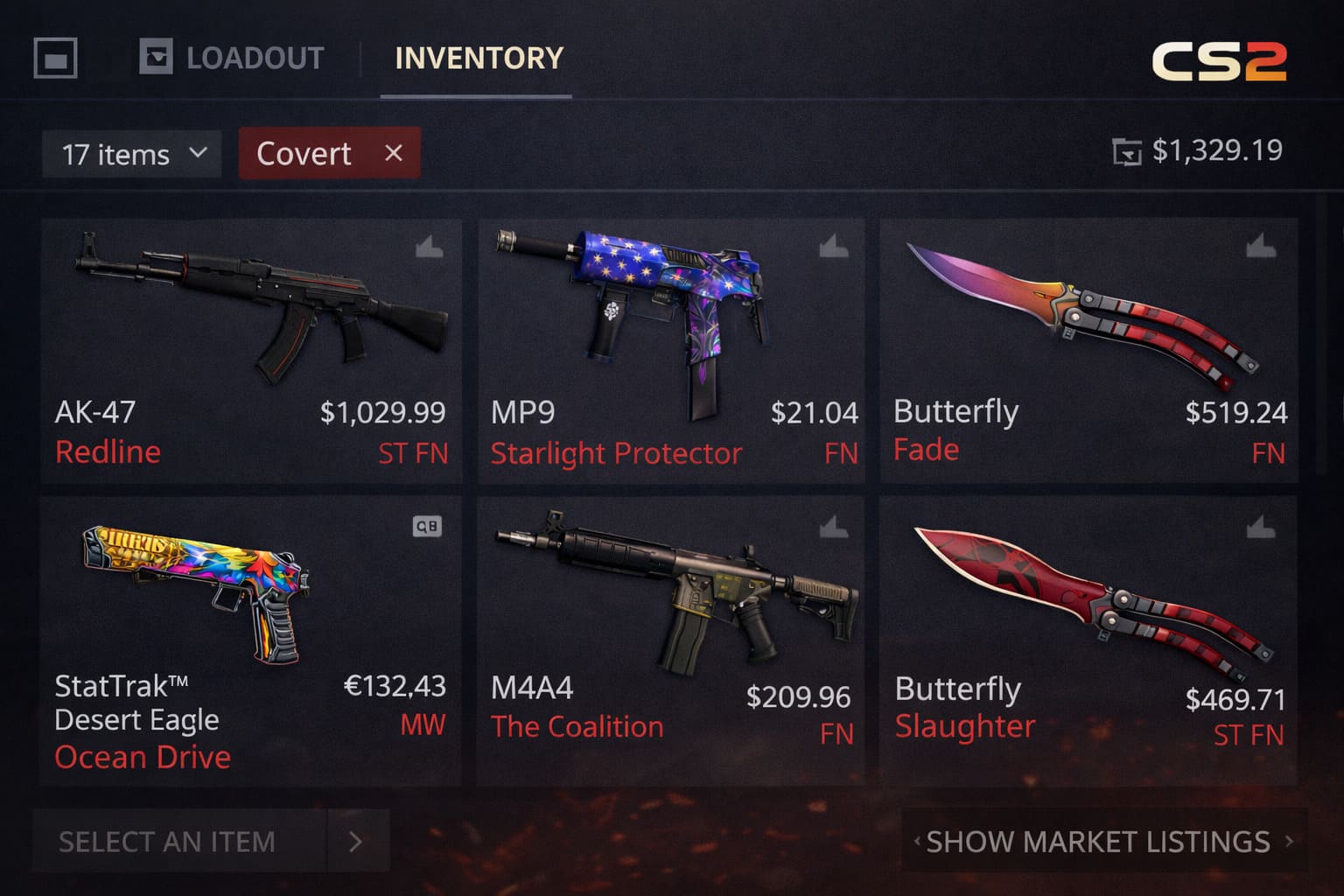
The market reaction was immediate and catastrophic. Within hours, knife prices entered freefall while Covert skin values skyrocketed. Market capitalization plummeted from $5.9 billion to $4.2 billion, then continued dropping to $3.0 billion at the trough. Items worth $1,300 before the update traded for $200 at the lowest point. Meanwhile, previously cheap Covert skins like the MP9 Starlight Protector jumped from under $5 to over $40 as traders scrambled to secure crafting materials.
This value destruction chain happened faster than anyone anticipated: Update → artificial scarcity removal → panic selling → market collapse. Valve had fundamentally rewritten the economic rules overnight.
The Covert Skin Price Surge and Gold Collapse
The CS2 market crash created winners and losers through an inverse correlation that shocked traders. Gold-tier knives and gloves – the market's most coveted items – lost approximately 70% of their value within hours. Simultaneously, red Covert quality skins surged up to 300% as they transformed from mid-tier cosmetics into essential "crafting fuel" for knife production.
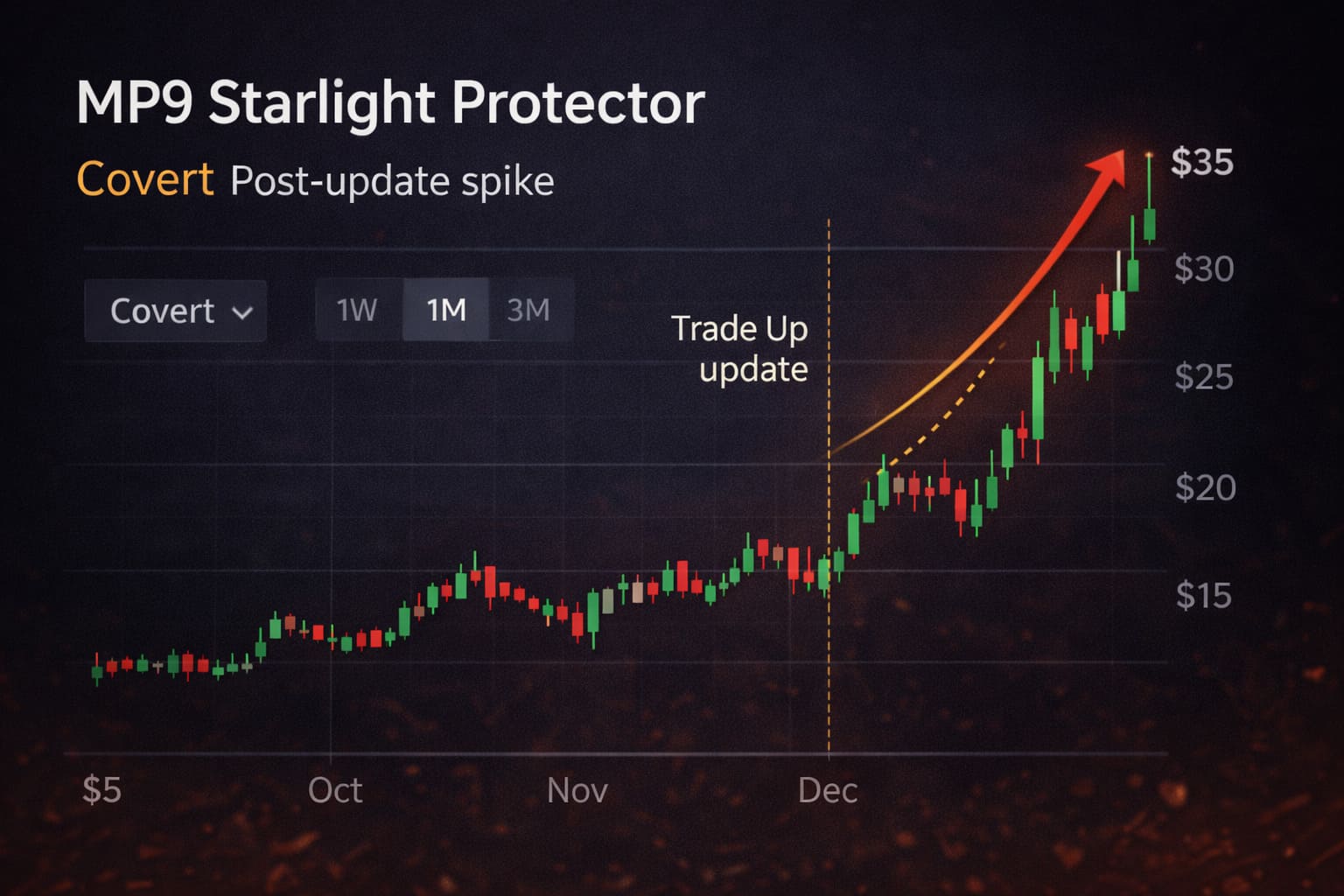
This wasn't value disappearing into thin air. Money was transferring from knife collectors to anyone who stockpiled Covert skins before or immediately after the update. One trader reported their inventory jumping from negligible worth to $90,000 simply because they held red skins. The 5-skin requirement for each knife craft created sustained demand that pushed Covert prices to unprecedented levels and kept them elevated even as the broader market recovered.
Specific examples illustrate the magnitude: Butterfly Knives that traded at $2,300 dropped to $1,800 in 10 hours. Karambit Dopplers fell from $14,000 to around $6,000. One Reddit user watched $1,400 vanish from their knife's value in just 30 minutes. These weren't percentage declines on paper – this was real purchasing power evaporating in real-time as panic gripped the market.
| Item Type | Pre-Crash Price | Trough Price | Loss |
| Butterfly Fade | $2,300 | $1,800 | -22% |
| Karambit Doppler | $14,000 | $6,000 | -57% |
| M9 Bayonet Gamma | $1,300 | $200 | -85% |
| MP9 Starlight (Covert) | $5 | $40 | +700% |
| AK-47 Nightwish (Covert) | $8 | $50 | +525% |
Investor Chaos: Panic Selling and Massive Losses
The human cost extended beyond spreadsheet numbers. Professional players, collectors, and investors watched years of value disappear in hours. Former CS pro olofmeister live-streamed his inventory depreciation from $58,000 to $18,000 – a $40,000 loss representing 65% of digital assets. Football star Neymar Jr., whose CS2 collection exceeds $214,000, lost $50,000 overnight.
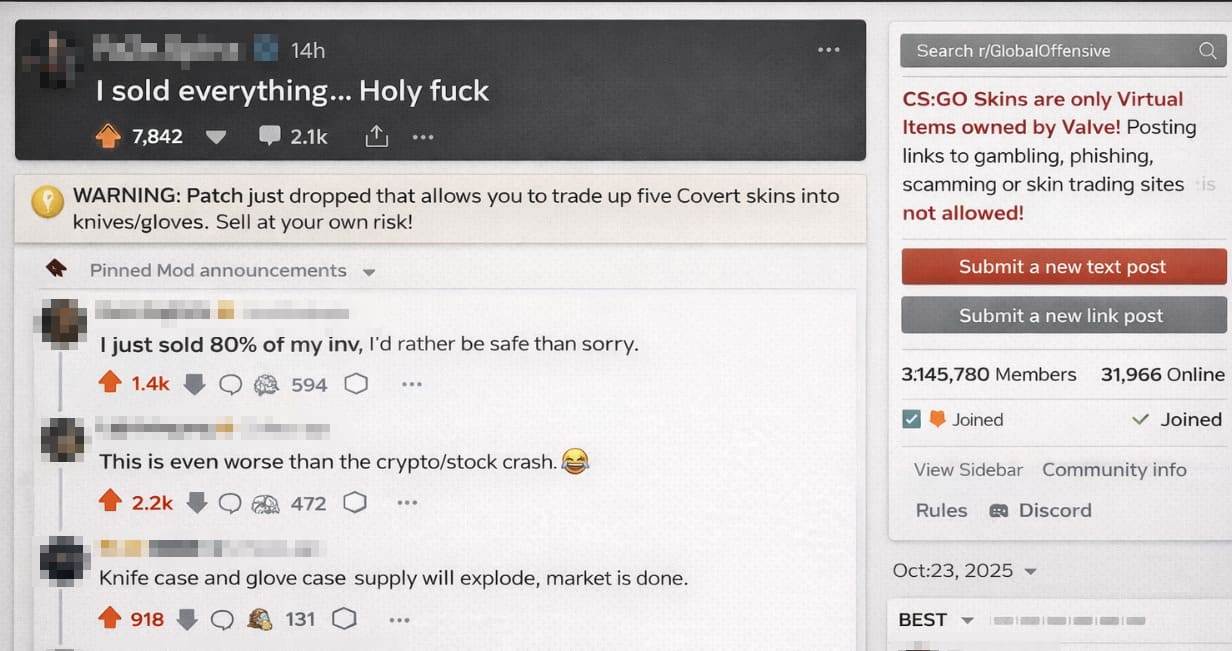
Professional player Spinx captured the despair following the csgo crash: "I sold everything I had. Every skin I owned is gone. I'm completely out of the CS2 market, I can't take it anymore." When someone with Spinx's status quits entirely, it signals how deeply the crash shook confidence. Panic became so extreme that Reddit's top post became a list of suicide prevention hotlines.
British trader Coco suffered the largest reported loss: approximately $550,000. These weren't wealthy hedge fund managers – many were young adults viewing CS2 inventories as serious investments or income sources. Trading forums transformed into support groups as people desperately tried to salvage something.
The community split sharply. Casual players celebrated newfound access to premium items. One Reddit user captured this divide: "I got burned a little, but as a player this is better. Has given me faith that Valve values average players more than market whales." Meanwhile, investors felt betrayed by Valve's unilateral decision to restructure the economy without warning.
The 47% Overnight Recovery That Shocked Analysts
After hitting $3.0 billion on October 24, something remarkable happened. Within 24 hours, the CS2 market surged 47% to $4.1 billion – regaining $1.1 billion that many assumed was permanently lost. This V-shaped recovery defied predictions and demonstrated unexpected resilience in a market that seemed destroyed.
Traders debated whether this represented genuine recovery or "dead cat bounce" – temporary rebound before further collapse. Arguments for sustainable recovery pointed to several factors: knife prices had overcorrected in panic, Covert scarcity would limit knife production, and market fundamentals suggested the drop was emotion-driven. As hours passed without renewed collapse, confidence slowly returned.
Player engagement metrics told a surprising story. October 2025 shattered records with 31 million weapon cases opened – highest monthly total since CS2's release. More remarkably, 15 million cases opened in just 72 hours following the update. This unprecedented activity occurred during the worst crisis, creating what analysts called an "anti-cyclical economy": when traders lose money, regular players spend more, and Valve profits through key sales.
Case opening distribution reveals where players focused:
- Revolution Case: 4 million openings at $0.54 average.
- Recoil Case: 3.4 million openings.
- Fever Case: 2.9 million openings.
- Fracture Case: 1.46 million openings.
Market capitalization continued stabilizing toward $4.7 billion over subsequent weeks. While below the pre-crash $5.9 billion peak, this represented remarkable strength given the fundamental restructuring Valve implemented. The recovery suggested the market hadn't died – it had evolved, albeit painfully.
Which Skins Recovered and Which Stayed Down
Recovery didn't happen uniformly across all items. The CS2 market repriced assets based on new scarcity dynamics rather than reverting to pre-crash values. Knives and gloves managed to regain approximately 50% of their losses within 48 hours – items that crashed from $1,300 to $200 climbed back toward the $600-700 range. However, they never approached their original valuations, and likely never will be given the permanent change to supply mechanics.
Covert skins told a different story. These red-tier items retained most of their post-crash gains because they became essential crafting resources. Even as panic subsided, Covert prices remained elevated due to sustained demand from players crafting knives. StatTrak variants commanded additional premiums as the only path to StatTrak knives through trade-ups.
Market segmentation became clear: high-end collectors who owned premium patterns and rare StatTrak items maintained better value retention than holders of common knife variants. Limited edition skins from discontinued cases also showed resilience, as their scarcity couldn't be replicated through the new crafting system. The market had fundamentally repriced itself around new realities.
| Category | Crash Depth | 48h Recovery | New Normal |
| Common Knives | -70% | +50% | -35% vs pre-crash |
| StatTrak Knives | -60% | +45% | -30% vs pre-crash |
| Rare Patterns | -40% | +30% | -15% vs pre-crash |
| Covert Skins | +300% | -10% | +250% vs pre-crash |
| Limited Cases | -25% | +20% | -10% vs pre-crash |
What Ryan Wyatt Got Right: The Trust Problem
Former YouTube gaming executive Ryan Wyatt identified something crucial many missed in initial panic: this wasn't primarily about supply and demand. "I think it has much less to do with supply shock than it does that Valve can, and will, unilaterally make dev decisions that wipe billions in market cap," Wyatt explained. "It's more a confidence issue. It's this today, what tomorrow?"
Wyatt's analysis cut to centralized platform risk. FloatDB calculations suggested that even if every Covert skin underwent trade-up conversion, knife supply would only double from 5.5 million to 11 million units. Supply increase alone couldn't explain 70% collapse. The real issue was trust – investors realized their "valuable assets" existed entirely at Valve's discretion with zero regulatory protection.
This confidence crisis has lasting implications. Players don't own CS2 skins meaningfully – they license temporary access to cosmetics within Valve's ecosystem. The company can modify, devalue, or remove items without compensation. Unlike stock crashes where regulators investigate and investors have remedies, CS2 traders discovered they operate in an unregulated space where the house makes all rules.
The community fractured over whether Valve acted appropriately. Average players praised democratizing access to items previously gatekept by artificial scarcity. But investors who spent thousands felt betrayed by changes that seemed designed to punish speculation. This reflects fundamental tension: are CS2 skins toys or assets? Valve's update answered definitively – they're game cosmetics, and the developer controls their value entirely.
CS2 Market vs Crypto: Centralized vs Decentralized Digital Assets
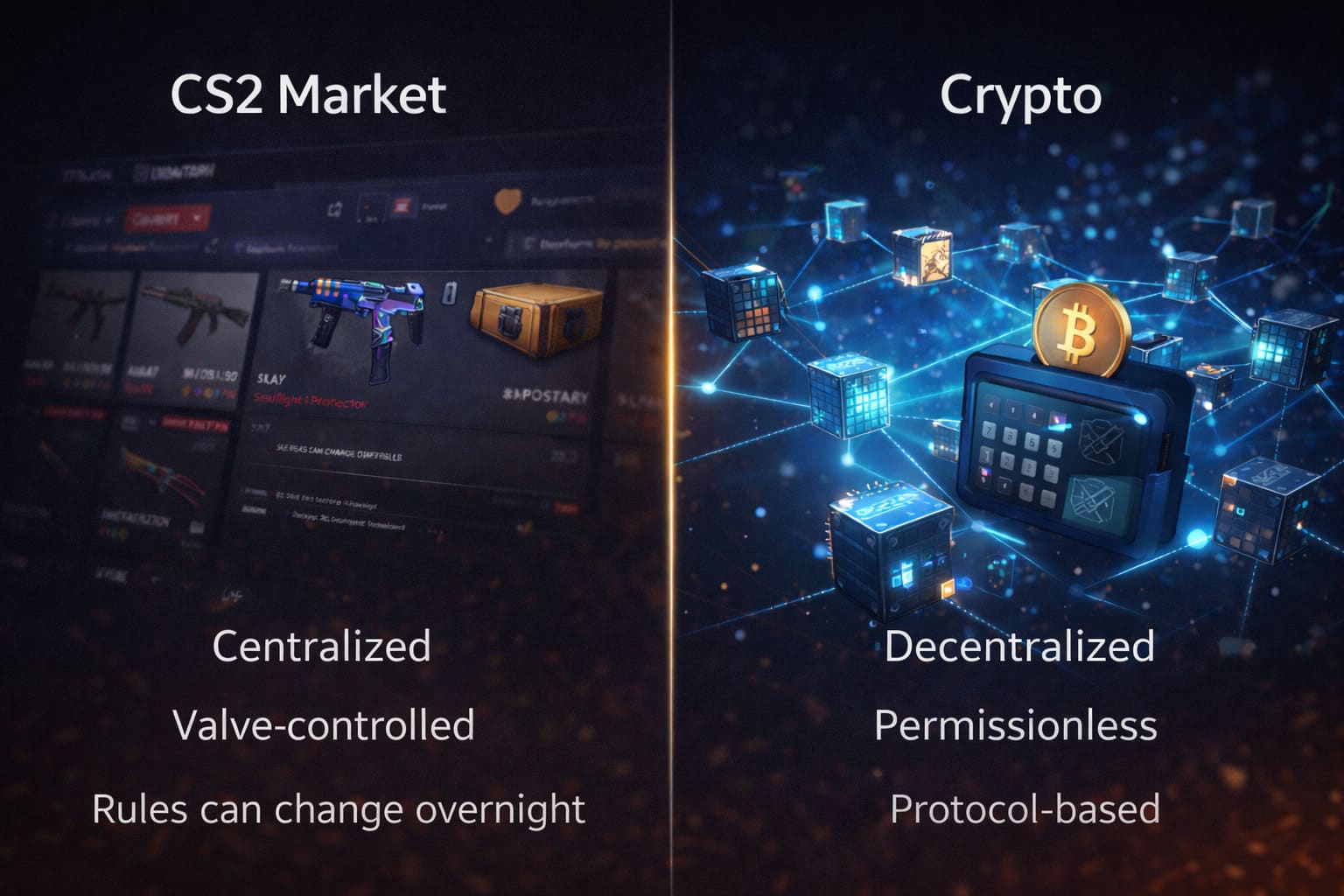
The CS2 market crash sparked intense debate about ownership models in digital economies. Let's compare CS2 skins to cryptocurrency-based gaming platforms to understand the fundamental differences:
| Dimension | CS2 Skins | Cryptocurrency Gaming |
| Ownership | License from Valve | Blockchain-based possession |
| Control | Centralized (Valve) | Decentralized protocols |
| Rule Changes | Unilateral, no warning | Requires consensus |
| Regulatory Oversight | None | Varies by jurisdiction |
| Value Security | Developer discretion | Market-driven |
| Transparency | Opaque mechanics | Provably fair algorithms |
| Withdrawal Rights | Steam wallet only | Full asset control |
| Permanence | Subject to removal | Immutable blockchain records |
CS2 operates on Valve's centralized servers where the company maintains absolute authority over every aspect of the economy. When Valve updates game mechanics, there's no consultation, no voting, no appeals process. The October 2025 crash demonstrated this power starkly – billions in player value disappeared because one company decided to implement a feature change. Players have zero recourse regardless of their investment size or duration.
Cryptocurrency-based gaming platforms like PLG.BET offer a fundamentally different ownership model. Operating since 2016 with Curaçao licensing, crypto gaming platforms provide regulatory oversight absent in traditional game economies. More importantly, assets exist on blockchains independent of any single company's control. While game developers can still influence value through updates, they cannot unilaterally eliminate asset ownership or prevent transfers.
The provably fair algorithms common in crypto gaming address transparency concerns raised by Valve's opaque decision-making. When players can verify game mechanics through blockchain records, trust doesn't depend on corporate goodwill. This doesn't eliminate risk – crypto assets experience extreme volatility and regulatory uncertainty – but it shifts control from centralized platforms to individual ownership in ways CS2's licensing model never provides.
For players considering where to invest time and money in digital assets, understanding these ownership differences matters. The CS2 crash wasn't just a price correction – it was a demonstration that centralized platform risk makes virtual items fundamentally unsuitable for serious investment regardless of apparent market stability.
Smart Buying Opportunities and Risk Management
Every market crash creates buying opportunities for those who understand the risks. Post-crash CS2 prices made previously expensive items accessible to average players. But before diving in, you need a clear-eyed assessment of what you're actually buying and the realistic chances of future returns.
Current Opportunities:
- Classic knife patterns at 30-35% below pre-crash levels offer relative value for players who want cosmetics without speculating on appreciation.
- Limited edition skins from discontinued cases maintain scarcity that new trade-ups cannot replicate.
- StatTrak variants command premium prices with more stable demand than regular versions.
- Rare pattern combinations (Blue Gems, specific fades) show better value retention than common variants.
- Portfolio diversification across rarity tiers reduces exposure to single-category collapses.
However, every opportunity comes wrapped in substantial risks. Valve demonstrated willingness to restructure the economy without warning or concern for existing investments. What happens if they modify trade-ups again? Expand crafting to include more items? Implement new case systems that further dilute scarcity? These aren't hypothetical concerns – they're realistic threats given what occurred in October 2025.
Risk Management Strategies:
Traditional investment wisdom like the 7% stop-loss rule doesn't work in CS2's extreme volatility. When assets can drop 70% in hours with no trading halts or circuit breakers, automated risk management is impossible. Instead, apply these principles:
- Never invest more than total loss tolerance – treat any CS2 spending as entertainment expense, not investment.
- Diversify across platforms – don't concentrate wealth in Valve-controlled assets.
- Track market indicators – use Pricempire and similar tools for price monitoring.
- Understand licensing vs ownership – you don't own these items; you're renting them from Valve.
- Set time-based limits – decide maximum holding periods rather than price targets.
The fundamental reality remains: CS2 skins exist entirely at Valve's discretion with zero regulatory protection. Treat purchases as consumable entertainment, not investments with expected returns. If you happen to profit from price movements, consider it fortunate speculation rather than skillful investing.
Lessons for Digital Asset Investors
The CS2 market crash offers crucial insights for anyone investing in virtual items across gaming platforms, NFT marketplaces, or cryptocurrency projects. These lessons extend far beyond Counter-Strike:
Five Critical Lessons:
- Platform control risk is existential – When single entities control asset value, supply, and marketplace rules, your "investment" depends entirely on their decisions.
- Diversification means different ecosystems – Owning 50 CS2 knives doesn't diversify risk; true diversification requires spreading across uncorrelated systems.
- Market resilience doesn't equal stability – CS2's 47% recovery impressed traders, but volatility remains extreme and fundamental centralized risk hasn't changed.
- Community sentiment predicts confidence crises – When pros like Spinx exit markets and Reddit posts suicide hotlines, these indicate systemic problems beyond normal corrections.
- Alternative platforms offer different risk profiles – Cryptocurrency-based gaming like PLG.BET provides blockchain ownership addressing specific centralized control issues Valve's economy exposed.
Artificial scarcity only persists as long as controllers maintain it. Valve proved this by destroying knife scarcity overnight. Before investing in any digital asset, ask: who controls this, and what prevents them from changing rules? Evaluate trade-offs between centralized convenience and decentralized ownership.
The October 2025 crash may rank among gaming's most significant economic events. It demonstrated that billion-dollar digital economies can restructure overnight when single companies control the rules. For investors treating virtual items seriously, this reality demands different approaches than traditional assets with regulatory protections.
Conclusion
The CS2 market crash erased $1.7 billion before recovering 47% within 24 hours – capturing digital asset investing's extreme risk and resilience. Valve's Trade Up Contract update destroyed artificial scarcity overnight, proving centralized platforms create unique vulnerabilities.
Ryan Wyatt's thesis proved prescient: the real damage wasn't supply increase but Valve making unilateral decisions wiping out billions without warning. For casual players, the update delivered affordable cosmetics. For investors, it revealed fundamental instability of licensing masquerading as ownership.
The market stabilized around $4.7 billion. Player engagement reached records with 31 million cases opened in October 2025. CS2's economy survived its worst crisis.
Approach CS2 skins as entertainment, not investment. Diversify across platforms, understand licensing versus ownership, and never invest more than you can lose. The October 2025 crash taught harsh lessons: in centralized gaming economies, your digital assets exist only as long as developers permit.