The Dota 2 ranking system features 40 total ranks across 8 tiers (Herald through Immortal), determined by your MMR (Matchmaking Rating). Each solo win awards approximately +30 MMR while losses subtract -30 MMR, operated by Valve Corporation. The elite Immortal rank requires 5620+ MMR and is held by only 1.91% of players according to Hawk Live distribution data. This guide breaks down every tier, explains the Glicko algorithm from Patch 7.33, and reveals exactly what it takes to climb the competitive ladder.
Understanding the Dota 2 MMR System
MMR dota 2 (Matchmaking Rating) is the numerical skill metric that determines your competitive standing. Win a solo ranked match and earn +30 MMR, lose and drop -30 MMR. Party matches follow similar patterns with ±20 MMR adjustments.
The system requires 100 hours of unranked gameplay before ranked access. Once unlocked, you'll play 10 calibration matches determining your initial MMR placement. Since Patch 7.33, Valve implemented the Glicko algorithm for calculations, replacing the fixed-point system. This approach considers not just wins and losses, but rank confidence and opponent skill levels.
Your dota 2 mmr ranking tracks separately for Core and Support roles, allowing specialization and independent progression. One crucial clarification: Does KDA affect MMR? No. Your kills, deaths, and assists don't directly influence MMR gains or losses. The Glicko algorithm focuses purely on match outcomes—winning is what matters for your rating.
| Match Type | MMR Gain (Win) | MMR Loss (Defeat) |
|---|---|---|
| Solo Ranked | +30 (average) | -30 (average) |
| Party Ranked | +20 (average) | -20 (average) |
How the Glicko Algorithm Calculates MMR
The Glicko algorithm revolutionized matchmaking with Patch 7.33, calculating variable MMR gains and losses based on multiple factors. Unlike fixed points, it incorporates rank confidence—how certain the system is about your skill level. New players or returning players have lower confidence, leading to larger MMR swings until accurate placement.
The algorithm factors in opponents' ranks, meaning victories against higher-rated players yield more points. This dynamic approach prevents MMR distribution stagnation and creates more accurate skill reflection across all ranks.
Core vs Support Role MMR Tracking
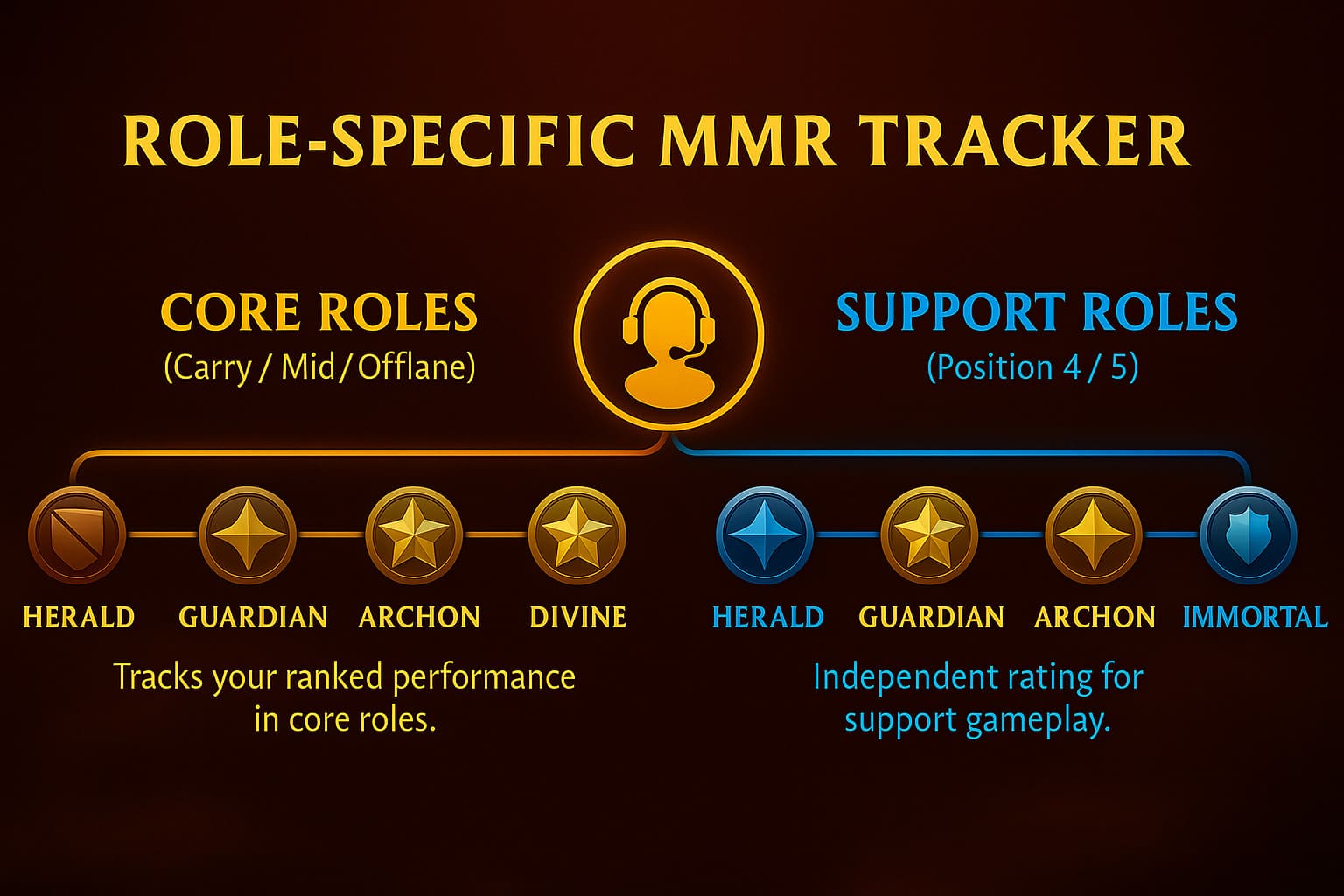
Dota 2's unique role-specific ranking maintains two separate MMR values: Core roles (carry, mid, offlane) and Support roles (position 4 and 5). You could be Legend as carry but Archon as support—perfectly normal.
This allows specialization without forcing unfamiliar positions. When queuing ranked, you select preferred roles, and the system uses appropriate MMR for balanced matches. Your displayed rank medal shows the higher of your two ratings.
Complete Dota 2 Rank Tiers and MMR Requirements
Dota 2 ranks span from beginners to professional esports players, with precise MMR thresholds separating each tier. The dota 2 mmr brackets create a structured ladder where every 150-200 MMR represents meaningful progression. Each of the 8 tiers (Herald, Guardian, Crusader, Archon, Legend, Ancient, Divine, Immortal) divides into 5 sub-ranks—except Immortal, which uses a leaderboard system.
Current dota 2 rank distribution from Stratz shows player concentration follows a bell curve. The majority cluster around middle ranks, with fewer at extremes. Here's the 2025 distribution: Herald (0-769 MMR, 7.34%), Guardian(770-1539 MMR, 12.18%), Crusader (1540-2309 MMR, 15.87%), Archon (2310-3079 MMR, 22.75%—most populated), Legend (3080-3849 MMR, 18.53%), Ancient (3850-4619 MMR, 12.94%), Divine (4620-5619 MMR, 8.48%), and Immortal (5620+ MMR, 1.91%).
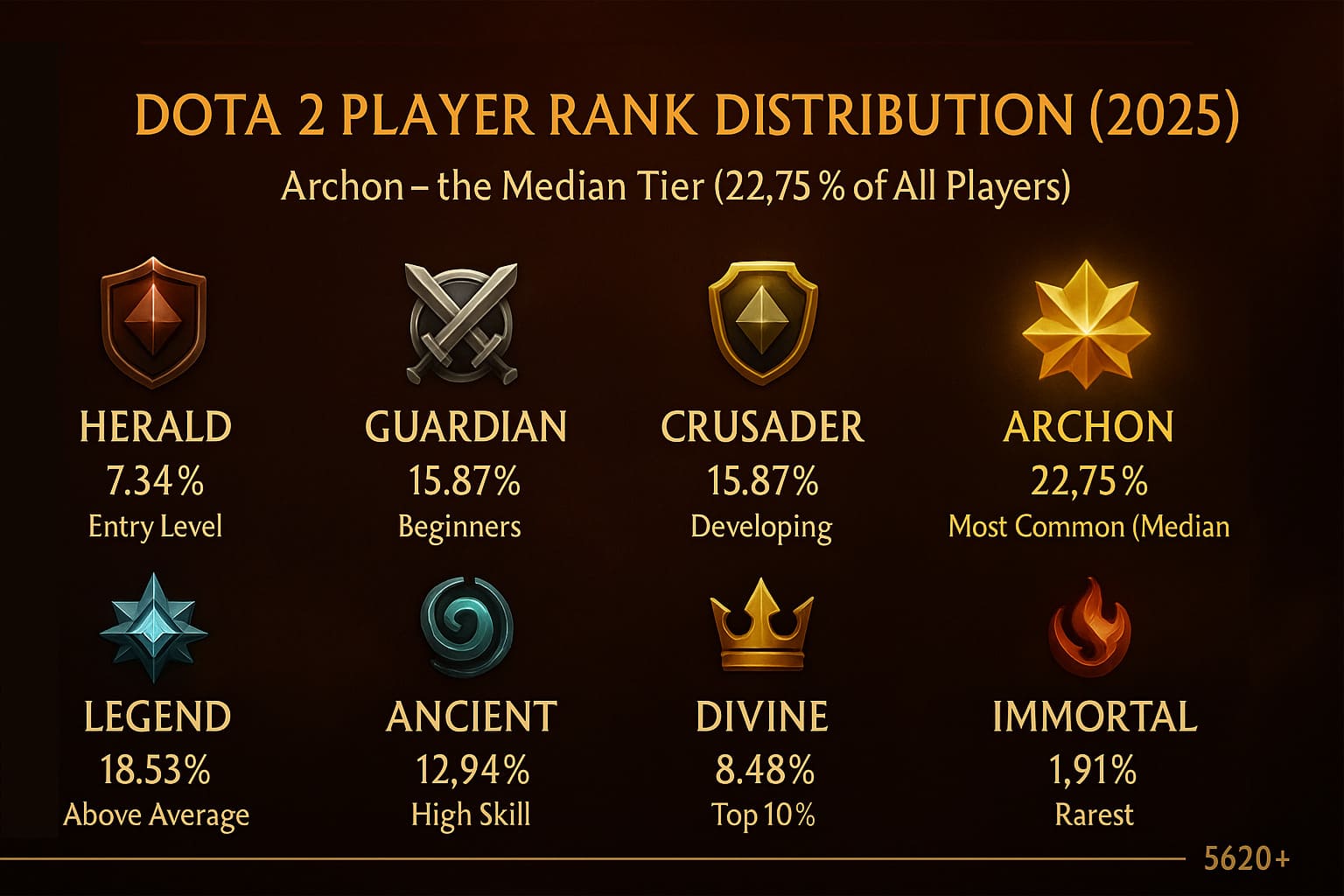
What rank is 3200 MMR? That's Legend tier, specifically Legend 1 or 2. You're performing better than approximately 60% of ranked players—respectable achievement showing mastery of fundamentals.
| Rank | MMR Range | Rank | MMR Range |
|---|---|---|---|
| Herald 1 | 0-153 | Legend 1 | 3080-3233 |
| Herald 2 | 154-307 | Legend 2 | 3234-3387 |
| Herald 3 | 308-461 | Legend 3 | 3388-3541 |
| Herald 4 | 462-615 | Legend 4 | 3542-3695 |
| Herald 5 | 616-769 | Legend 5 | 3696-3849 |
| Guardian 1 | 770-923 | Ancient 1 | 3850-4003 |
| Guardian 2 | 924-1077 | Ancient 2 | 4004-4157 |
| Guardian 3 | 1078-1231 | Ancient 3 | 4158-4311 |
| Guardian 4 | 1232-1385 | Ancient 4 | 4312-4465 |
| Guardian 5 | 1386-1539 | Ancient 5 | 4466-4619 |
| Crusader 1 | 1540-1693 | Divine 1 | 4620-4773 |
| Crusader 2 | 1694-1847 | Divine 2 | 4774-4927 |
| Crusader 3 | 1848-2001 | Divine 3 | 4928-5081 |
| Crusader 4 | 2002-2155 | Divine 4 | 5082-5235 |
| Crusader 5 | 2156-2309 | Divine 5 | 5236-5619 |
| Archon 1 | 2310-2462 | Immortal | 5620+ |
| Archon 2 | 2463-2616 | ||
| Archon 3 | 2617-2770 | ||
| Archon 4 | 2771-2924 | ||
| Archon 5 | 2925-3079 |
Herald Rank (0-769 MMR)
Herald rank represents the entry point for competitive Dota 2, where players learn core mechanics like last-hitting, item builds, and map awareness. The tier spans 0-769 MMR across five sub-ranks, with Herald 1 (0-153 MMR) being the rarest sub-rank at just 0.06% of players. Players here are developing fundamental skills—everyone starts somewhere.
Archon Rank (2310-3079 MMR) - The Median Tier
Archon tier represents the average competitive Dota 2 player, concentrating 22.75% of the ranked population. If you're Archon, you're exactly in the middle—not a beginner, but with room to grow.
Archon 1 MMR requires 2310-2462 MMR, with each star needing roughly 150-155 additional MMR. Players here understand lane mechanics, basic itemization, and map movements. The difference between Archon and higher ranks often comes down to consistency—Archon players know what to do but don't execute perfectly every match. Archon serves as the benchmark for "average" skill discussions.
Immortal Rank (5620+ MMR) - Elite Tier
The pinnacle of competitive Dota 2, Immortal rank demands 5620+ MMR and represents only 1.91% of players—the elite who've mastered advanced mechanics, draft strategies, and coordination. Unlike other tiers, Immortal operates on a regional leaderboard system ranking players from Top 25,000 down to Top 1.
What separates Immortal from Divine? Consistency at the highest level. These players maintain exceptional farm efficiency, execute complex combos flawlessly, and demonstrate superior game sense. Many professional dota 2 players maintain Immortal status.
The leaderboard creates internal competition—players want Top 1000, Top 100, or #1 position. Regional rankings (Europe, Americas, Southeast Asia, China) maintain separate leaderboards. As of 2025, top European players have reached the 17,000 MMR milestone, with Mark "Mangekyou" Kharlamov becoming the first to break 17k in June 2025, followed by Ilya "Satanic" Mulyarchuk in May 2025. The competitive ceiling continues to rise as the most skilled players push MMR boundaries.
Dota 2 Rank Distribution and Player Percentages
Where do you stand compared to millions of other players? Understanding dota 2 rank distribution provides crucial context for your competitive journey. According to data aggregated by Stratz from over 7 million analyzed players in 2025, the distribution follows a classic bell curve pattern with Archon at its peak.
The mmr distribution dota 2 reveals fascinating insights. Roughly half of all players fall below Archon (combining Herald, Guardian, and Crusader), while the other half sits above it (Legend through Immortal). This creates natural skill progression milestones—reaching Legend means you've surpassed approximately 60% of the competitive player base, while Divine places you in the top 10%.
Is 3.5k MMR good? Absolutely. At 3500 MMR, you're sitting in Legend tier (specifically Legend 3-4), which places you above approximately 60-65% of all ranked players. You've demonstrated a solid understanding of game mechanics, hero matchups, and strategic thinking. While there's always room to improve, Legend tier represents above-average skill that many players aspire to reach.
The distribution also reveals an interesting trend: rank percentiles remain relatively stable across seasons, despite MMR inflation at the highest levels. Valve's Glicko system helps maintain distribution balance by adjusting point gains and losses based on overall player population and skill clustering.
| Rank Tier | Cumulative % Below | Percentile Standing |
|---|---|---|
| Herald | 0% | Bottom 7.34% |
| Guardian | 7.34% | Bottom 19.52% |
| Crusader | 19.52% | Bottom 35.39% |
| Archon | 35.39% | Bottom 58.14% |
| Legend | 58.14% | Bottom 76.67% |
| Ancient | 76.67% | Bottom 89.61% |
| Divine | 89.61% | Bottom 98.09% |
| Immortal | 98.09% | Top 1.91% |
Rank Calibration System: How to Get Your Initial MMR
Starting your ranked journey? The rank calibration process determines your initial MMR through specialized assessment. New players must first accumulate 100 hours of unranked gameplay in modes like All Pick or Turbo, ensuring basic familiarity with mechanics, heroes, and objectives before competitive matches.
Once unlocked, you'll play 10 calibration matches analyzing your performance. These placement matches don't just count wins and losses—the system evaluates performance relative to other players at similar temporary ratings. Strong performance places you higher, while inconsistent play starts you lower.
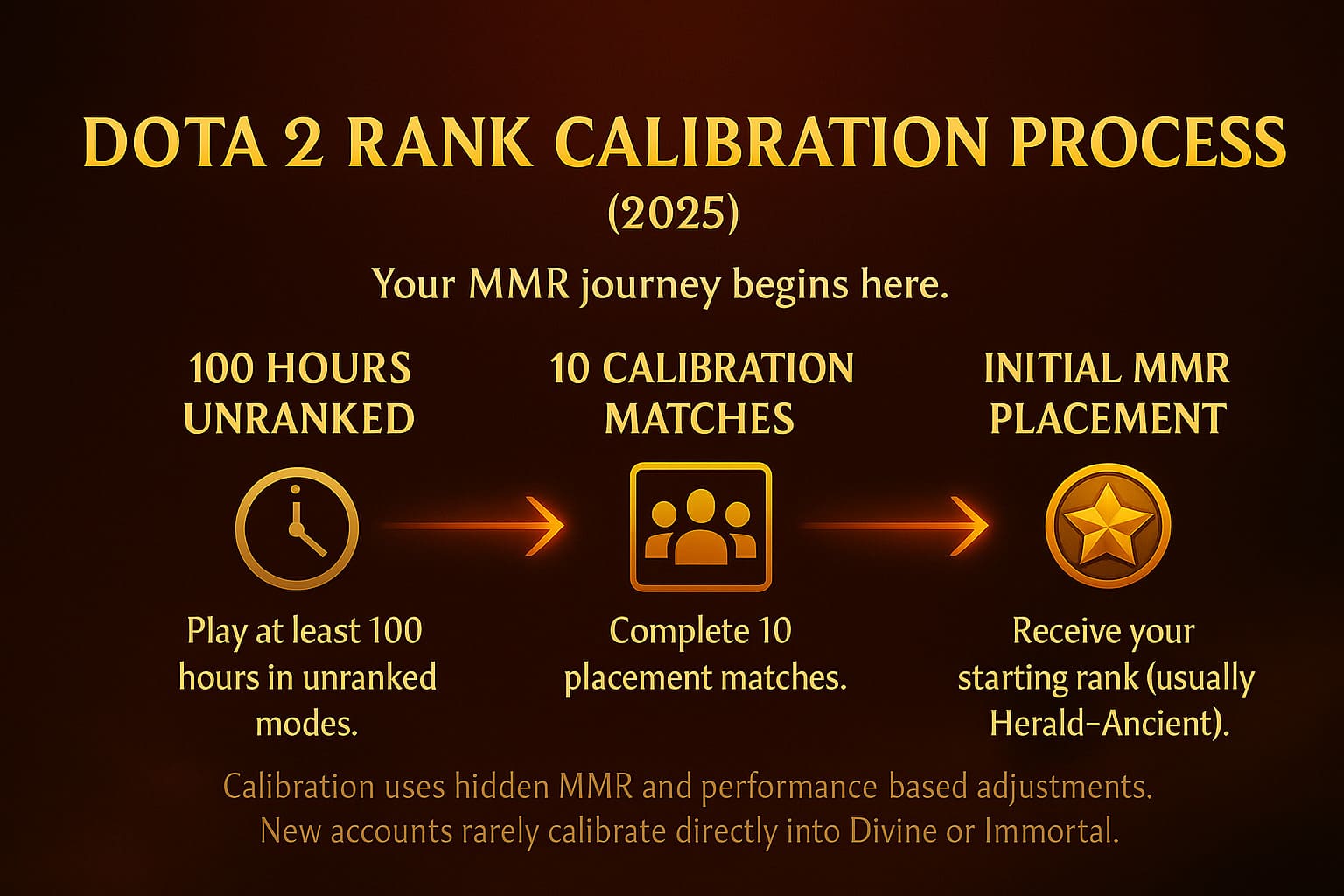
Calibration games use hidden MMR that adjusts rapidly based on each match. Your final placement after 10 games reveals your starting rank, ranging from Herald to Ancient (new accounts rarely calibrate directly into Divine or Immortal).
The system features seasonal recalibration opportunities. Existing players can optionally recalibrate at new season starts, playing placement matches that adjust MMR based on recent trends. This prevents stagnation and helps genuinely improved (or declined) players reach appropriate ranks faster.
Calibration Process:
- Complete 100 hours unranked
- Unlock ranked mode
- Play 10 calibration matches
- Receive initial rank (Herald-Ancient typically)
- Begin regular ranked progression with ±30 MMR
Seasonal Recalibration Mechanics
Seasonal calibration offers experienced players a chance to reset rank confidence and potentially jump tiers faster than grinding. Dota 2's recalibration is "soft"—it considers previous MMR as a starting point but allows dramatic shifts based on calibration performance.
Recalibration appears in settings at major season starts. Playing these 10 matches can result in several hundred MMR changes up or down. The rank confidence factor increases volatility during this period, making each calibration win or loss carry more weight than regular matches.
How to Gain and Lose MMR in Ranked Matches
The mechanics behind gain MMR and lose MMR systems determine your competitive progression. In solo ranked matches, winning typically awards +30 MMR while losses subtract -30 MMR. Party matches follow similar patterns with ±20 MMR adjustments. These represent averages—actual amounts vary based on Glicko algorithm factors.
Why do MMR gains fluctuate? Several factors influence awards. Defeating opponents with higher average MMR yields bonus points (potentially +35-40 MMR), while losing to lower-rated opponents costs more (possibly -35-40 MMR). The system considers rank confidence—players with uncertain ratings (new accounts, returning players) experience larger swings until accurate placement.
Your role-specific MMR tracking means Core and Support ratings change independently. Win as carry? Your Core MMR increases ~30 while Support MMR stays unchanged. This separation allows focused improvement in specific positions.
The dota 2 mmr gain rate remains consistent across all ranks—Herald and Immortal players both earn roughly 30 points per solo win. What changes is competition level and consistency required at higher tiers.
| Match Scenario | MMR Change | Notes |
|---|---|---|
| Solo Win (even match) | +30 | Standard gain |
| Solo Loss (even match) | -30 | Standard loss |
| Win vs Higher MMR | +35 to +40 | Bonus for upset |
| Loss vs Lower MMR | -35 to -40 | Penalty |
| Party Win | +20 | Reduced for group |
| Party Loss | -20 | Reduced for group |
MMR Loss Scenarios and Penalties
Can you lose MMR for abandoning games? Yes—abandoning ranked matches results in -30 MMR plus Low Priority queue penalties. This applies whether you intentionally disconnect or face technical issues.
Beyond MMR loss, abandoning games triggers escalating penalties. First offenses result in Low Priority for several matches. Repeated abandons increase Low Priority duration and can lead to temporary ranked bans. Other mmr penalty triggers include being reported for disruptive behavior and going AFK. The message is clear: complete matches to protect your MMR and account standing.
Professional Player MMR Benchmarks and Records
The absolute pinnacle of professional dota 2 players showcases the true skill ceiling. While Immortal rank begins at 5620 MMR, the gap between baseline Immortal and top pros spans thousands of rating points.
Who has 17k MMR in Dota 2? The highest verified peaks hover around 17,000 MMR, achieved by players like Mark "Mangekyou" Kharlamov in 2025, according to European leaderboards.
Who was the first 10k MMR player? Amer "Miracle" Al-Barkawi achieved legendary status becoming the first to reach 9,000 MMR in May 2016 while playing for OG. He later reached 10,000 MMR in June 2020, cementing his place in history. Miracle won The International 2017 with Team Liquid, proving high MMR correlates with professional success.
The 10k mmr milestone represents elite mastery. After Miracle, Abed "Abed" Yusop became the first to hit 10,000 MMR under the new medal system in June 2019, then pushed to become the first 11,000 MMR player in May 2020.
Who is 23savage? Nuengnara "23savage" Teeramahanon is a Thai professional carry player known for exceptional skill and one of the first to break 12,000 MMR. He's competed for T1, Talon Esports, and OG, earning over $870,000 in career prize money.
Put your Dota 2 ranking knowledge into practice by following The International and other professional tournaments on plg.bet, where understanding MMR levels and player skill dynamics can enhance your esports viewing experience.
Notable Professional Players and Their Ranks
Abed - Is Abed Dota 2 Filipino? Yes, Abed Azel Yusop is a Filipino mid player who reached 10k MMR first under the new system and 11k MMR, showcasing exceptional skill on Meepo and Invoker. He's competed for Evil Geniuses, Fnatic, and other elite teams.
Arteezy - Is Arteezy retired? Artour "Arteezy" Babaev achieved 9k MMR in July 2016 as the second player to reach that milestone. After Shopify Rebellion failed to qualify for The International 2024, Arteezy announced his step back from active competition in July 2024 to focus on streaming and content creation. In April 2025, he confirmed he is no longer affiliated with Shopify Rebellion.
Yatoro - Illya "Yatoro" Mulyarchuk led Team Spirit to victory at TI 2021 and TI 2023, cementing his status as one of the greatest carry players.
Zai - Did Zai win TI? Ludwig "Zai" Wåhlberg never won The International despite being one of the most decorated players. His best finish was 3rd place with Evil Geniuses at TI 2014.
Tips for Climbing the Dota 2 Ranked Ladder
Ready to increase mmr and climb ranks? Understanding MMR mechanics provides strategic advantages beyond mechanical skill. Leverage the role-specific MMR system—specializing in Core or Support allows focused improvement. Pick 3-5 heroes you enjoy and master them deeply rather than playing every hero superficially.
Consistency matters more than spectacular performances. The rank up dota 2 journey rewards players who maintain 51-55% win rates over hundreds of matches. Every +30 MMR win adds up, while avoiding tilted losing streaks prevents devastating losses.
Climb ranks faster by understanding timing windows specific to your MMR bracket. Herald-Archon players often ignore farm efficiency, giving you advantages by simply out-farming opponents. Legend-Ancient requires better map awareness and positioning. Divine-Immortal demands perfecting fundamentals while adding draft knowledge and coordination.
Build rank confidence through steady play rather than sporadic sessions. The Glicko algorithm favors consistent players who maintain regular match frequency—playing 3-5 games daily yields faster gains than weekend binges. Study dota 2 ranked tips from high-level players but adapt them to your current skill level.
Follow high-level professional Dota 2 matches on plg.bet to observe advanced strategies and decision-making from Immortal-ranked players, accelerating your own MMR climbing journey.
Understanding Your Rank Position in the Player Base
Is 3.5k MMR good? This reveals the importance of contextual understanding. At 3500 MMR, you're ranked in Legend tier (Legend 3-4), placing you above approximately 60-65% of all competitive players. That's solidly above average—genuine achievement showing strong fundamentals, game sense, and execution.
However, "good" depends on your goals. Aspiring professional? You need 10,000+ MMR. Casual competitive? Legend represents respectable skill. The average mmr dota 2 sits around 2500-2700 MMR (Archon tier), making 3.5k notably above median.
Understanding dota 2 rank percentiles provides motivation and realistic expectations. The median rank (Archon) serves as your benchmark. Below it? You're developing core skills. Above it? You've demonstrated mastery of fundamentals. Divine tier (top 10%) represents expert-level play, while Immortal (top 2%) signifies elite status.
Don't let rank anxiety distract from improvement. Focus on consistent personal growth rather than obsessing over medal colors.
Conclusion
The dota 2 ranking system represents one of gaming's most sophisticated competitive ladders. From Herald's 0 MMR beginners to Immortal's 17,000+ MMR professionals, the 40 ranks across 8 tiers create clear progression pathways powered by Valve Corporation's Glicko algorithm. The ±30 MMR system rewards consistency, while role-specific tracking allows specialization.
Understanding rank progression transforms how you approach competitive Dota 2. Archon's 22.75% player concentration marks the average, Legend's 3080-3849 MMR represents above-average skill, and Immortal's 5620+ requirement separates elite players. Whether you're calibrating or pushing for that next tier, remember that mmr system fluctuations are normal. Focus on consistent improvement.
Track progress using resources like Stratz and Hawk Live for ongoing dota 2 rank distribution analysis, set realistic goals based on your percentile, and enjoy the competitive journey.