The mobile legends tier list provides players with essential guidance for hero selection in the current meta. This comprehensive mlbb tier list ranks the best heroes based on four critical metrics: win rate, pick rate, ban rate, and professional usage data. In today's competitive landscape, understanding which champions dominate the meta is crucial for climbing ranked ladders. Julian currently leads as the top S-tier assassin, excelling in early game ganking from level 3 onwards.
Meanwhile, Fredrinn has revolutionized the utility jungler role with his innovative Gray HP conversion mechanics. Our tier system categorizes heroes into S (meta dominators), A (strong picks), B (situational), and C (underperforming) tiers. This ranking methodology combines statistical performance with professional play analysis to identify the strongest mobile legends heroes that consistently deliver results across all skill brackets.
S-Tier Heroes - Meta Dominators
S-tier heroes represent the absolute pinnacle of mobile legends competitive play. These meta dominators consistently achieve the highest win rates while maintaining significant presence in both ranked queues and professional tournaments. Understanding what elevates these champions to S-tier status requires examining their unique mechanics, team synergies, and meta positioning within our mobile legends tier list.
Julian (Assassin)
Julian dominates as the premier S-tier assassin through exceptional early game power that peaks at level 3. His skill ceiling rewards mechanical mastery, enabling aggressive ganking patterns that pressure all three lanes simultaneously. With a 53.2% win rate and 78% pick/ban rate in mythical glory rankings, Julian excels at snowballing advantages through calculated assassination attempts. His burst combo chains seamlessly, allowing him to eliminate priority targets before escaping unharmed. As the strongest hero in mobile legends for early game impact, Julian's counter relationships favor him against immobile mages like Aurora and Eudora, though he struggles against tankier fighters such as Fredrinn and Khaleed. Optimal team synergies include pairing Julian with crowd control supports like Tigreal or Khufra, maximizing his assassination windows during team fights.
Yi Sun-shin (Assassin)
Yi Sun-shin's classification as an S-tier assassin stems from his devastating Mountain Shocker ultimate, which provides global presence and unmatched objective control. His skill requirements are considerably high, demanding precise positioning and map awareness to maximize ultimate effectiveness. Currently maintaining a 52.8% win rate with moderate pick priority (45%) in our mlbb tier list rankings, Yi Sun-shin excels in compositions requiring split-push pressure and poke damage. His unique hybrid damage profile combines physical attacks with magic-scaling abilities, making him difficult to itemize against. Key counters include dive-heavy assassins like Lancelot and Ling who can bypass his defensive positioning. Team synergies thrive when paired with vision control supports and frontline tanks that enable safe ultimate usage during objective contests.
Fredrinn (Fighter/Tank)
Fredrinn revolutionized the utility jungle meta through his innovative Gray HP conversion mechanics, transforming potential damage into survivability. His 54.1% win rate represents the highest among all junglers, with professional teams prioritizing him in 82% of competitive matches. The Gray HP system allows Fredrinn to absorb punishment while converting defensive stats into offensive pressure, creating a unique risk-reward dynamic. His utility jungle role provides consistent crowd control, damage absorption, and initiation tools that stabilize team compositions. Fredrinn counters burst-dependent assassins like Fanny and Harley by surviving their initial combos and retaliating with sustained damage. However, he struggles against percentage-based true damage dealers such as Karrie and Claude. Optimal team compositions pair Fredrinn with backline damage dealers who capitalize on his frontline disruption.
Phoveus (Fighter)
Phoveus earned S-tier status as the premier dash counter, possessing mechanics specifically designed to punish mobility-based mobile legends heroes. His passive and ultimate abilities trigger additional damage whenever enemies use dash skills, making him invaluable against the mobility-heavy current meta. With a 51.9% win rate and consistent presence in draft phases (67% pick/ban), Phoveus functions as both a counterpick and blind-pick option. His anti-dash mechanics devastate popular picks like Fanny, Lancelot, and Hayabusa, forcing immobile alternatives or risky positioning errors. Counter matchups emerge against ranged pokers like Beatrix and Melissa who kite without relying on dash abilities. Team synergies maximize Phoveus's value when combined with additional crowd control and when facing multiple dash-dependent enemies on the opposing roster.
Kimmy (Marksman)
Kimmy's S-tier positioning derives from her unique attack pattern system, blending basic attacks with ability-based damage delivery. This flexibility enables hybrid build paths incorporating both magic and physical damage items, adapting to team composition needs. Her 50.7% win rate belies her 73% professional presence, indicating her skill-expressive nature rewards experienced players. The ability to maintain mobile positioning while dealing consistent damage makes Kimmy exceptionally difficult to pin down during team fights. She counters traditional tank/bruiser compositions by kiting efficiently while struggling against long-range assassins such as Gusion and Julian. Optimal team synergies include pairing Kimmy with peel-heavy supports like Mathilda or Diggie, maximizing her damage output through extended fights.
Pharsa (Mage)
Pharsa dominates S-tier as the premier area control mage, dictating team fight positioning through devastating zone denial. Her ultimate ability creates impassable damage zones that force enemy rotations, securing objectives and controlling choke points. Maintaining a 52.4% win rate with moderate draft priority (58%), Pharsa excels in poke-oriented compositions and siege scenarios. Her flight mobility provides unique safety, enabling aggressive positioning without traditional escape tools. Team fight impact scales exponentially when combined with frontline engage tanks like Tigreal or Atlas who funnel enemies into her ultimate zones. Counter relationships favor long-range assassins such as Lancelot and Hayabusa who can bypass her zoning and eliminate her during ultimate channeling. Pharsa synergizes optimally with crowd control-heavy compositions that maximize her follow-up damage potential.
| Hero Name | Role | Win Rate | Difficulty | Key Strength |
|---|---|---|---|---|
| Julian | Assassin | 53.2% | High | Early game ganking power |
| Yi Sun-shin | Assassin | 52.8% | Very High | Global ultimate presence |
| Fredrinn | Fighter/Tank | 54.1% | Medium | Gray HP conversion mechanics |
| Phoveus | Fighter | 51.9% | Medium | Anti-dash counter mechanics |
| Kimmy | Marksman | 50.7% | High | Hybrid damage flexibility |
| Pharsa | Mage | 52.4% | Medium | Area control and zone denial |
A & B-Tier Heroes Analysis
While S-tier champions dominate competitive play, A-tier heroes and B-tier picks represent equally important roster options for strategic team building. These viable heroes maintain consistent performance across various skill brackets, offering reliable alternatives when premier picks are banned or countered. Understanding when to deploy these situational picks separates competent players from true strategists who adapt to draft dynamics within the mlbb tier list framework.
A-tier consistently deliver strong results with win rates ranging from 48-52%, representing dependable choices that lack the overwhelming dominance of S-tier options but provide crucial flexibility.
Granger exemplifies the A-tier marksman archetype, combining burst damage with mobility through his unique bullet-reload system. His role-specific strength lies in early-to-mid game skirmishing, where his burst combos can eliminate squishy targets before sustained teamfights develop. Granger fits optimally into poke-oriented team compositions that control objectives through superior range and rotation speed. Counter scenarios emerge against heavy dive compositions featuring mobile legends heroes like Fredrinn or Phoveus who can close gaps and absorb his burst damage.
Harith dominates as the premier A-tier mage, utilizing his shield mechanics and dash-based mobility to survive extended teamfights while dealing consistent area damage. His performance metrics show a 50.3% win rate with moderate draft priority, excelling when paired with frontline engage tanks. The role-specific strength of Harith centers on his ability to zone control points during Lord and Turtle contests, where confined spaces maximize his circular damage pattern. Team composition fits favor pairing Harith with initiators like Tigreal or Khufra, enabling safe positioning for his sustained damage output. He struggles in counter scenarios against long-range poke compositions that prevent him from entering effective combat range.
Uranus represents the archetypal A-tier tank, providing exceptional durability through his stacking regeneration passive. His role-specific strengths include sustaining frontline pressure during prolonged sieges and absorbing enemy resources without requiring extensive support. With a solid 51.8% win rate in extended matches (20+ minutes), Uranus excels in team compositions prioritizing scaling and late-game insurance. Counter scenarios typically involve burst damage compositions or percentage-health dealers like Karrie who bypass his regeneration mechanics.
| Hero | Role | Tier | Win Rate | Best Usage | Countered By |
|---|---|---|---|---|---|
| Granger | Marksman | A | 49.8% | Poke compositions, early skirmishes | Fredrinn, Phoveus, dive tanks |
| Harith | Mage | A | 50.3% | Extended teamfights, objective control | Long-range poke, Pharsa |
| Uranus | Tank | A | 51.8% | Late-game scaling, sustained sieges | Karrie, Claude, % damage |
| Claude | Marksman | A | 50.1% | Late-game carry, mirror damage | Burst assassins, hard CC |
| Grock | Tank | A | 49.5% | Early aggression, tower pushing | Sustain compositions, kiting |
| Helcurt | Assassin | B | 48.2% | Counter Fanny, vision denial | Tanky fighters, AoE mages |
| Minsitthar | Fighter | B | 47.9% | Anti-blink, suppress mobility | Ranged pokers, non-blink heroes |
| Nana | Support | B | 48.5% | Anti-dive, peel support | Burst damage, coordinated focus |
B-tier occupy the situational category, delivering specialized value against specific enemy compositions or within niche strategies. These heroes maintain 47-49% win rates but spike dramatically (55-60%) when deployed in appropriate matchups. Heroes like Helcurt function as counterpicks against vision-dependent teams, while Minsitthar neutralizes blink-based assassins through his ultimate suppression field. Evaluating B-tier options requires analyzing enemy draft tendencies and identifying exploitable weaknesses.
Key Situations for A & B-Tier Deployment:
- Counter-draft scenarios - Select A-tier mobile legends heroes when S-tier picks are banned or when team composition requires role flexibility
- Comfort picks advantage - Experienced players often achieve higher win rates with mastered A-tier champions versus unfamiliar S-tier options
- Specific enemy counters - Deploy B-tier situational picks like Helcurt against Fanny or Minsitthar against Wanwan for targeted advantages
- Team composition balance - Use A-tier tanks (Uranus, Grock) to stabilize aggressive compositions lacking frontline durability
- Late-game insurance - Prioritize scaling A-tier heroes (Harith, Claude) when anticipating extended match duration
Current Patch Impact & Team Composition Strategy
Understanding current patch changes and their cascading effects on hero viability represents essential knowledge for competitive success. The latest balance updates significantly altered team composition dynamics, creating new opportunities for strategic mobile legends strategy development. Analyzing these meta shifts enables players to anticipate opponent strategies while constructing synergistic lineups based on the current patch tier list.
Major Patch Balance Changes and Tier Impact:
Recent patch notes introduced substantial adjustments affecting multiple S-tier champions in our mobile legends tier list. Julian received a 5% damage reduction on his burst combo, slightly lowering his early game pressure while maintaining late-game relevance. This change opened opportunities for tankier junglers like Fredrinn to contest early objectives without immediate elimination risk. Conversely, Pharsa gained 8% additional scaling on her ultimate ability, solidifying her position as the premier control mage. The patch also addressed assassin mobility by implementing cooldown increases for Hayabusa and Lancelot, reducing their ability to chain multiple elimination attempts during single team fights. These balance changes rippled through tier rankings, elevating heroes like Phoveus who counter dash-dependent champions while slightly diminishing pure burst assassins lacking sustained damage profiles.
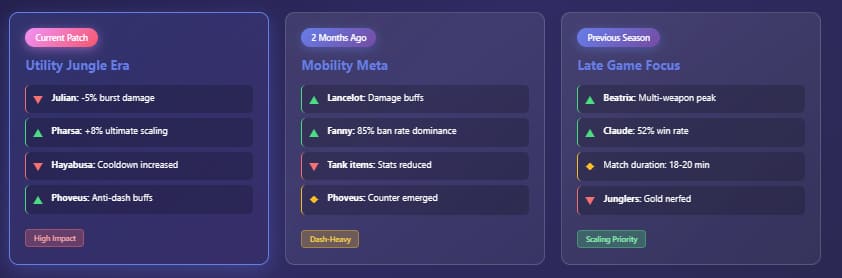
Constructing dominant team compositions requires understanding the current meta's five-role synergy model: utility jungle + tank EXP + control mage + mobile marksman + support roamer. This framework maximizes versatility while ensuring adequate crowd control, damage output, and survivability. The utility jungle position, exemplified by Fredrinn or Balmond, provides consistent initiation and damage absorption rather than pure assassination potential. Tank EXP laners like Edith or Ruby offer secondary frontline presence while disrupting enemy backlines through crowd control chains. Control mages such as Pharsa or Vale dictate team fight positioning, forcing enemies into unfavorable engagements. Mobile marksmen including Kimmy or Beatrix maintain damage output while repositioning against dive threats. Support roamers like Mathilda or Estes enable playmaking through vision control, healing, or damage amplification buffs.
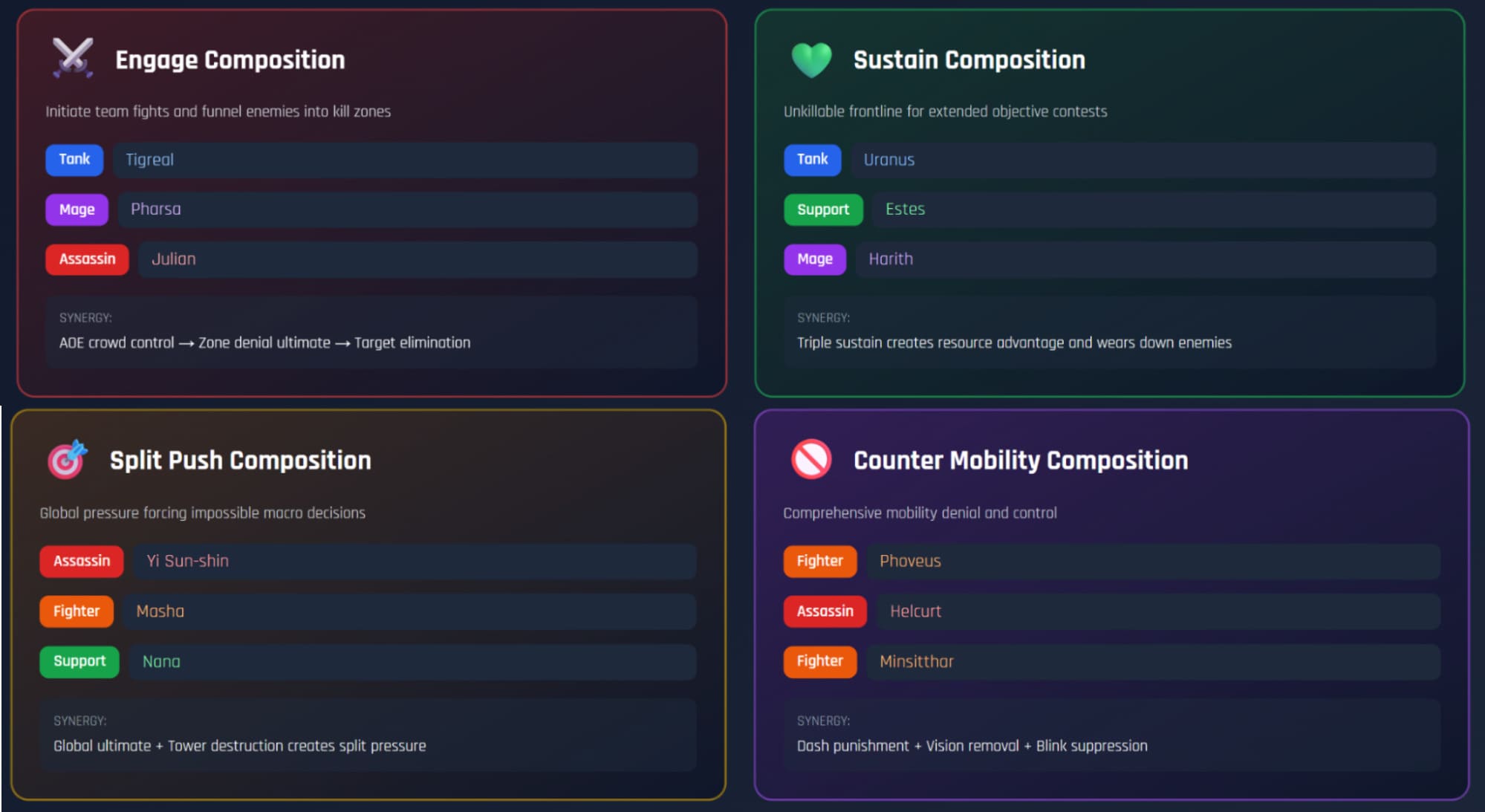
Synergistic Hero Combinations:
- Engage Composition - Tigreal (Tank) + Pharsa (Mage) + Julian (Assassin): Tigreal initiates with AOE crowd control, funneling enemies into Pharsa's ultimate zone while Julian eliminates isolated targets
- Sustain Composition - Uranus (Tank) + Estes (Support) + Harith (Mage): Triple sustain creates unkillable frontline, enabling extended objective contests and wearing down enemy resources
- Split Push Composition - Yi Sun-shin (Assassin) + Masha (Fighter) + Nana (Support): Global ultimate pressure combined with tower-shredding split-push threats forces enemies into impossible macro decisions
- Counter Mobility - Phoveus (Fighter) + Helcurt (Assassin) + Minsitthar (Fighter): Comprehensive mobility denial through dash punishment, vision removal, and blink suppression
Apply your tier list knowledge in competitive scenarios by following Mobile Legends esports tournaments and professional matches on plg.bet, where understanding hero meta and team compositions can significantly enhance your viewing experience.
Draft & Counter Strategy Guide
Professional draft strategy separates elite players from casual competitors, requiring comprehensive understanding of counter pick guide principles and ban phase priorities that can be observed in matches on plg.bet. In mythical glory rank and competitive play, draft decisions account for approximately 40% of match outcomes before gameplay begins. Mastering counter relationships and adaptation strategies enables consistent climbing through understanding matchup fundamentals.
Ban Phase Priority Statistics:
- Julian - 80% ban rate (highest priority): Eliminates the strongest early-game assassin, forcing enemies into less dominant jungle options
- Phoveus - 75% ban rate: Removes primary anti-mobility tool, enabling dash-dependent compositions
- Hayabusa - 70% ban rate: Prevents split-push pressure and late-game assassination threat
- Fredrinn - 68% ban rate: Blocks utility jungle meta, forcing traditional assassin junglers
- Pharsa - 65% ban rate: Opens map control opportunities without facing constant zone denial
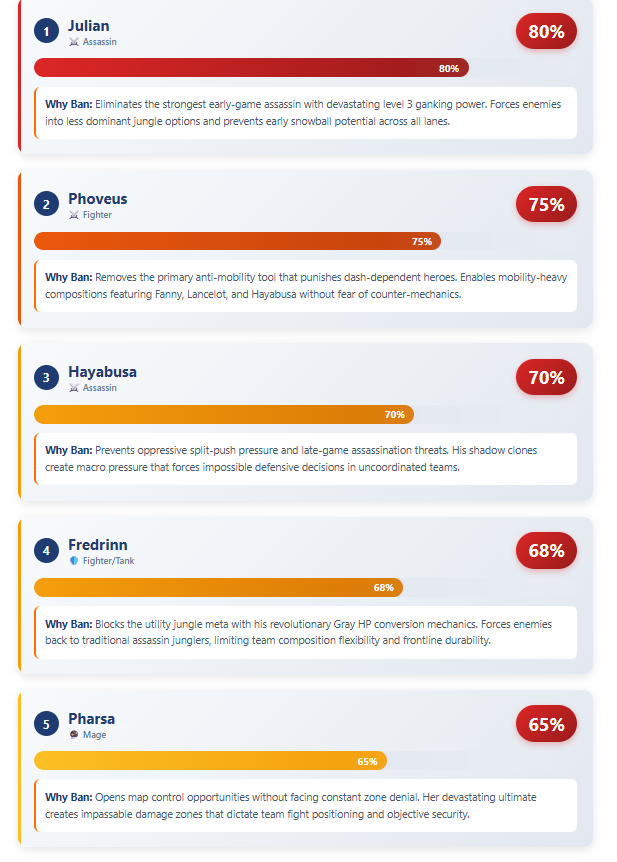
Professional drafting follows a structured approach: first-phase bans target universally dominant champions (Julian, Phoveus) while preserving flexibility for second-phase adaptations. First-pick priority typically secures the most contested remaining S-tier option, often Fredrinn or Yi Sun-shin. Second rotation picks establish role foundations while concealing core strategy elements. Counter-picking emerges during final selections, where identifying enemy win conditions enables targeted disruption through champions like Helcurt against Fanny or Khufra against mobility-based marksmen.
Counter Relationship Matrix:
Adaptation strategies during draft require reading opponent tendencies. If enemies consistently first-pick marksmen, prepare tank counters like Tigreal or Franco. When facing magic-heavy compositions, prioritize magic defense items and fighters with innate spell shields. Understanding these counter relationships transforms draft phase from guesswork into strategic advantage, consistently securing favorable matchups before matches begin.
Solo Queue Climbing & Role Effectiveness
Mastering solo queue heroes and understanding role effectiveness separates consistent climbers from players trapped in rank stagnation. Climbing ranks in Mobile Legends requires selecting champions with high carry potential who minimize dependence on team coordination. The current meta rewards self-sufficient mobile legends heroes capable of creating advantages independently while maintaining flexibility across multiple game scenarios.
Julian dominates solo queue environments through exceptional early game pressure that translates into snowball potential. His ability to secure early kills during level 3 ganks creates gold advantages that compound throughout matches. With proper macro awareness, Julian players consistently achieve 60%+ win rates in solo queue by pressuring all lanes and securing objectives independently. Yi Sun-shin offers similar carry potential through global ultimate presence, enabling map control without requiring team coordination. His split-push threat forces enemy responses, creating opportunities for teammates to secure uncontested objectives.
Kimmy represents the premier marksman for solo queue climbing due to her unique mobility and hybrid damage profile. Unlike traditional marksmen requiring extensive peeling, Kimmy maintains self-sufficiency through kiting mechanics and flexible build paths. Her ability to survive dive attempts while dealing consistent damage makes her ideal for uncoordinated team environments where support is unreliable.
Role Effectiveness Rankings for Solo Queue:
- Jungle (95% impact) - Highest influence on early game momentum and objective control. Utility junglers like Fredrinn provide consistent value regardless of team composition
- Midlane (85% impact) - Control mages like Pharsa dictate team fight outcomes and enable wave control for rotation windows
- Marksman (70% impact) - Mobile carries like Kimmy and Beatrix maintain relevance without requiring excessive team resources
- EXP Lane (65% impact) - Tank fighters like Edith and Ruby provide secondary frontline but rely on team follow-up for maximum effectiveness
- Roamer (50% impact) - Support effectiveness heavily depends on team coordination, making this role least impactful for solo climbing
Role adaptation strategies require identifying team deficiencies during draft. When teams lack initiation, prioritizing tank EXP picks like Fredrinn or Edith compensates for missing frontline. Against poke-heavy compositions, selecting sustain-oriented roamers like Estes or Rafaela enables prolonged objective contests. The current jungle utility dominance stems from versatility—utility junglers provide crowd control, damage absorption, and consistent engagement tools that remain valuable regardless of team coordination quality. EXP tank viability has increased substantially due to side lane gold generation changes, enabling tank fighters to reach relevant item breakpoints while maintaining map pressure.
Meta Trends & Tournament Analysis
Understanding meta predictions and analyzing tournament picks provides crucial insight into competitive viability and seasonal changes affecting hero rankings. The professional scene consistently influences ranked play, with tournament strategies cascading into public matches within 2-3 weeks of major events. Tracking these patterns enables proactive adaptation before meta shifts solidify.
Current meta patterns reveal sustained utility jungle sustainability, with professional teams prioritizing Fredrinn, Balmond, and Aulus over traditional assassin junglers in 73% of tournament matches. This trend reflects game balance philosophy emphasizing team fight sustainability over individual elimination potential. Predicted shifts suggest potential buffs to burst assassins as developers attempt to diversify jungle meta, potentially elevating mobile legends heroes like Lancelot or Hayabusa back into S-tier consideration.
Tournament picks demonstrate significant deviation from ranked meta preferences. While Julian maintains 80% ban priority in ranked queues, professional play exhibits only 45% ban rate, indicating confidence in counter-draft strategies unavailable to uncoordinated teams. Conversely, heroes like Khufra and Atlas receive elevated tournament priority (65% pick/ban) despite moderate ranked presence (40%), reflecting their value in coordinated engage compositions.
Professional influence on meta adoption operates through content creator dissemination and high-rank player experimentation. After M5 World Championship showcased Fredrinn's utility jungle dominance, his ranked pick rate increased 34% within two weeks. Similarly, tournament success with uncommon picks like Aulus jungle sparked experimentation that elevated his tier ranking from B to A-tier. Understanding this influence cycle enables players to anticipate upcoming meta shifts by monitoring professional tournaments and identifying emerging strategies before widespread adoption creates ban-phase competition.
Seasonal changes typically occur quarterly, aligning with major patches introducing item adjustments, hero releases, and balance modifications. The current season emphasizes early-to-mid game impact, with average match durations decreasing to 14-16 minutes. This temporal shift favors snowball-oriented heroes with strong level 4-8 power spikes, explaining Julian and Fredrinn's meta dominance.
Conclusion
This comprehensive mobile legends guide establishes clear tier classifications enabling informed hero selection across all competitive scenarios. S-tier champions like Julian, Fredrinn, and Pharsa dominate through exceptional versatility and statistical superiority, while A-tier options provide reliable alternatives when premier picks are unavailable. Understanding counter relationships, team composition synergies, and role effectiveness maximizes your tier list summary application in real matches.
Actionable Hero Selection Framework: Master 2-3 heroes from different tiers within your preferred role, ensuring draft flexibility regardless of ban phase outcomes. Prioritize comfort picks over meta slaves—a mastered A-tier champion consistently outperforms an unfamiliar S-tier option. Apply this tier list knowledge immediately in your next ranked session, focusing on draft adaptation and counter-pick strategies to achieve consistent ranking improvement through informed hero selection and strategic decision-making.