Ramp, Lobby, Garage, Secret, Silo, Room. If these words mean nothing to you right now, that is about to change. Nuke's vertical layout punishes vague comms harder than any other CS2 map. Knowing every callout is what separates a clean rotation from a lost round.
Once you learn the different CS2 Nuke callouts, your communication with teammates reaches a whole new level. During your matches, you'll exchange messages with them like a real pro. That kind of coordination also pays off if you follow the pro scene. It also sharpens your reads for CS2 esports bets on your favorite squads.
These callouts remain consistent from CS:GO to CS2, so they stay valuable for players transitioning between versions.
What are Nuke Callouts in CS2?
Imagine a map of your city with the names of streets, squares, monuments, and landmarks. Callouts do the same for a Counter-Strike map. Players use them to represent different positions on Nuke. For example, Lobby marks the large room in front of T Spawn that Terrorists cross on the way to A Site or Ramp.
You may have a question: why do you need to use callouts to mark key positions on the map? There are several reasons. First, they are convenient. It is much easier to say something like Ramp or T Spawn than to describe the objects you see at your current position.
Second, Nuke callouts unify communication between players. Once you know their meaning, it doesn't matter which country the gamer lives in. Callouts like Hut, Dark, or Big Box will be understood by any player, anywhere.
Counter-Strike 2 and Nuke Evolution
Counter-Strike 2, released on September 27, 2023 as the successor to CS:GO, maintains Nuke's iconic layout and callout system. Counter-Strike 2 map updates include improved lighting, higher resolution textures, and enhanced particle effects powered by the Source 2 engine. The 2016 CS:GO Nuke redesign under Operation Wildfire established most current callouts that Counter-Strike 2 preserves.
While graphics improved dramatically, callout positions remain functionally identical in the CS:GO vs CS2 comparison. Players transitioning from CS:GO recognize all major callouts immediately. Even the original CS 1.6 Nuke shares a similar core structure, and this Nuke evolution has kept naming conventions stable. Callout knowledge transfers directly between versions, so no relearning is required for Counter-Strike 2 play at PLG.bet.
CS2 Update: Good news for CS:GO players: all Nuke callouts remain the same in CS2!
General Nuke Blueprints
Nuke is a popular map where the Terrorist team tries to plant bombs in 2 places: the A Site and B Site. The Counter-Terrorists seek to thwart their enemies in every way possible. If you have played Counter-Strike for at least 5-10 hours, you should be well aware of this game mechanic.
Although Nuke is not a huge map, it packs many callouts. Lower-level players often get confused about them, and some beginners don't even know they exist. Either way, you must learn all the callouts if you want to play at an average or pro level. The following map will help you do this.
Nuke's Unique Vertical Layout
Nuke is unique among competitive CS2 maps because A Site sits directly above B Site. This multi-level layout defines the Nuke map structure, and the CS:GO 2016 redesign refined its vertical map design. Rotation timing runs roughly 8-10 seconds from A to B through vents and 12-15 seconds via outside routes. Audio cues become critical because hearing enemies above or below often decides rounds.
Clear callouts are essential because teammates cannot visually see which level you are describing. Multiple vertical paths (vents, ramp, heaven, hell) create complex rotation options. The map requires different strategies for T and CT sides, sharpening the value of precise position calls. Unlike Dust2 or Mirage, Nuke stacks bombsites on top of each other, so learning all callout names is non-negotiable.
Pro Tip: On Nuke, always specify "upper" or "lower" when calling positions near vents or ramp.
Nuke Callout Map
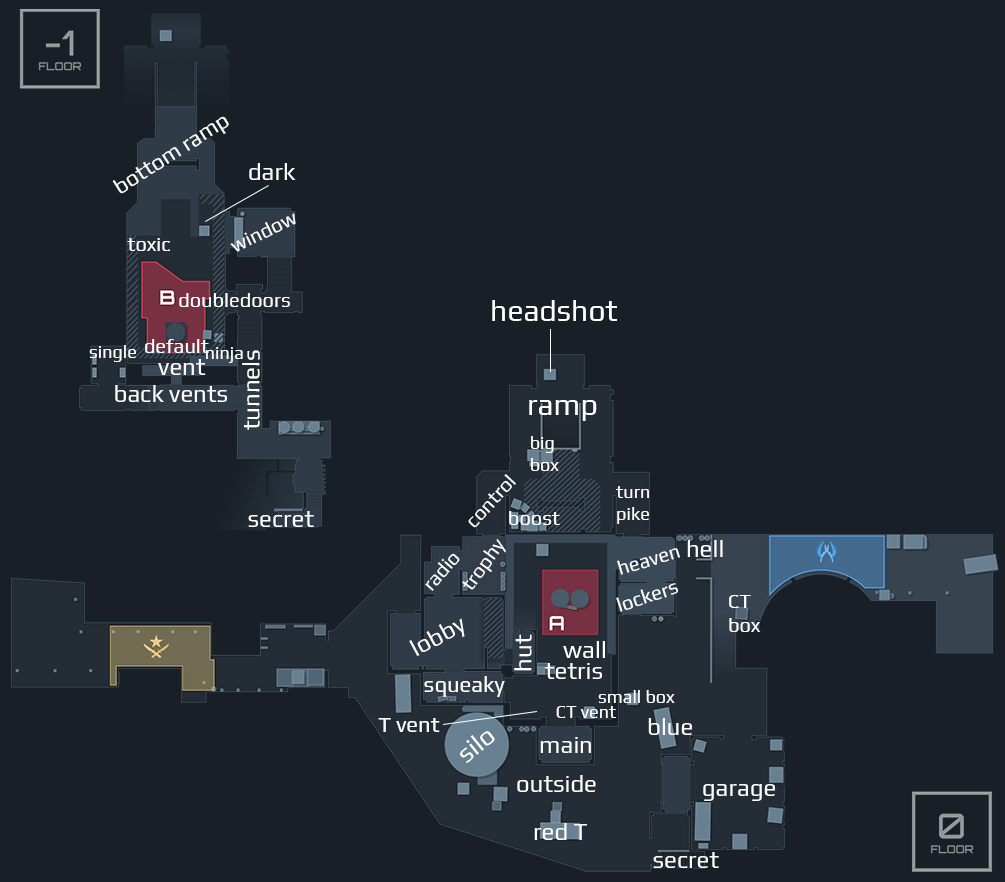
Don't be put off by the sheer number of Nuke callouts. You don't have to learn them all at once. Right now, it is much more important for you to know their names and read their brief descriptions. This is what we suggest you do.
CS2's visual improvements affect how you read the map without changing any callout locations. Dynamic shadows make certain positions like Dark and Toxic darker while improving overall visibility elsewhere. Higher resolution textures help identify positions faster, and volumetric lighting through windows changes how Outside and Lobby feel visually.
CS2's dynamic smoke grenades behave more realistically, affecting positions like Ramp and Heaven where smokes are commonly deployed. These CS2 Nuke visuals count as map design changes at the fidelity level. They do not alter callout locations or names. Improved visual fidelity actually makes it easier for new players to identify and remember callout positions.
Nuke Callouts CS2 Overview
The callouts below cover every key position on Nuke, broken down by area. Read the descriptions once, then reference them during your first few matches until the names click.
T-Spawn and Outside
- T Spawn is the point on the map where the Terrorist team starts the battle. If you often play as them, you'll easily remember where the T Spawn is located. From the T Spawn you'll try to get to the A Site or B Site to plant the bomb.
- T Roof is located above the Lobby. To reach this roof, find the ladder near the Terrorists' base. You won't miss this ladder if you look around carefully.
- Silo (also Marshmallow or Twinkie) is a large white cylindrical tank near T Spawn. It sits not far from the roof and gives Ts a lookout over Outside.
- T Red is a position located a short distance from the Silo. Its name comes from the red container you can see there.
- Outside is the area near the T Red.
- Secret is the point on the Nuke map that indicates the stairs leading down. Go down these stairs and you'll reach the B Site soon.
- Garage is one of the Nuke positions whose purpose is clear from its name. This is a large garage that you'll find right at the entrance to the Secret.
- Blue is a blue box at the bottom right of the map.
- Small Box sits near the Blue, Main, and CT Vent.
- CT Box is near the CT Spawn. It belongs to the key positions usually controlled by snipers.
CT-Spawn and A Plant
- CT Spawn is the Counter-Terrorists' spawn zone on Nuke, like on other maps. The CT Box we talked about above is just around the corner from CT Spawn. If you wish, you can take this position as soon as you can control your character.
- Hell and Heaven are 2 positions next to each other. The first sits under the second. Many players think Hell is a good spot to protect a building with a nuclear block.
- Heaven is a spot above the A Site.
- Lockers identifies a small room near the stairs you can use to reach Heaven. This small room has lockers with blue doors, which is where the name comes from.
- Main is the entrance you can use to access the A Site.
- Vent gives you the opportunity to access the level under the A Site.
- Tetris is the area near the A Site named after the 3 boxes stacked there. One of them sits on top of the other. Climb these boxes and you'll get to the Hut.
- Mustang is at the top of the A Site. It sits in the corner next to the Hut exit.
- Rafters is a platform running along the back wall of the A Site where the Terrorists aim to plant one of their bombs.
- Hut is a small building near the A Site. Experienced CS2 players call it Hut without any further explanation. The Terrorists often appear from this small building to take control of the bomb site.
Lobby and Ramp
- Turn Pike is a room near the Ramp.
- Stack appears when you're in the Ramp area. Find the boxes in the lower right corner. Those boxes are called the Stack.
- Boost refers to the boxes in the lower left corner of the Ramp area.
- Big Box gets its name for an obvious reason. Callouts like this are easy to remember.
- Ramp is the name of the area leading down to the B Site.
- Headshot (or Back Ramp) is a position you reach by moving towards the back of the Ramp.
- Lobby connects different positions that let you reach some important spots on the map: the Ramp and the A Site.
- Squeaky sits near the Lobby. Its distinctive door sound tells the whole enemy team when someone opens it, so it doubles as a sound cue.
- Radio is a room past the Lobby that leads towards the Ramp.
- Trophy is the room you end up in after passing through the Radio.
- Control Room is the last location you need to get through to reach the Ramp. Its short name is Control.
B Cross and B Plant
- Tunnels is a location with rather narrow passages. You enter the Tunnels from the Secret.
- Vents connect the Tunnels and the B Site.
- Back Vents is a passage that takes you to the Decon.
- Decon is the location where you arrive right after the Back Vents. Once you're there, you'll find a door. This door precedes the path to the B Site.
- Double Doors is an entrance that leads to the B Site. To get to this entrance, you have to go through the Tunnels. Just picture a doorway with an orange door on the left and an identical one on the right. Together they form double doors.
- Window is a room that follows the Double Doors. You can see a couple of windows here, which explains the name.
- Dark means the position behind the red boxes with stickers that warn of radiation danger. Move to one of the extreme points of the B Site to hide in the Dark.
- Toxic is the place where the Terrorists plant C4 explosives. They first reach the B Site and then proceed to its upper left corner.
- Default callout marks a location for C4 explosives. This spot sits behind the nuclear reactor, which is one of the objects of the B Site.
- Bottom Ramp identifies 2 exits that lead to the B Site.
Other Important Callouts
- Bridge is the position to the right of the A Site.
- Vending Room is the room with the vending machines near the Trophy.
- CT Red is a container at the Outside.
CS2 Callout Changes and Continuity
All major CS2 Nuke callouts remain identical to CS:GO, including Ramp, Heaven, Hell, Outside, and Silo. Minor visual changes to some areas have not spawned any real callout differences. The community has kept consistent terminology across the transition. T Spawn, CT Spawn, Ramp, and Heaven remain unchanged in usage and function.
Some updated positions look slightly different visually but retain the same names and tactical roles. Players can use CS:GO callout guides for CS2 Nuke callouts without confusion. Any new callouts that emerge in play will likely be site-specific variations rather than full replacements.
CS2 Note: Transitioning from CS:GO? You're good to go. All Nuke callouts work exactly the same.
Weapon-Specific Strategies for Key Callouts
Weapon selection influences how you approach different areas of Nuke, and this Nuke weapon strategy shapes every round. Your weapon also determines optimal engagement distances on the map, from long AWP holds to close SMG pushes. Match knowledge like this sharpens your reads for CS2 competitive betting too.
Outside rewards AWP and sniper rifles at CT Box and T Red. Long sightlines favor precision weapons, and strong AWP positions like CT Box hold the angle toward Silo and Garage. Ramp control favors SMGs like the MP9 and MP7. Close-quarters combat and tight angles make spray weapons effective, and SMGs suit force-buy rounds economically.
A Site (Heaven and Rafters) favors rifles like the M4A4 and AK-47, some of the best weapons for Nuke. Holding crossfire positions from Heaven and Hut gives defenders a strong edge. B Site (Vents and Decon) rewards SMGs and shotguns in tight vent pushes. Rifles handle post-plant angles from Toxic and Dark.
On CT defense, key AWP positions include Heaven for A and Window for B. On T side, buy rifles for site takes and use SMGs on anti-eco rounds. CS2's improved smokes also let AWPers shoot through smoke edges more predictably than in CS:GO, opening new weapon economy plays.
Strategy Note: AWP players: prioritize CT Box and Heaven positions for maximum map control.
Conclusion
To gain an advantage over your online rivals, you must learn the callouts for all the CS2 maps. Nuke is a great choice to start with. It is not very big, and it is easy to navigate.
Once you learn all the callouts, chatting with your teammates gets much easier. You can replace whole phrases with 2-3 words. That is a huge advantage during any match. With Counter-Strike 2's release, these callouts remain as relevant as ever. They give you a competitive edge in ranked matches and tournaments.