
Aaron Rodgers is the oldest current NFL player in 2025. At 41 years old, the Pittsburgh Steelers quarterback returns from a 2024 torn Achilles and steps into his 21st NFL season with the kind of track record that shapes odds and narratives. The four-time NFL MVP brings 59,000+ passing yards, a Super Bowl XLV ring, and a reputation for late-game precision that still moves betting lines. For fans and bettors alike, Aaron Rodgers age isn’t just trivia — it’s a case study in quarterback longevity.
The headline facts are straightforward: Rodgers is the oldest active NFL player, he’s playing for Pittsburgh on an Aaron Rodgers contract 2025 valued at $13.65 million, and he remains healthy after his Achilles rehab. But the bigger story is how he fits into NFL age records and where he sits on the timeline stretching from George Blanda to Tom Brady — and how modern training, recovery, and modern sports medicine keep veterans productive in their 40s. This season, Rodgers isn’t simply hanging on; he’s anchoring a young roster and illustrating how elite decision-making can extend prime years well beyond the league average.
Top 10 Oldest NFL Players in History
Longevity in the NFL isn’t evenly distributed. Quarterbacks, kickers, punters, and certain specialists turn experience into years, while high-collision roles face steeper attrition. Here’s the historical context that frames Rodgers’ 2025 season.
Top 10 Oldest NFL Players Ever (All-Time)
| Rank | Player | Age at Retirement | Position | Years Active | Teams | Championships / Notes |
|---|---|---|---|---|---|---|
| 1 | George Blanda | 48 years, 109 days | QB/K | 26 | Bears, Oilers, Raiders | George Blanda age 48 record; dual-position icon |
| 2 | Adam Vinatieri | 47 | K | 24 | Patriots, Colts | Adam Vinatieri 47; 4 Super Bowls; oldest NFL kicker case |
| 3 | Tom Brady | 45 | QB | 23 | Patriots, Buccaneers | Tom Brady 45; 7 Super Bowls; Tom Brady retirement age benchmark |
| 4 | Jeff Feagles | 45 | P | 22 | Giants, Seahawks, others | Jeff Feagles punter; 352 games; punter longevity archetype |
| 5 | Warren Moon | 44 | QB | 17 (NFL) | Oilers, Vikings, others | Warren Moon 44; Hall of Fame players |
| 6 | Jerry Rice | 42 | WR | 20 | 49ers, Raiders, Seahawks | Jerry Rice retirement age 42; Super Bowl champion quarterbacks rivaled by WR longevity outlier |
| 7 | Morten Andersen | 47 | K | 25 | Saints, Falcons, others | 382 games (record-holder note) |
| 8 | Brett Favre | 41 | QB | 20 | Packers, Jets, Vikings | Brett Favre retirement age 41 |
| 9 | Eli Manning | 39 | QB | 16 | Giants | Eli Manning retirement at 39 |
| 10 | Joe Montana | 38 | QB | 16 | 49ers, Chiefs | Joe Montana retirement age 38 |
Why it matters for bettors: This table reveals clear NFL position longevity patterns. Specialists and smart-pocket QBs persist. When you analyze NFL player retirement trends, age alone isn’t the story — role, usage, and health profile are.
Current Active NFL Players Over 40 in 2025
Only a handful of pros crack 40 — and each brings matchup-specific value. Knowing who they are and how they’re used helps frame NFL betting insights age analytics for props and sides.
Current 40+ (and Near-40) Veterans
Understanding which active NFL players over 40 are actually logging snaps is crucial. Workloads, short-yardage packages, and special-teams usage influence hit rates on player props. Tracking these veteran players throughout the year can uncover efficiency trends.
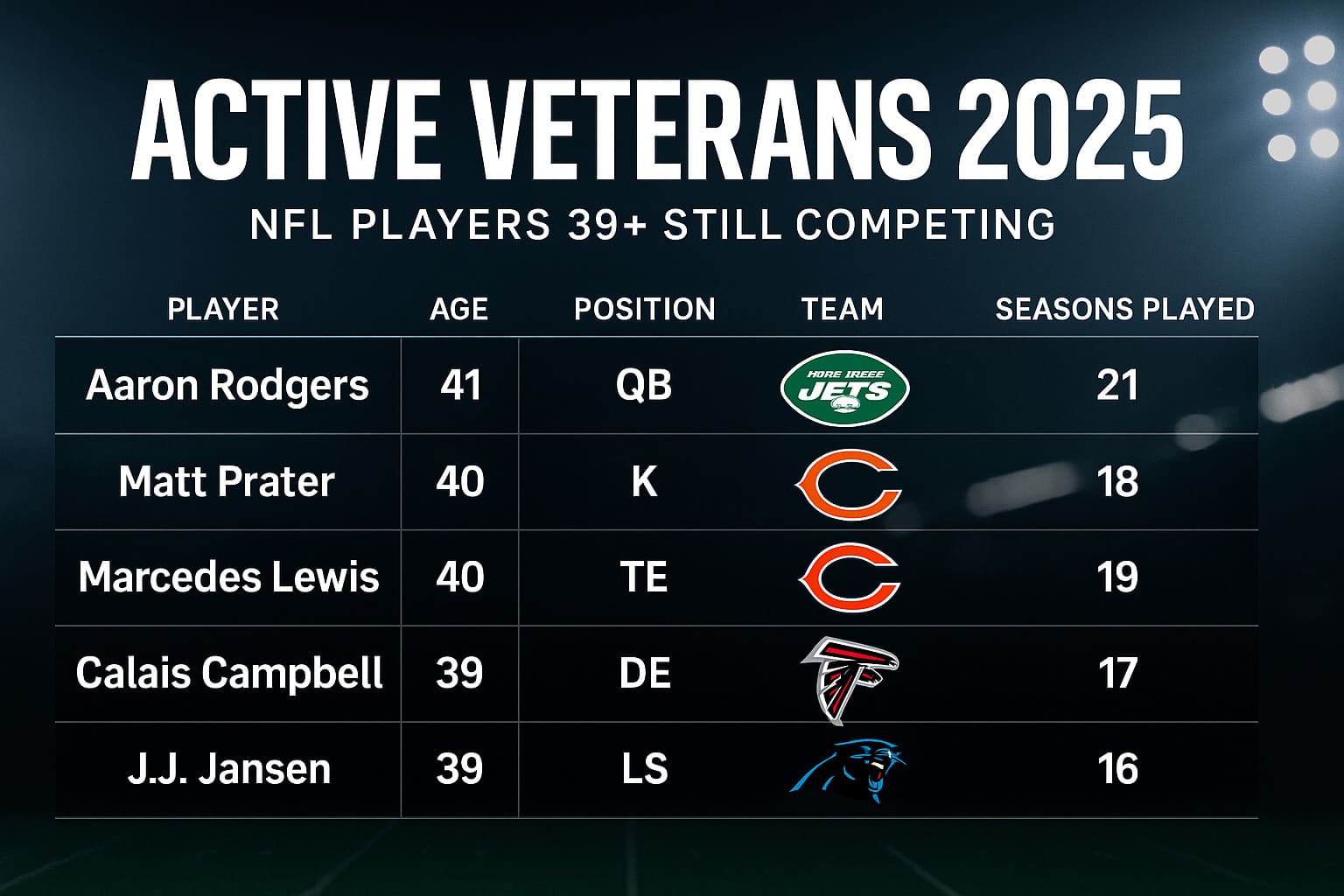
Follow the oldest NFL players’ performances and leverage age-based analytics for smarter decisions on plg.bet.
Oldest active player comparison
Rodgers (41) leads the list, with Matt Prater 40 and Marcedes Lewis 40 next in line. On defense, Calais Campbell 39 exemplifies rare durability for a high-impact role.
Aaron Rodgers – 41-Year-Old Steelers QB
Rodgers’ arc in 2025 blends recovery and leadership. As a 41 year old quarterback, he pairs elite processing speed with timing routes that minimize hits. Aaron Rodgers Pittsburgh Steelers is more than a headline; it’s a strategic fit for a young, ascending roster. He returns from an Aaron Rodgers torn Achilles suffered in 2024, and his Aaron Rodgers passing yards total — now 59,000+ — cements his place among all-time leaders. Add Aaron Rodgers MVP awards (four), Aaron Rodgers Super Bowl XLV, and an Aaron Rodgers contract 2025 worth $13.65 million, and you get a living case study in sustained excellence.
From a quarterback longevity perspective, Rodgers demonstrates how pre-snap diagnostics, pocket footwork, and surgical accuracy extend careers. For handicappers, sustained yards-per-attempt efficiency and red-zone turnover avoidance remain the telltales to watch.
Matt Prater – 40-Year-Old Record-Setting Kicker
Prater is the classic oldest NFL specialist profile: low contact, high repetition, tight technique. His 64-yard field goal from 2013 still resonates, and the Arizona Cardinals trust his leg at volume. He’s a blueprint for kicker career length pushing toward the mid-40s, and a reminder that late-season weather, altitude, and dome splits can move kicking props by whole points.
Calais Campbell – Approaching 40 as a Defensive Legend
For defensive player careers, Campbell is a rare long-tenured outlier. A Walter Payton Man of the Year honoree and member of the 100-sack club, he’s back in Arizona as a tone-setter and situational pass rusher. His usage illustrates a vital betting concept: older defenders who rotate snaps but specialize in high-leverage downs can remain efficient per play, even as total volume dips.
Marcedes Lewis and the Oldest NFL Specialists
Lewis owns the most seasons by a tight end and exemplifies trench savvy — hand placement, leverage, and route nuance age well. Alongside long snappers like J.J. Jansen, Jon Weeks, and Morgan Cox, Lewis highlights how specialists defy the league’s average. In the macro view of NFL career longevity, these roles underscore the gap between high-impact positions and technique-first jobs.
NFL Career Length and Retirement Age by Position
The league-wide average masks critical differences by role. That matters for prop expectations, roster forecasting, and season-long wagering angles.
Position Longevity Snapshot
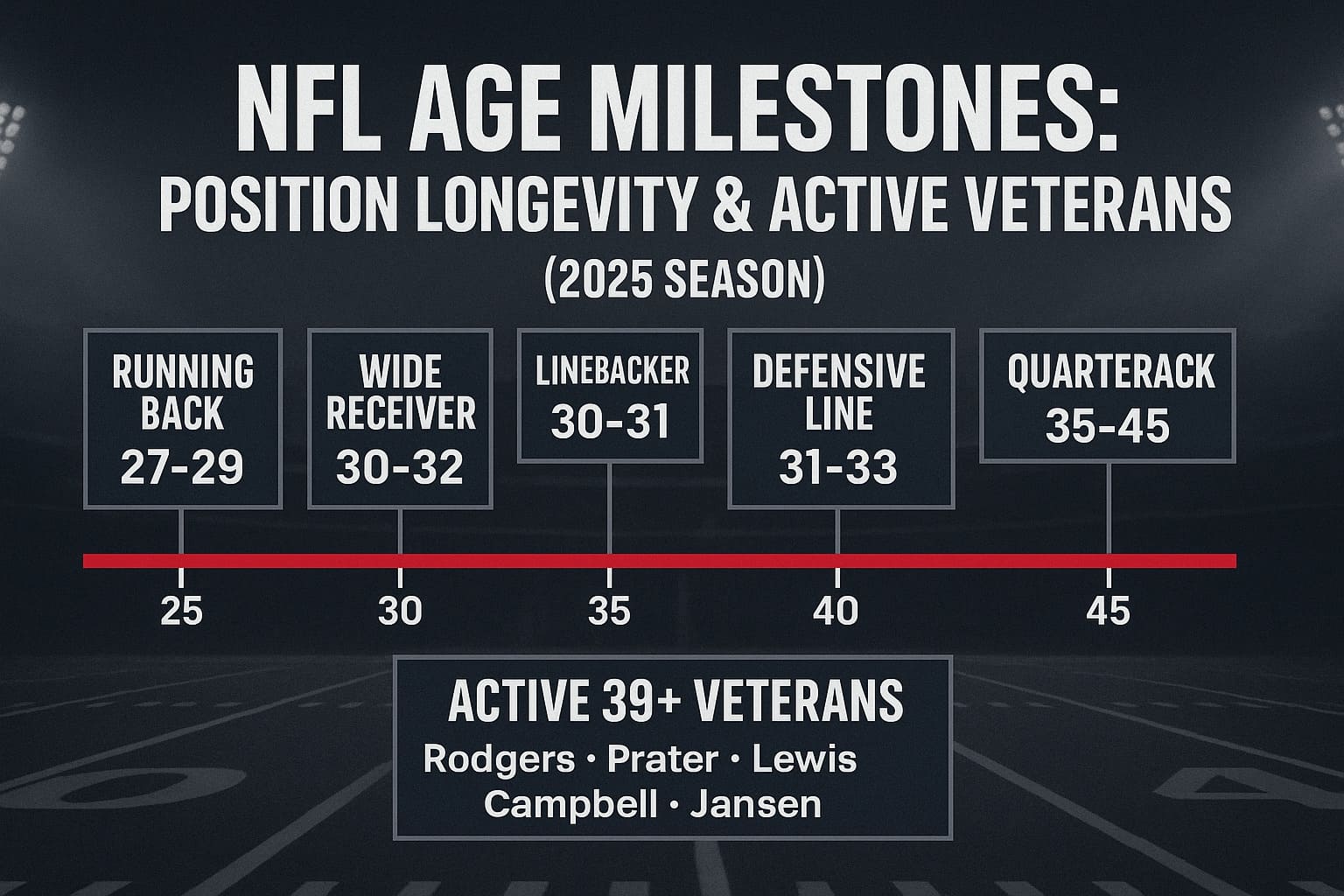
These figures outline retirement age by position, reveal NFL position longevity, and frame NFL player retirement trends that inform futures and props markets.
Why Quarterbacks Play Longer Than Most Positions
The QB job rewards cognition as much as physicality. Film-based anticipation, hot-route control, and pocket economy reduce hits and widen QB prime years beyond pure athletic arcs. While the average NFL career length sits just above three seasons, elite passers can thrive for 15-plus. Super Bowl champion quarterbacks like Brady and Rodgers offer the model: elite in structure, careful in chaos, and relentlessly prepared.
Rule evolution also matters. Over two decades, QB protection updates — combined with modern sports medicine — have shifted the curve, allowing high-end operators to compete into their early and even mid-40s. In age modeling, the peak NFL age for quarterbacks centers between 28–34; after that, sharp drop-offs are less about arm talent and more about injury accumulation and mobility loss. Rodgers’ late-30s efficiency and now age-41 return test — and extend — that curve.
Kicker and Specialist Longevity Advantages
Kicking and punting emphasize repeatable mechanics and mental resilience. That’s why kicker career length often exceeds a decade and why punter longevity yields 20-year résюmés like Jeff Feagles punter or the 25-year arc of Morten Andersen. Minimal contact and technique-driven improvement support production well into the 40s. For bettors, this means older specialists can offer stable baselines even as skill positions fluctuate.
Average Retirement Ages for Skill and Defensive Positions
On the other end, running backs and receivers face relentless deceleration forces — hits, high-speed cuts, hamstring cycles — pulling average careers below four years. Defensive linemen and linebackers live in traffic, where leverage wars create chronic wear. Outliers exist — Jerry Rice retirement age at 42 is the most famous — but they prove the rule more than they break it.
Notable Recent NFL Retirements and Age Analysis
Retirements cluster by position and context. Some legends leave in their prime; others climb the longevity charts.
Legendary Quarterbacks and Their Retirement Ages
| Player | Age at Retirement | Career Length | Rings |
|---|---|---|---|
| Brett Favre retirement age | 41 | 20 seasons | 1 |
| Joe Montana retirement age | 38 | 16 seasons | 4 |
| Eli Manning retirement | 39 | 16 seasons | 2 |
These exits shaped expectations for the modern era — paving the way for Tom Brady retirement age at 45 and Rodgers at 41 still playing.
Prime-Age Retirements: Donald, Gronkowski, Luck
Aaron Donald retirement age was 32 — an elite defender stepping away at the height of his powers. Rob Gronkowski retire age 33 and Andrew Luck retire age 29 highlight another path: prioritizing long-term health. These choices influence how we interpret NFL player retirement trends across positions.
Oldest vs Youngest: NFL Age Extremes and Records
NFL age extremes define the spectrum. On one end, Rodgers is the oldest active NFL player; on the other, rookies arrive barely out of college. The youngest NFL player in a given season can be just 20 or 21, reminding us the league is simultaneously a youth pipeline and a longevity challenge.
| Category | Player / Example | Age | Context |
|---|---|---|---|
| Oldest current NFL player | Aaron Rodgers | 41 | Steelers QB; 21st season |
| Oldest NFL player ever | George Blanda | 48 | All-time record; QB/K dual role |
| Oldest NFL quarterback | Tom Brady (modern benchmark) | 45 | Set the recent QB age standard |
| Oldest NFL specialist | Adam Vinatieri | 47 | Kicker with 4 Super Bowls |
| Youngest NFL player | Various rookies | 20–21 | Early entries, raw upside |
NFL maximum age limit? There isn’t one. Teams sign whoever performs. And so far, no 50 year old NFL players have ever taken the field; Blanda’s 48 remains the frontier. For preview models and oldest active player comparison, Rodgers vs the field holds in 2025.
The Evolution of NFL Player Longevity
From film rooms to force plates, modern sports medicine has reshaped how long stars can thrive. Sleep tracking, individualized nutrition, and soft-tissue prehab reduce missed games, while rule emphasis on QB protection boosts quarterback longevity. Rodgers’ Achilles comeback is a live demonstration: with targeted rehab and movement efficiency, late-30s skill sets can scale into the 40s.
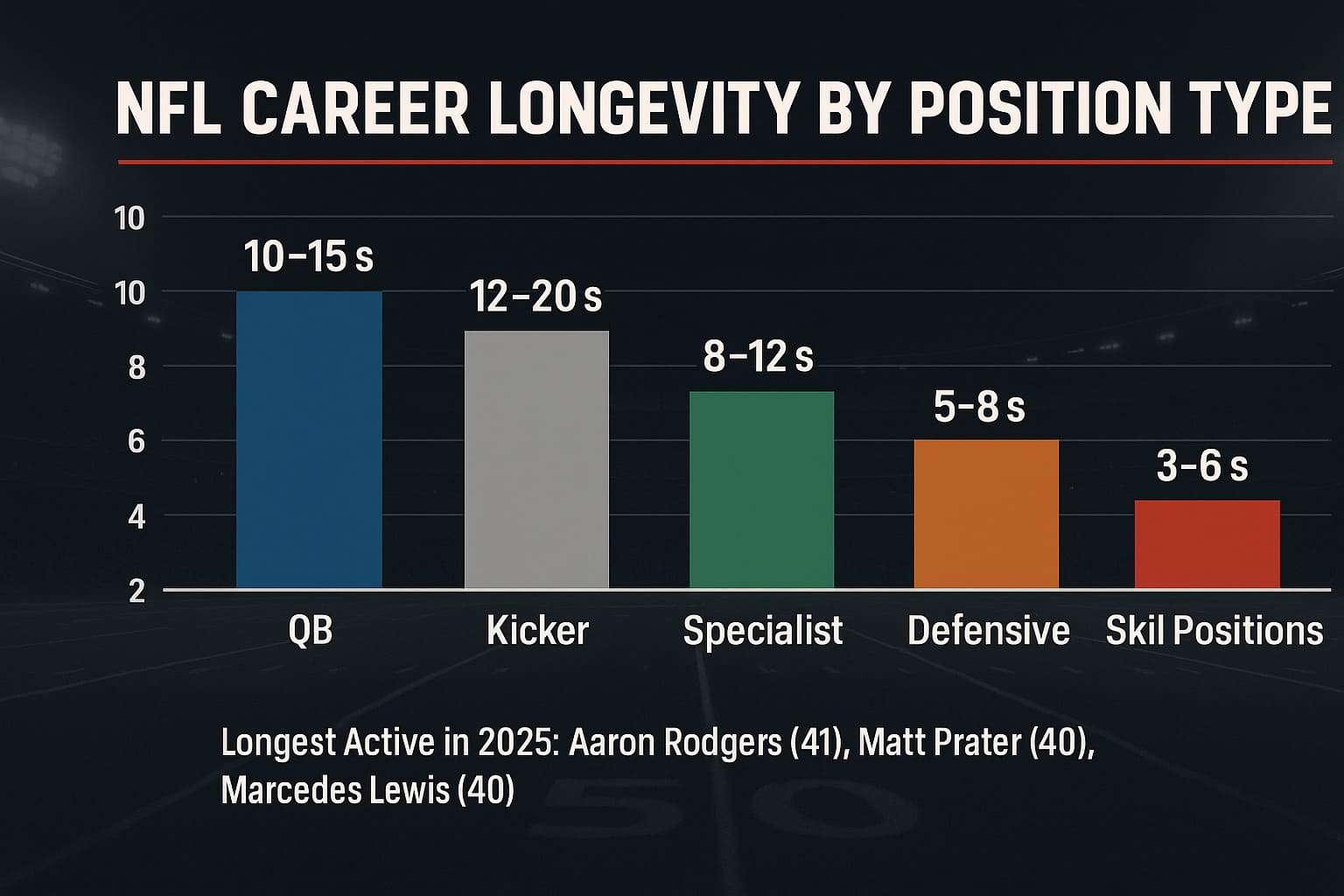
Zoom out, and player age trends show more veterans extending careers at low-impact positions and a handful of elite QBs pushing the envelope. For handicappers, this intersects with NFL betting insights age analytics — age curves inform snap projections, injury probabilities, and pricing for NFL 40+ players on props. Keep an eye on 2025 NFL roster veterans lists during the season; attrition and late signings can open value pockets.
FAQs: NFL Player Age and Retirement Questions
Who holds the record as the oldest NFL player ever?
Are there any active NFL players over 40 years old?
Why do NFL kickers play longer than other positions?
How does Aaron Rodgers compare to Tom Brady's retirement age?
What is the average NFL career length?
Has anyone ever played in the NFL at 50 years old?
Is Aaron Rodgers or Joe Flacco older?
Is there a maximum age limit for the NFL?
Conclusion: The Evolution of Longevity and What It Means for 2025
The data is clear: NFL career longevity depends on position, health profile, and how efficiently a player translates experience into on-field value. Rodgers — now the oldest active NFL player — embodies the convergence of preparation, protection rules, and modern sports medicine. From George Blanda to Tom Brady, the roadmap is there; 2025 adds a fresh chapter in Pittsburgh, where the Pittsburgh Steelers quarterback turns age into an advantage.
As we track NFL age extremes through the year — young rookies rising, 2025 NFL roster veterans pushing history — the smart approach is to blend context with numbers. That’s how you recognize value, whether you’re debating Super Bowl champion quarterbacks legacies or weighing the next prop. For analytical edges grounded in age curves and usage trends, keep your models current — and your eyes on the oldest man still dealing from the pocket in Pittsburgh.