

Return to Player (RTP) is the first number gamblers should check before picking a casino game. RTP tells you the theoretical percentage of wagered money a casino game returns to players over millions of rounds. A slot with a 96% RTP, played long enough, returns $96 for every $100 wagered on average.
The figure is required disclosure in most regulated markets and sits at the heart of every house edge calculation. We have tracked RTP disclosures across hundreds of slots and table games, and the number remains the cleanest proxy for how much a game will cost over time. A working grasp of RTP changes how you pick games, size bets, and read bonus offers.
Key takeaways:
- RTP is the theoretical return to the player, expressed as a percentage.
- Online slots typically sit between 92% and 98% RTP.
- House edge mirrors RTP: House Edge equals 100% minus RTP.
- RTP describes long-term averages, not single sessions.
- Independent testing labs verify every regulated game's RTP before launch.
The Definition and Basics of RTP
RTP is a statistical measure of theoretical payback. The figure represents the percentage of total wagers a casino game pays back to players across millions of simulated rounds. The industry uses three terms for the same calculation: payout percentage, theoretical return, and Return to Player.
Regulated operators in markets like the UK, Malta, and Sweden must display the RTP for every game they offer. The UK Gambling Commission's testing strategy requires simulation-based verification before any game reaches the public.
The RTP calculation assumes a sample of millions of game rounds. On a single spin or a single session, actual results can deviate wildly from the stated percentage. Most online casino games publish RTPs between 92% and 99%, with slot machines averaging lower and table games averaging higher.
Key components of an RTP figure:
- A theoretical value derived from mathematical simulation, not observed results.
- Sample size covers millions of game rounds, not individual sessions.
- Independent testing laboratories verify the figure before game certification.
- Game providers lock RTP inside the math model; operators cannot alter it.
How RTP Is Calculated
RTP equals total prize money divided by total money wagered, multiplied by 100. A slot that pays out $980,000 from $1,000,000 wagered has a 98% RTP. Game developers build the figure through mathematical simulation, modeling every possible outcome weighted by its probability rather than observing live play.
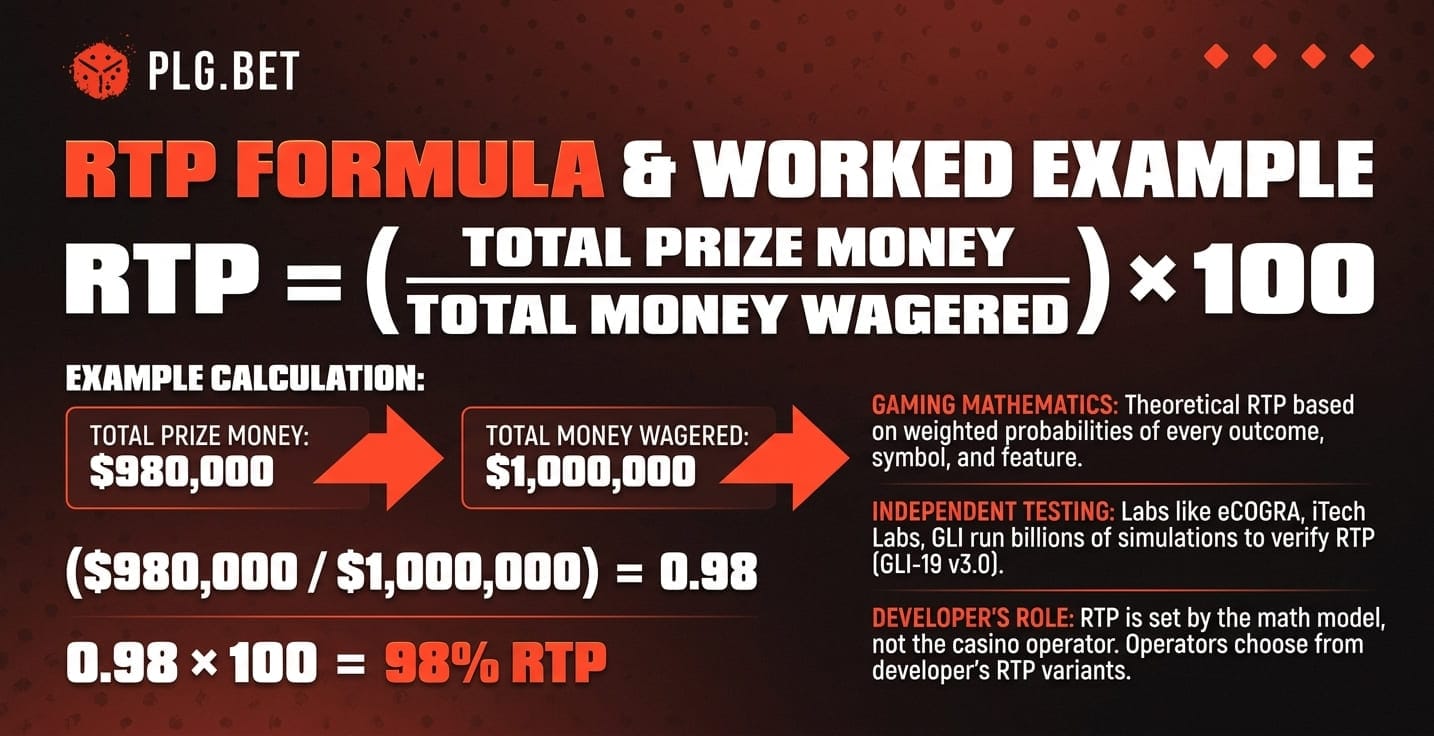
Independent testing laboratories verify the result before a game launches. The UK Gambling Commission requires every licensed game to be tested by an approved lab such as eCOGRA, iTech Labs, or Gaming Laboratories International (GLI).
Under GLI-19 v3.0, the interactive gaming standard, labs run billions of simulated rounds and confirm that the actual RTP falls within an acceptable range of the expected RTP, with the range set by each game's volatility profile.
One nuance matters: the RTP is set by the math model, not the casino operator. Some slots offer RTP variants, for example a 96% and a 94% version of the same game, and the operator chooses which variant to license.
How Game Complexity Affects RTP
Game design choices change where the RTP lands, even when the headline figure stays the same. Modern slots pack feature rounds, free spins, multipliers, and bonus buys into their math models. Each feature receives a portion of the total RTP allocation, and the base game on its own usually returns well below the advertised figure.
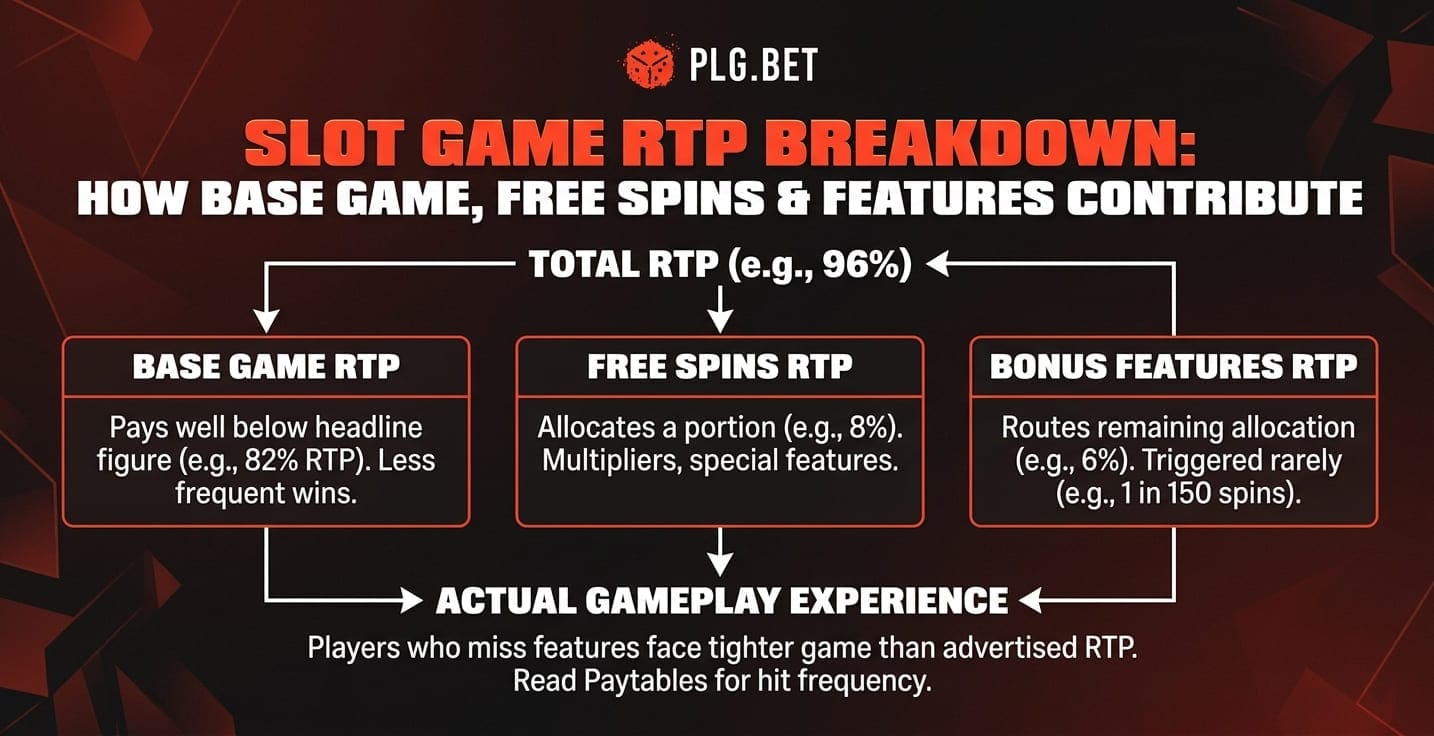
A 96% RTP slot might pay 82% in the base game. The remaining 14% routes through a bonus round triggered roughly once every 150 spins. Players who never hit the bonus during a session face a tighter game than the headline number suggests. Paytables disclose feature hit frequency, and a quick read of the help screen is the only reliable way to see how a game actually pays.
Why RTP Matters to Players
RTP sets the mathematical cost of playing a game. At 98% RTP, players lose about $2 per $100 wagered on average. At 92% RTP, the average cost climbs to $8 per $100. Over thousands of spins, the gap compounds into real money.
Gambling odds are the practical expression of RTP. Every bet carries an implied probability of return; RTP aggregates those probabilities across every possible outcome in the game. Expected value, the mathematical product of probability and payout, is the decision input that turns an abstract percentage into a concrete per-bet figure.
A worked example shows the effect on bankroll. A player wagering $1 per spin across 1,000 spins puts $1,000 through the game. At 98% RTP, the expected loss is $20. At 92% RTP, the expected loss is $80, and a higher-RTP game stretches a bankroll roughly four times further for the same session length.
Expected Loss Over 1,000 Spins at $1 per Spin:
RTP |
Expected Loss |
Cost per 1,000 Spins |
99% |
$10 |
Very low |
98% |
$20 |
Low |
96% |
$40 |
Moderate |
94% |
$60 |
High |
92% |
$80 |
Very high |
Bankroll management treats expected value as a core input when ranking games. A consistent gambling strategy built on RTP awareness favours titles with lower house retention and reserves higher-volatility, lower-RTP games for smaller stake sizes.
RTP does not predict any single session. Volatility operates independently from RTP: a game can carry high RTP and high volatility at the same time, and the two metrics measure different things. Volatility shapes how wins arrive; RTP shapes how much money comes back overall.
A player can lose a full bankroll on a 99% RTP game or double it on a 92% RTP one over a few hundred spins. Across thousands of sessions, the math wins and the RTP gap shows up in the balance. That is why RTP belongs in every game-selection decision, alongside volatility, hit frequency, and max-win data.
RTP vs. House Edge
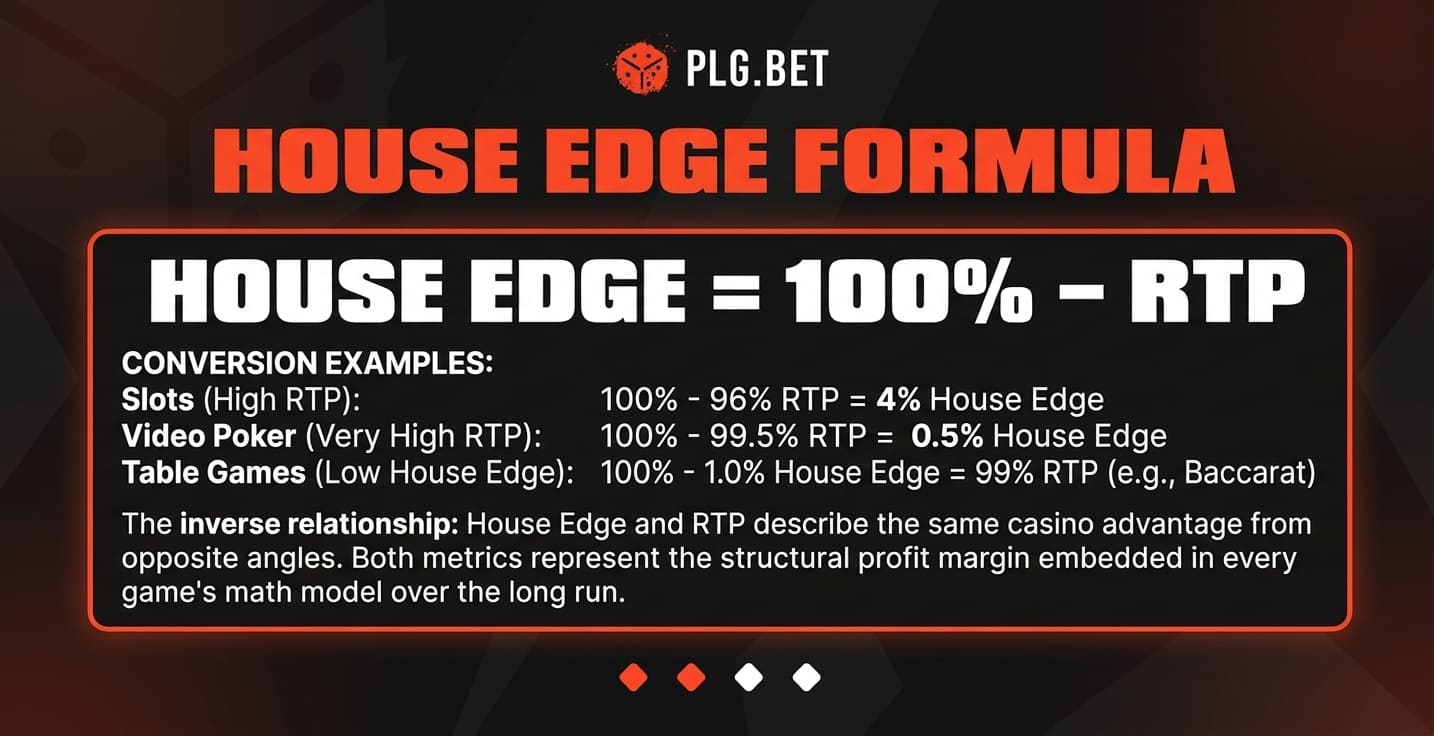
House edge is the inverse of RTP. The formula is House Edge equals 100% minus RTP, and both figures describe the same casino advantage from opposite angles. Slot marketing leads with RTP because a high percentage sells games. Table game tradition leads with house edge because blackjack, roulette, and craps have always been quoted that way.
The relationship is a simple statistical probability. House edge is the numerical expression of casino advantage, the structural profit margin embedded in every game's math model. Gambling mathematics validates the link: across a large enough sample, the casino's long-run take equals 100% minus the game's RTP.
We use both metrics when evaluating a game. A 99% RTP video poker variant and a 1% house edge baccarat bet look equivalent on paper, but variance and bet sizing rules decide which actually pays better over a session.
RTP Across Different Casino Games
Every casino game category has its own RTP range. Slots sit lowest, table games sit highest, and specialty games fall in between.
Typical RTP Ranges by Game Category:
Game Category |
Typical RTP Range |
Online slots |
92% to 98% |
Blackjack (basic strategy) |
99% to 99.5% |
Video poker |
96% to 99.5% |
Baccarat (banker bet) |
98.94% |
European roulette (single zero) |
97.3% |
American roulette (double zero) |
94.74% |
Craps (pass line with odds) |
98.59%+ |
Slot RTPs swing wider than any other category because bonus features absorb a variable share of the payout pool. NetEnt's Mega Joker carries a 99% RTP in its Supermeter mode, one of the highest published in the industry, while NetEnt's Blood Suckers sits at 98%. Many licensed slots cluster around 96%, and anything below 94% usually signals a progressive jackpot contribution or a bonus-heavy math model.
Roulette variants show the same pattern in miniature. Single-zero European roulette returns more than the American double-zero version, and the extra pocket costs players 2.56 percentage points per spin.
Want to put this into practice? Browse slots by RTP on PLG.bet to filter games by payout percentage and find titles that match your risk tolerance before playing for real money.
FAQ
What Does RTP Mean in Gambling?
Why Is RTP Important?
What Is a Good RTP Percentage?
How Do You Find the RTP of Casino Games?
How Does RTP Relate to the House Edge in Casino Games?
What Does 96% RTP Mean?
How Does RTP Work on Progressive Jackpot Games?
Can RTP Guarantee Winnings on a Single Session?
How Do You Calculate RTP?
What's the Difference Between Theoretical and Actual RTP?
Ready to apply this? Open PLG.bet, sort the casino library by payout percentage, and pick a game that matches your bankroll before placing your first bet.
