

What does volatility mean in slots? Slot volatility is the risk profile of every casino game you play. Low-volatility slots deliver wins often at small values. High-volatility slots pay rarely but hit much harder. Get it wrong for your bankroll and no gambling strategy saves you.
Understanding Slot Volatility: The Foundation of Smart Play
Slot volatility is the statistical measure of how risk and reward are distributed across a slot machine's payout model. It shapes your gambling experience more directly than any other variable.
Developers at studios like Pragmatic Play, Play'n GO, and NetEnt calculate slot machine volatility using the standard deviation of payout frequency and size across millions of simulated spins. That calculation determines whether a game pays small amounts often or large amounts rarely.
Slot volatility controls four things players care about:
- Win frequency: how often any paying combination lands per spin
- Payout size: the typical multiplier value of those wins relative to your bet
- Bankroll requirement: the slot machine risk level determines how much reserve you need to survive dry spells
- Emotional experience: whether your session feels consistent and steady or swings hard between highs and lows
Slot volatility is also called slot variance or dispersion. All three terms describe the same mathematical concept. Independent testing laboratories Gaming Laboratories International (GLI) and eCOGRA include volatility verification in their certification procedures for every regulated slot game.
How Volatility Differs from RTP and Hit Rate
Return to Player (RTP) measures long-run payout percentages: a slot with 96% RTP returns $96 for every $100 wagered over millions of spins. Hit frequency counts how often any win occurs. Variance in slots describes distribution: steady small amounts or rare large spikes. Slot machine volatility is none of the first two.
Two games sharing 96% RTP produce completely different sessions. A low-volatility game at 96% RTP delivers that return through constant small wins. A high-volatility game at 96% RTP concentrates payout value into bonus rounds and rare combination hits. Slot volatility connects to game mathematics through the probability algorithm that distributes payout weight across all possible reel outcomes.
| Concept | What It Measures | How It Affects Your Session | What It Means for Players |
| RTP | Long-run payout percentages | Determines theoretical value over thousands of spins | Reflects long-term casino game value, not short-session results |
| Volatility | Distribution of risk and variance in slots | Determines win frequency and size each session | Defines the slot machine risk level you accept per session |
| Hit Frequency | Raw count of any paying spin | Influences perceived momentum at the reels | Shows how often you feel the feedback of a win |
The Origins of Slot Volatility as a Concept

Slot volatility history traces back to the 1990s, when the transition from mechanical reel machines to electronic video slots in casino gambling created the conditions for formal variance design.
Mechanical casino slots operated with fixed physical reel stops and limited slot math models. Electronic platforms gave game developers the tools to engineer precise payout distributions across millions of outcomes. Game developers determine slot volatility by applying statistical variance models to slot design, formalizing it as a certified specification and a key moment in gambling terminology evolution.
By the 2000s, major studios including IGT, Microgaming, and NetEnt had adopted volatility ratings as standard components in game documentation. Today, volatility ratings appear in every slot certified by eCOGRA or GLI as a mandatory player disclosure.
The Spectrum of Slot Volatility: From Low to High
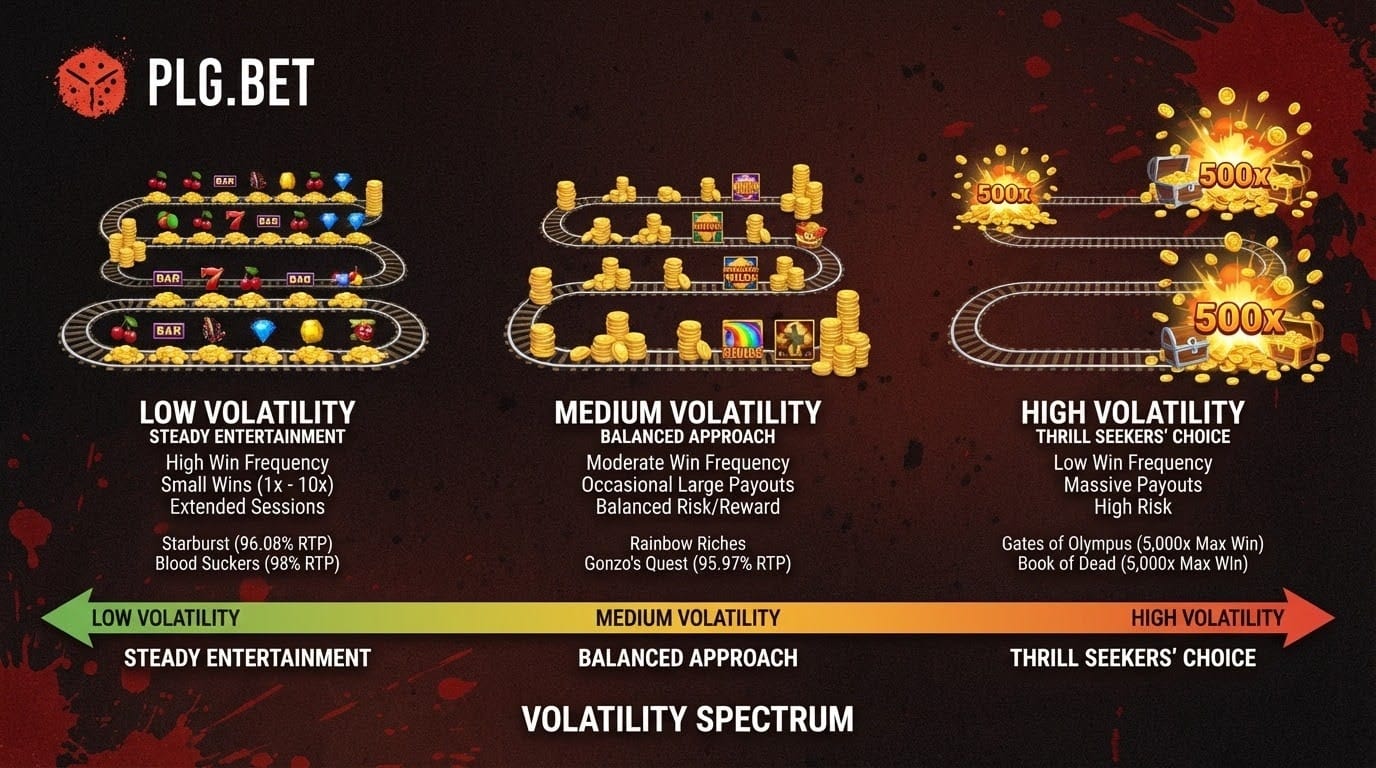
Slot volatility runs on a continuous spectrum from low to high, with medium occupying the middle band. No level is objectively better or worse: each one is a different contract between the slot machine and the player.
Low Volatility Slots deliver winning combinations on a high percentage of spins, keeping bankroll fluctuations minimal and sessions naturally extended. The opposite pattern governs High Volatility Slots: long stretches without significant wins, then large payouts when features finally trigger. Medium Volatility Slots occupy the overlap: regular base-game wins alongside periodic feature payouts, balancing sustainability with upside potential.
Slot Volatility determines which of these three profiles a game follows before a single spin is placed. Game developers encode that profile into the slot machine's probability model at the design stage. Your job is to match the volatility profile to your bankroll and session goals before you commit real money.
Low Volatility Slots: Steady Entertainment
Low-volatility slots deliver winning combinations on a high percentage of spins, with each win carrying a small multiplier value relative to the bet.
NetEnt's Starburst carries a 96.08% RTP and produces wins frequently across its 10 paylines, with base-game combinations typically paying between 1x and 10x the bet and a maximum win of 800x. Hit frequency varies across low-volatility titles: Starburst lands a win on approximately 23% of spins while Blood Suckers reaches 45%, keeping slot payout frequency consistently higher than high-volatility alternatives. Bankroll requirements stay minimal because consistent payouts offset losses efficiently.
Popular low-risk slots with verified RTP figures:
- Starburst (NetEnt): 96.08% RTP, expand-and-respin wilds, 800x max win, 23% hit frequency
- Blood Suckers (NetEnt): 98% RTP, one of the highest published RTPs in the NetEnt catalog
- Starmania (NextGen): 97.87% RTP, 5x3 grid, consistent payout pattern at all bet levels
- Medusa II (NextGen): 97.07% RTP, medium-high volatility, locked reels bonus during free spins
Low-risk slots appeal to risk-averse players who want extended sessions without bankroll swings. The emotional experience is consistent: wins land regularly and your balance moves in a narrow, stable range.
Strategy-wise, low-volatility slots reward flat betting across long sessions. A consistent stake over 200 spins extracts maximum value from the frequent payout rhythm these games deliver.
Medium Volatility Slots: The Balanced Approach
Medium-volatility slots combine moderate win frequency with occasional larger payouts, making them the most versatile gameplay option across the full volatility spectrum.
Medium-volatility titles suit players at every experience level because they balance risk and reward without demanding specialist bankroll management. These hybrid slot games appeal to a broad audience: they deliver the excitement of occasional large feature payouts alongside the sustainability of regular base-game wins.
Popular medium-volatility slots with balanced performance:
- Rainbow Riches (Barcrest): medium volatility, iconic bonus wheels, consistent base game hit frequency
- Eye of Horus (Blueprint Gaming): medium volatility, Egyptian theme, balanced free spins trigger rate
- Gonzo's Quest (NetEnt): medium-high volatility, 95.97% RTP, cascading reels with escalating multipliers
- Immortal Romance (Microgaming): medium volatility, 96.86% RTP, multiple story-driven bonus rounds
Bankroll requirements fall between low and high volatility: not minimal, not demanding. Regular small wins and periodic feature payouts sustain a session across 30 minutes or two hours without forcing an early exit.
High Volatility Slots: The Thrill Seekers' Choice
High-volatility slots concentrate payout potential into rare events, producing long stretches without significant wins until features trigger.
Pragmatic Play's Gates of Olympus carries a 96.5% RTP and a 5,000x maximum win, achieved through accumulating multiplier orbs during free spins. The hit frequency sits at approximately 28.82%, meaning winning combinations land roughly every 3.47 spins on average. The free spins feature triggers approximately every 448 spins. Without a reserve of 200 to 300 times your bet size, high-volatility play depletes your bankroll before the feature triggers.
High-volatility slots with verified max win data:
- Gates of Olympus (Pragmatic Play): 96.5% RTP, very high volatility, 5,000x max win, multiplier orbs up to 500x
- Book of Dead (Play'n GO): 96.21% RTP, high volatility, 5,000x max win, expanding symbol free spins
- Big Bass Bonanza (Pragmatic Play): 96.71% RTP, high volatility, 2,100x max win, fish-collector free spins
- Dead or Alive II (NetEnt): 96.82% RTP, extremely high volatility, 111,111x max win in High Noon mode
Progressive jackpot slots sit in the high-volatility category because jackpot prize pools divert value from base-game returns into rare triggering events. Bonus features built around multiplier stacking push volatility higher by pooling return into fewer, larger outcomes.
High-volatility slots carry a high risk level by design. Risk-seeking players with substantial bankrolls choose these titles for that concentration of payout potential. Two strategy rules apply: a hard stop-loss limit set before the session starts, and the smallest viable bet to extend spin count.
How to Identify a Slot's Volatility Level Before You Play
Slot volatility is determined by game developers through the slot mathematics they build into every title, and that information is published in the game's information panel on all regulated platforms. Five steps identify any slot's volatility level before you bet a cent.
- Step 1: Open the game's information or paytable screen. Most regulated slots list volatility directly, rated as low, medium, or high. Pragmatic Play rates Gates of Olympus at 5/5 for volatility in its official documentation.
- Step 2: Examine the paytable payout structure. High-volatility games show a wide gap between the smallest and largest symbol payouts. Low-volatility games show compressed paytables where most symbols pay within a narrow range.
- Step 3: Check the maximum win multiplier. Games with max wins above 5,000x the bet typically carry high or very high volatility. Games capped below 1,000x the bet sit in the low-to-medium range.
- Step 4: Measure slot payout frequency in demo mode. Demo play uses identical slot mathematics to the real-money version. Spinning 100 to 200 rounds reveals hit frequency and whether the game produces extended dry spells.
Step 5: Read verified slot reviews. Established sources test games across large spin samples and report observed hit frequency, average bonus values, and session behavior. Try slots in demo mode on PLG.bet to compare low, medium, and high volatility games side by side before your bankroll goes in.
FAQ
What is slot machine volatility?
Why does slot volatility matter?
What are the types of slot volatility?
How can you tell a slot's volatility?
How to choose the right slot volatility for your playing style?
What is the difference between high and low volatility slots?
Can you win big on low volatility slots?
How does volatility impact slot payouts?
Ready to apply what you now know about volatility? PLG.bet carries low, medium, and high volatility titles from Pragmatic Play, NetEnt, Play'n GO, and 70+ other providers under one account. Register on PLG.bet and start playing in under two minutes.
