In VALORANT, a deep understanding of VALORANT maps is a decisive success factor. Developed by Riot Games, this tactical shooter rewards players whose map knowledge sharpens positioning, callouts, and utility usage, creating a clear competitive advantage. This guide breaks down all 11 maps, covering layouts, strategies, agent synergies, and callouts.
Understanding the VALORANT Map Pool
The Valorant map pool is organized through a structured map rotation system that determines which environments appear in competitive play. In VALORANT, the current map pool features 7 active competitive maps, while 4 maps are rotated out at any given time. This approach by Riot Games keeps Valorant competitive maps fresh, limits meta stagnation, and allows targeted refinement using professional feedback.
Rotation changes follow an Episode-Act cadence, typically every 2-3 months, using a controlled selection method that avoids repetitive map sequences while ensuring variety. Limiting Valorant ranked maps helps players develop deeper strategies without an overwhelming learning curve. Importantly, the same rotation is used in VCT tournaments, ensuring seamless skill transfer between ranked and professional play.
How Many Maps Are in VALORANT?
The Valorant maps count currently stands at 11 standard maps across all modes in VALORANT, meaning the total Valorant maps include seven active competitive selections and four out of rotation. Team Deathmatch maps and The Range are separate, with additions released periodically.
VALORANT Maps Release Dates
The VALORANT map release timeline reflects steady map updates from Riot Games. Bind, Haven, and Split first appeared in the beta on April 7, 2020, followed by Ascent on June 2, 2020 (Patch 1.0) and Icebox on October 13, 2020 (Patch 1.10). Riot continued expanding the pool with Breeze on April 27, 2021 (Patch 2.08) and Fracture on September 8, 2021 (Patch 3.05), then introduced Pearl on June 22, 2022 (Patch 5.0).
In 2023, the map lineup grew with Lotus on January 10, 2023 (Patch 6.0) and Sunset on August 29, 2023 (Patch 7.04). The newest standard addition, Abyss, arrived on June 11, 2024 (Patch 8.11), while Glitch was released on October 22, 2024 (Patch 9.08) as part of the Team Deathmatch map set.
Determining Map Selection in VALORANT
Valorant map selection is governed by a structured map algorithm tied to the active competitive rotation. In VALORANT, Riot Games uses a deterministic random system that selects from seven maps while deliberately avoiding repeats.
This design preserves map variety, discourages map one-tricking, and reinforces competitive balance by forcing adaptability. Players often notice recently played maps appear less frequently within the next three to four matches, maintaining randomness without repetition fatigue.
VALORANT Map Layouts: Understanding Design Patterns
VALORANT map design follows a clear philosophy from Riot Games: every battlefield must encourage tactical decision-making while remaining readable and competitively fair. Most maps are built around two or three bombsites and structured lanes that naturally create contestable choke points, rotation paths, and information battles. Riot deliberately varies map size, verticality, and sightlines to prevent a single dominant playstyle from emerging across the entire pool.
Unique mechanics — such as teleporters, rotating or one-way doors, ziplines, and destructible walls — are introduced selectively to reshape how space is contested without breaking core fundamentals. These elements force teams to adapt agent selection, utility usage, and timing. Through iterative updates and rotation changes, Riot uses win-rate data and professional feedback to refine layouts, aiming for long-term balance and strategic diversity rather than perfect symmetry.
All VALORANT Maps List: Complete Breakdown
This section presents a definitive catalog of all Valorant maps, offering a structured Valorant map list with clear Valorant map names and consistent analysis. Each of the 11 Individual Maps is examined using the same framework, layout style, sites, mechanics, strategies, agent synergies, and callouts, making this a complete mastery reference for every battleground in Valorant Maps.
Ascent
Ascent is a medium-sized battlefield set in Italy with two bombsites and a strong emphasis on Mid control. The ascent map is defined by its unique mechanical doors in Mid, which can be closed to stall pushes or reopened to force rotations.
In this Valorant map guide, Mid acts as the central courtyard linking both sites; A Site includes Wine, while B Site is accessed through Market. Effective Valorant map strategies on attack prioritize Mid control for flexible splits, while defenders hold Mid and use doors to delay timing. Omen excels with Mid smokes, Sova gathers recon value, and Killjoy anchors sites. Key callouts include Mid Catwalk, A Heaven, B Main, and Wine.
Bind
Bind is a medium-sized map set in Morocco with two bombsites and a defining absence of a traditional Mid. The bind map relies on one-way teleporters that instantly link A and B, enabling deceptive rotations and surprise timings.
This no-Mid layout reshapes Valorant map strategies, forcing teams to commit to site pressure and manage sound cues at teleporter exits. Attacks thrive on teleporter fakes, Shower control on A, and Hookah dominance for B, while defenders set crossfires watching exits.
For Valorant map tips, Brimstone excels post-plant, Raze opens space aggressively, and Cypher monitors teleporters. Key callouts include Hookah, Showers, Lamps, Short A, and Long B.
Haven
Haven is a large map set in Bhutan and the only Haven map with three bombsites, fundamentally reshaping every Valorant site execute. With A, B, and C available, attackers gain flexibility (about a 52% edge), while defenders must split resources thinly across each Valorant bombsite.
Mid Courtyard enables rapid rotations, Garage links A and C, and Window connects B to C. Strong attacks pressure multiple sites to force rotations, while lurks punish gaps. Defenders succeed by prioritizing sites based on composition and keeping rotation paths flexible.
Controllers like Viper, Omen, and Astra are vital, with Cypher anchoring information. Key callouts include A Long, C Long, Garage, Window, and Courtyard.
Split
Split is a small, vertically intense battlefield set in Tokyo, Japan, built around two bombsites and rope ascenders. The split map emphasizes elevation, where rapid vertical shifts create sharp valorant map angles that favor defenders (about a 47% attacker win rate).
Mid control dictates Valorant map control, unlocking A Ramps pressure or B Heaven access. Attacks must secure Mid, clear stacked elevations with utility, and execute tightly.
Defenders exploit height advantages, contest Mid aggressively, and use ropes for unexpected retake angles. Jett and Raze thrive with mobility, Viper controls space on sites, and Cypher secures Mid intel. Key callouts include Mid Mail, A Rafters, B Heaven, and Sewers.
Icebox
Icebox is a medium-large, Arctic-themed battlefield built around extreme verticality and horizontal ziplines. The icebox map features two bombsites where ziplines enable fast repositioning but leave players exposed mid-travel, creating risky yet rewarding Valorant map angles.
A Site stacks multiple elevations like Nest and Pipes, while B Site revolves around Yellow control and tight vertical fights. Attackers benefit slightly (around 51%) by securing elevation before committing, using zipline timings for surprise pressure.
Defenders counter by holding layered crossfires and punishing predictable routes. For Valorant map positioning, Jett, Raze, and Reyna excel in vertical duels, Viper controls sites, and Sage blocks elevations. Key callouts include A Nest, B Yellow, Belt, Tubes, and Pipes.
Breeze
Breeze is the largest battlefield in VALORANT, set in the Bermuda Triangle and defined by vast open spaces and extreme sightlines. The breeze map heavily emphasizes long-range gunfights, where precise Valorant map angles reward Operators and Vandals while limiting close-range aggression.
Mid is a wide, exposed control zone. A Site centers around Hall and Pyramids, and B Site funnels through Tunnel and Elbow. Control of space is everything: attackers must use utility to break vision and secure picks before committing, while defenders patiently hold angles and rely on disciplined Valorant map control.
Viper is indispensable for cutting sightlines, Chamber and Jett excel with snipers, and KAY/O clears utility. Key callouts include Mid Hall, A Pyramids, B Tunnel, and Elbow.
Fracture
Fracture is a medium-sized map set in Santa Fe, New Mexico, and is one of the boldest examples of modern Valorant map design. The fracture map uses an H-shaped layout with dual attacker spawns, enabling constant pincer pressure on both bombsites.
Defenders begin centrally and must react to threats from multiple angles, giving attackers a slight edge (around 52%). Ziplines and the underground Arcade accelerate rotations and enable deceptive timings.
Effective Valorant map strategies revolve around coordinated split pushes and zipline fakes, while defenders counter by taking aggressive forward control and rotating quickly through Arcade. Breach thrives enabling pincer hits, Neon pressures space, and Cypher gathers intel. Key callouts include A Drop, B Arcade, Dish, and Canteen.
Pearl
Pearl is a small, underwater-themed map set in Lisbon, Portugal, built around classic fundamentals. The Pearl map is the only battleground without special mechanics, placing full emphasis on positioning, timing, and Valorant map control.
Its traditional three-lane structure, A Main, Mid, and B Main, rewards disciplined defaults and coordinated utility. Tight chokepoints slightly favor defenders (about 48% attacker success), making clean Valorant map strategies essential.
Attackers must secure the Mid Connector to unlock flexible executes, while defenders rely on early Mid presence and structured retakes. Controllers like Omen or Brimstone dominate Mid smokes, and Killjoy or Cypher excel at anchoring sites. Key callouts include Mid Connector, A Art, B Main, and Flowers.
Lotus
Lotus is a medium-large, three-site battleground set in India’s Western Ghats and a standout in Valorant map design. The lotus map introduces rotating doors that swing 90 degrees to reshape sightlines and rotations, plus destructible walls that open new paths mid-round.
With A (Rubble), B (Main), and C (Waterfall), teams must constantly reassess priorities. Balance sits near 50/50, rewarding adaptable Valorant map strategies. Attackers gain timing edges through door manipulation and surprise wall breaks; defenders manage coverage, use doors for info, and rotate fluidly.
Controllers like Omen or Astra handle three sites, Sova or Fade gather intel, and Chamber flexes an Operator. Key callouts include A Tree, B Main, C Waterfall, and Root.
Sunset
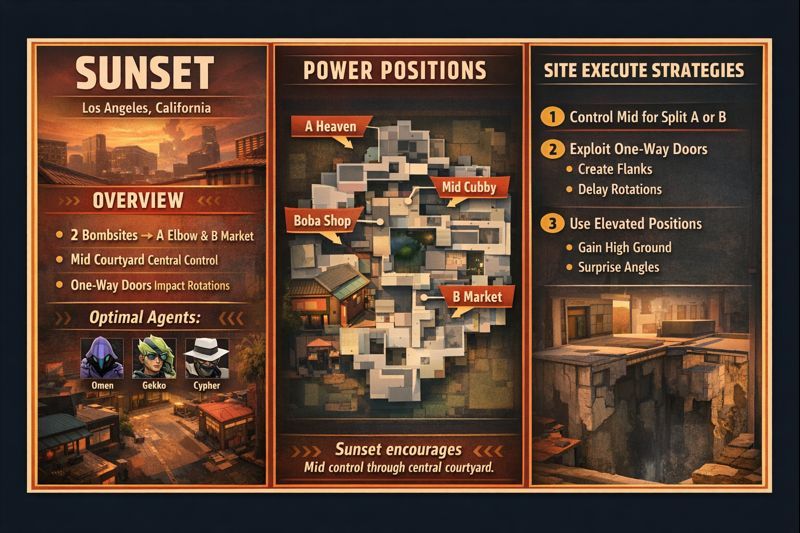
Sunset is a medium-sized, Los Angeles-themed battleground that highlights modern Valorant map design through subtle asymmetry. The sunset map features one-way doors that open in a single direction, shaping rotations and creating timing-based advantages.
Mid Courtyard is the strategic heart, determining access to both sites; A Site plays through Elbow, while B Site funnels via Market. With a slight attacker edge (about 51%), effective Valorant map strategies prioritize Mid control and door exploitation for favorable trades.
Defenders counter by anchoring Mid, planning rotations around door flow, and setting disciplined crossfires. Omen excels at controlling Mid sightlines, Gekko gathers entry info, and Cypher stabilizes passive defense. Key callouts include Mid Courtyard, A Elbow, B Market, and Boba.
Abyss
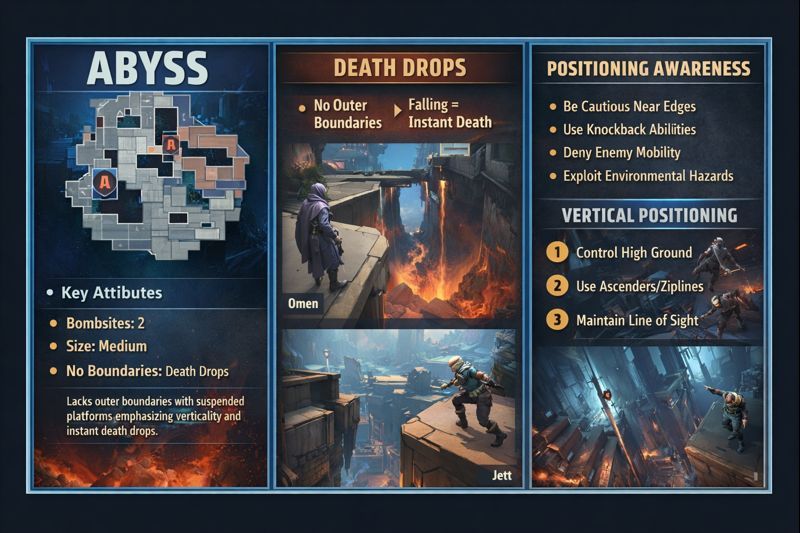
Abyss is a conceptual, medium-sized battleground that pushes Valorant map design into new territory. The abyss map removes outer boundaries entirely; falling off suspended platforms results in instant death, introducing constant risk-reward decision-making.
With two bombsites and heavy vertical emphasis, there are fewer “safe” corners, demanding precise Valorant map positioning. As the newest map, balance data is still emerging.
Attackers must control height, punish edge mistakes, and move deliberately; defenders aim to force opponents into risky paths and weaponize death drops. Agents with knockback (Breach, Omen), strong mobility (Jett, Raze), and area denial (Viper) shine. The community is still standardizing callouts.
Team Deathmatch Maps in VALORANT
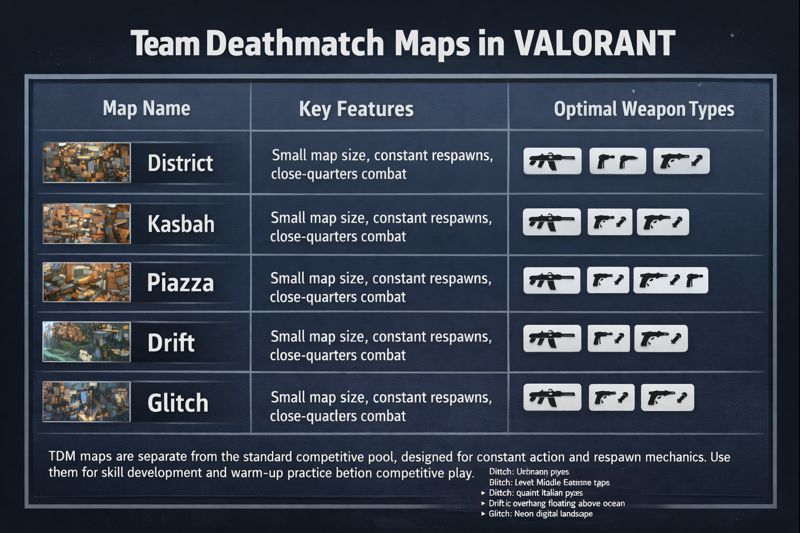
Team Deathmatch maps are separate from the standard competitive pool in VALORANT and are not counted among the 11 core maps. These Valorant map names, District, Kasbah, Piazza, Drift, and Glitch, are designed for fast-paced combat, smaller layouts, and constant respawns.
Unlike ranked play, the Valorant minimap and simplified lanes emphasize immediate engagements and close-quarters fights. Their purpose is skill building: sharpening aim, movement, and overall Valorant map knowledge in a low-pressure environment. Time spent here translates directly into better mechanics and confidence in competitive matches.
Map-Specific Agent Selection: Optimizing Your Team Composition
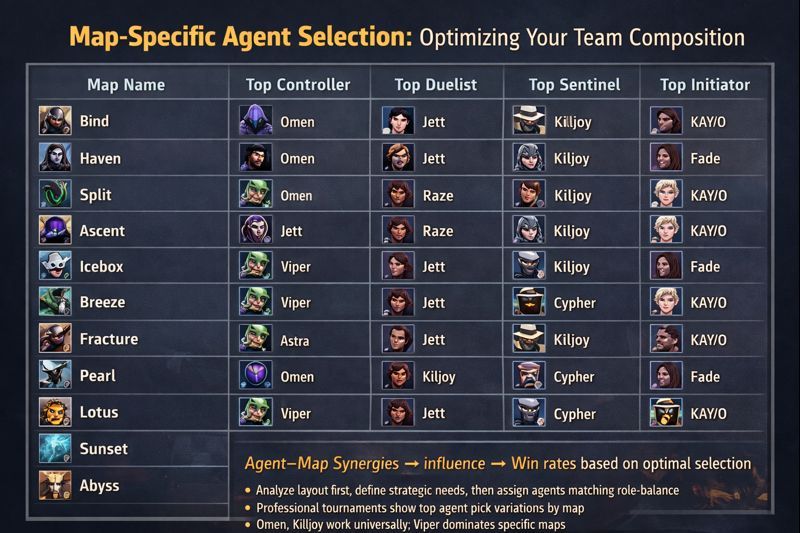
Choosing the right agents is what separates good teams from consistent winners on the best Valorant maps. Through Agent-Map Synergies, each map’s size, layout, and mechanics directly shape optimal picks, patterns often reflected in Valorant map statistics and pro play data that inform any serious Valorant map tier list.
Large, open maps demand more substantial controller presence, making Viper indispensable on Breeze, while compact layouts like Pearl reduce that necessity. Unique mechanics also matter: Fracture rewards Breach for coordinated pincer pressure, while Icebox and Split prioritize mobility from Jett or Raze due to vertical combat.
A reliable system is to analyze layout first, define strategic needs, then assign roles—controllers for vision control, duelists for entry, sentinels for anchoring, and initiators for information. Some agents remain flexible across many maps (Omen, Killjoy), while specialists like Viper dominate specific environments.
Map Statistics and Win Rates
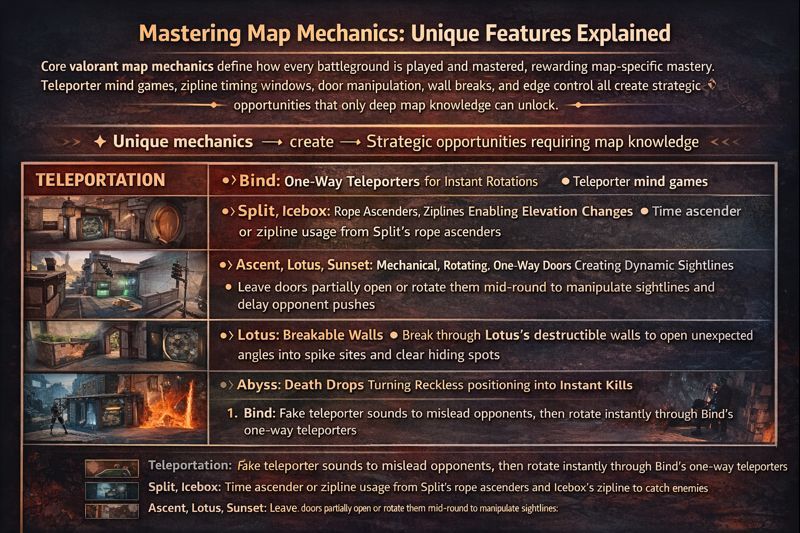
Understanding Valorant map win rates helps explain why certain maps feel easier on attack or defense. Current Valorant map statistics show attacker-favored environments like Haven (52%), Fracture (52%), Sunset (51%), and Icebox (51%), while Bind, Breeze, Pearl, and Lotus sit near a balanced 50%.
Defender-leaning maps include Split (47%) and Ascent (48%). Riot Games tracks ranked and professional data, adjusting maps gradually to approach a 50/50 ideal. These trends shape any accurate valorant map tier list and guide agent choices and round planning.
Mastering Map Mechanics: Unique Features Explained
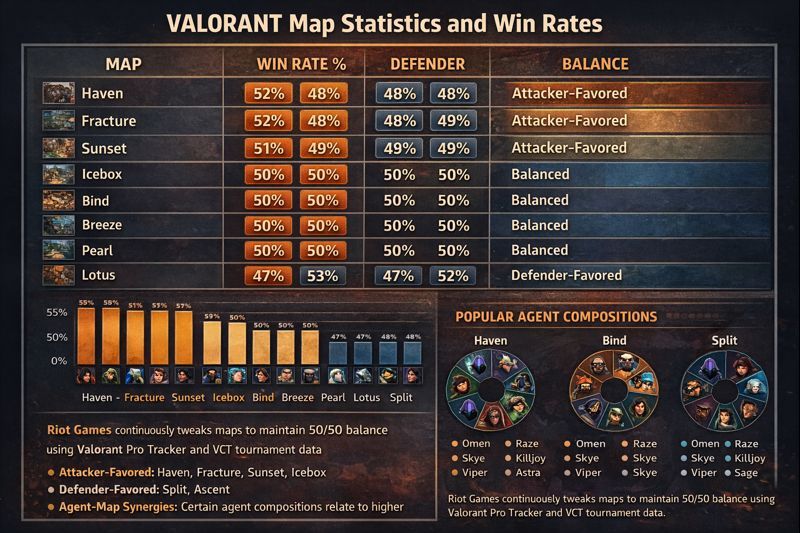
Core Valorant map mechanics define how every battleground is played and mastered. Teleportation on Bind enables instant rotations and deceptive fakes, while vertical mobility on Split and Icebox introduces elevation-based duels that reshape Valorant map control.
Interactive doors on Ascent, Lotus, and Sunset alter sightlines and timing, demanding deliberate coordination, and Lotus’s destructible walls unlock surprise pathways mid-round. Abyss adds environmental hazards through death drops, turning positioning errors into instant punishment.
Together, these systems showcase intentional Valorant map design, rewarding players who adapt tactics to each mechanic. Teleporter mind games, zipline timing windows, door manipulation, wall breaks, and edge control all create layered strategic opportunities that only deep map knowledge can unlock.
Map Callouts: Communication Guide for Competitive Play
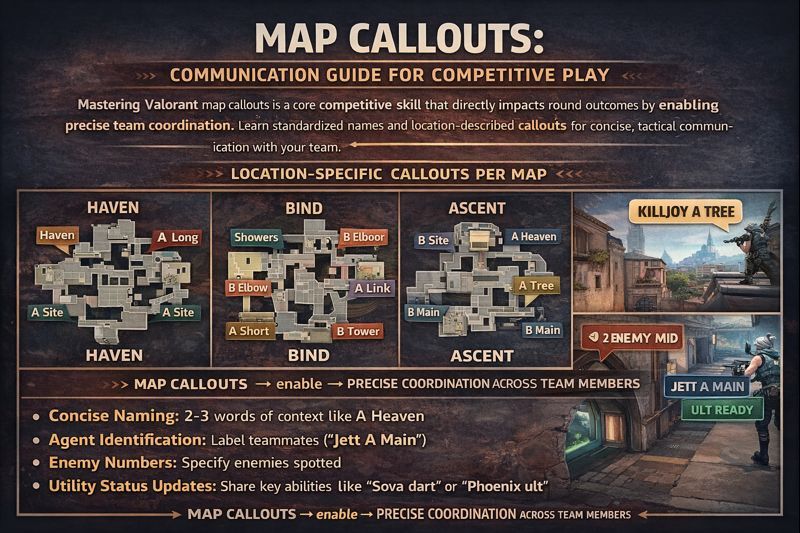
Mastering Valorant map callouts is a core competitive skill that directly impacts round outcomes. A clear Valorant map callout guide allows teams to coordinate rotations, trade efficiently, and react instantly to enemy positioning, turning raw Valorant map knowledge into an actionable advantage.
Standardized, community-agreed names ensure universal understanding, so a callout like “A Heaven” conveys precise information across ranks and regions. Effective communication adds specificity, pairing location with context (“two pushing B Main”) instead of vague warnings.
While learning callouts takes time, frequent minimap reference accelerates familiarity. Professional teams rely on consistent terminology to synchronize executions and retakes, proving its competitive value.
Best practice favors brevity, two to three words, alongside agent identification, enemy count, and utility status when possible. Minor regional naming differences exist, but they rarely disrupt clarity when fundamentals are strong.
Map Coordinates and Hidden Details
Beyond gameplay, Valorant map design hides lore-rich details. Each loading screen shows real-world coordinates, deepening Valorant map knowledge and a richer Valorant map overview. Ascent points to Venice, Bind to Rabat, Haven to Thimphu, Split to Tokyo. Riot Games embeds Alpha/Omega Earth clues, radios, and signatures, pure immersion for players worldwide.