Bunny hopping is a movement technique that allows players to gain speed beyond normal running capabilities in Counter-Strike 2. This advanced movement skill involves precise timing of consecutive jumps combined with air strafing to maintain momentum. Players who master the art of bunny hopping can move quickly around the map, gain tactical advantages, and improve their overall gameplay effectiveness. Whether you're playing on community servers or practicing for competitive matches, understanding bunny hop mechanics will enhance your movement skills and give you an edge over opponents.
What is Bunny Hopping in CS2?
Bunny hopping in CS2 is a movement technique that exploits the game's physics engine to achieve speeds exceeding the normal 250 units per second running speed. This advanced movement technique involves jumping and landing in a specific rhythm while using air strafing to maintain momentum between jumps. When executed correctly, players can reach speeds of 285-300+ units, making them harder to hit and allowing for faster map traversal.
In Counter-Strike 2, formerly CS:GO, bunny hop mechanics have been modified by Valve, making them more challenging to execute and harder to chain together for sustained speed gains compared to the previous version. While the core technique remains possible, CS2's physics changes require players to adapt their timing and execution methods to achieve consistent results.
The physics behind bunny hopping relies on maintaining velocity through consecutive jumps without touching the ground for extended periods. This works because there is a single-frame window where friction is not applied when the player hits the ground, requiring frame-perfect timing to input the jump command without losing speed. This technical limitation is what makes bunny hopping such a skill-intensive technique that rewards precision and practice.
The effectiveness of bunny hopping varies significantly between competitive servers and community servers. Official Valve servers implement restrictions and velocity caps that limit the technique's potential, while community servers often modify these settings to remove limitations and make bunny hopping more accessible for practice. Successful bunny hopping requires understanding frame-perfect timing, air strafing mechanics, and precise mouse movement coordination to create the smooth gliding effect that provides tactical advantages in gameplay.
Origins and Evolution of Bunny Hopping

Bunny hopping originated in Quake (1996) as an unintended movement exploit that became a celebrated skill within the community. The technique evolved through various game engines, with Half-Life (1998) revitalizing bunny hopping after Quake 2's restrictions. Counter-Strike (2000) embraced the mechanic, leading to dedicated community servers and the rise of DeFRaG mod, which established competitive bhop culture.
Throughout its history, developers frequently attempted to remove or limit the technique rather than balance it. Counter-Strike 1.3 significantly nerfed bunny hopping, while CS:GO (2012) introduced further restrictions. The transition from CS:GO to CS2 brought additional physics changes affecting timing and execution.
The evolution of bunny hopping reflects gaming culture's appreciation for skill expression and movement mastery. From Quake's arena combat to Counter-Strike's tactical gameplay, bunny hopping spawned entire communities dedicated to movement techniques, custom maps, and competitive racing that continue thriving today.
Benefits of Bunny Hopping in CS2
- Increased movement speed. Thanks to bunny hopping, you can increase your velocity up to 285.94 units in competitive matches, with higher speeds achievable on community servers with modified settings. For comparison, your speed when running with a knife doesn't rise above 250 units, making bunny hop a significant advantage for moving quickly around the map.
- Reduced chance of dying in combat. A player who moves in a straight line is much easier to hit than a gamer who jumps and dodges using bunny hop techniques. While opponents are trying to catch a chaotically moving character in their crosshair, you may have time to run away, find cover, or even eliminate them first. This unpredictability gives you a crucial survival advantage in competitive matches.
- Gaining an edge on the battlefield. Thanks to the high speed and agility, you can quickly take advantageous shooting positions before your enemies. The technique helps you surprise opponents who don't expect such rapid movement. It's also worth noting that bunny hopping allows you to cut corners faster and navigate complex map geometry more effectively, giving you tactical advantages similar to other advanced CS2 strategies.
- Improved reaction speed and precision. During any bunny hop sequence, you must quickly move your mouse and press several keys simultaneously while maintaining precise timing. You need to coordinate your movements across the screen just as quickly. All this has a positive effect on your reaction time and develops movement skills that benefit overall gameplay performance.
- Mastering a useful gaming skill. Bunny hop will come in handy not only in Counter-Strike 2, but also in other first-person shooter games that support the technique. If you watch Valorant, Quake, or Apex Legends matches, you'll most likely see players who perform incredible movement tricks. This mechanic is widely used in these popular FPS games, making it a valuable skill to develop alongside other essential CS2 techniques.
- Access to unique map areas and tactical advantages. Advanced bunny hopping techniques allow you to reach certain positions and angles that are difficult or impossible to access through normal movement. This expanded tactical toolkit provides creative solutions to common gameplay challenges and opens up new strategic possibilities that can surprise enemies and provide competitive advantages in both casual and ranked matches.
For more advanced Counter-Strike 2 strategies and gameplay techniques, explore our comprehensive CS2 guides and tips to improve your overall game performance.
Essential CS2 Bhop Commands
If you want to use bunny hop commands every time you play CS2, you can't do without creating a private server. Unfortunately, these commands don't work on official Valve servers. Now open your console and enter the commands from the table below to set up optimal bunny hopping conditions.
| Command | Description |
|---|---|
sv_cheats 1 |
This command enables cheats in Counter-Strike 2. |
sv_enablebunnyhopping 1 |
To be able to bunny hop, you must enter this command and specify 1 as its argument. |
sv_autobunnyhopping 1 |
If this command is entered, you can bhop by holding down the space bar key. |
sv_staminajumpcost 0 |
This command sets the value of the stamina penalty you get when jumping. |
sv_staminalandcost 0 |
When you land after jumping, you also receive a stamina penalty. Use sv_staminalandcost 0 and forget about this problem. |
sv_staminarecoveryrate 0 |
To set the stamina recovery rate, you'll need this command. It's measured in units per second. |
sv_staminamax 0 |
The main purpose of this command is to set the maximum stamina penalty. Its argument sets the value after which it stops incrementing. |
sv_airaccelerate 2000 |
To set the acceleration of your character in the air, you must enter this command in the developer console. |
sv_accelerate_use_weapon_speed 0 |
By default, acceleration in CS2 depends on the weapon you use. Specify 0 as an argument to this command and no weapon will affect it. |
sv_maxspeed 800 |
This command sets the maximum speed players can achieve on the current map. |
Executing these commands provides 2 significant advantages. First, they remove the default restrictions on bunny hopping in CS2. Second, they maximize your character's speed and allow you to gain speed beyond normal movement limitations. You gain true freedom of movement in the vastness of the game world!
Note that such a large number of bhop commands is extremely inconvenient to enter every time you start playing. To make your bunny hop experiments easier, we've combined them into one line. Just copy it from the table below and paste it into the developer console.
Quick Setup Command:
sv_cheats 1; sv_enablebunnyhopping 1; sv_autobunnyhopping 1; sv_staminajumpcost 0; sv_staminalandcost 0; sv_staminarecoveryrate 0; sv_staminamax 0; sv_airaccelerate 2000; sv_accelerate_use_weapon_speed 0; sv_maxspeed 800
Regular vs Fast Bhop Commands
Regular Bunny Hopping Commands provide balanced settings for learning proper technique while maintaining some challenge:
sv_cheats 1; sv_enablebunnyhopping 1; sv_staminajumpcost 0; sv_staminalandcost 0; sv_airaccelerate 150; sv_maxspeed 400
Fast Bunny Hopping Commands maximize speed and momentum for advanced practice sessions:
sv_cheats 1; sv_enablebunnyhopping 1; sv_autobunnyhopping 1; sv_airaccelerate 2000; sv_maxspeed 1000; sv_staminamax 0
Server Setup Commands
For comprehensive practice server setup, use these additional commands to optimize your training environment:
bot_kick; mp_roundtime 60; mp_freezetime 0; mp_restartgame 1
We recommend that you save these bunny hop commands to a file so they don't get lost. An alternative option is to add this page to your Bookmarks and open it when you want to practice and improve your gaming experience with our help.
Basic Bhop Technique and Jump Timing

Mastering jump timing forms the foundation of successful bunny hopping in CS2. The technique requires frame-perfect execution, meaning players must press the jump key at precisely the right moment before landing. However, CS2's subtick system has fundamentally changed bunny hopping mechanics compared to CS:GO, making the technique significantly more challenging and inconsistent.
CS2 operates on 64-tick servers enhanced with a subtick system that processes player actions between traditional ticks. This system creates more frequent ground speed checks, making perfect bunny hops extremely difficult or sometimes impossible to achieve. Unlike CS:GO's 128-tick servers, CS2's implementation can result in inconsistent timing windows that vary based on your system's performance.
FPS stability plays a crucial role in CS2 bunny hopping consistency. Many players report improved bhop performance by capping FPS to 60-75 using fps_max 60 commands, as CS2's frame-based input system creates inconsistencies at higher framerates. Practice jumping in place initially to develop rhythm and timing sense, focusing on landing jumps just before touching the ground.
Building muscle memory requires consistent practice sessions on community servers designed for movement training. Start with simple forward bunny hopping before progressing to directional changes. Monitor your velocity using cl_showpos 1 to track improvement, aiming to maintain speeds above your base running speed of 250 units.
The key challenge in CS2 is adapting to the subtick system's unpredictable timing requirements, which demand significantly more precision than previous Counter-Strike versions while offering fewer consistent opportunities for perfect execution.
Strafing and Mouse Movement Techniques
Air strafing combines keyboard input with coordinated mouse movement to maintain and increase momentum during bunny hops. The critical technique involves releasing the forward key (W) while airborne and pressing movement keys (A or D) while simultaneously moving the mouse in the corresponding direction. When pressing A (left strafe), move the mouse left smoothly and consistently; when pressing D (right strafe), move the mouse right.
Successful air strafing requires precise synchronization between small mouse movements and strafe key presses. The movement should be fluid, not jerky or inconsistent. Match every strafe key with a small mouse movement in the same direction to maintain momentum and control throughout each jump sequence.
Mouse settings significantly impact strafing effectiveness. Use DPI settings between 400-800 and in-game sensitivity between 1.5-3.0 for balanced movement control. Disable mouse acceleration with m_rawinput 1 and use a large mousepad for smooth strafing motions. Lower sensitivity (1.0-2.5) generally provides better strafe control for bunny hopping compared to standard CS2 gameplay.
Advanced practitioners develop the ability to chain left and right strafes seamlessly, creating serpentine movement patterns that maximize speed while maintaining directional control. This multi-directional approach allows for complex navigation around obstacles while preserving momentum through smooth transitions between directional changes.
Optimal Bind Settings for Bunny Hopping
Choosing the right key binding for jumping significantly impacts bunny hop performance. The traditional spacebar method works but has limitations for rapid, consistent input required for advanced techniques. Many players prefer binding jump to the mouse scroll wheel for improved timing control, as scrolling provides multiple rapid inputs faster than repeatedly pressing spacebar.
To bind jump to scroll wheel, use these commands:
bind "mwheelup" "+jump"bind "mwheeldown" "+jump"bind "space" "+jump"
This setup allows both scroll directions and preserves spacebar as backup.
Important warning: Binding scroll wheel to jump removes weapon switching functionality. Restore it with:
bind "mwheeldown" "invnext"; bind "mwheelup" "invprev"
Potential drawbacks: Accidental jumps during combat can disrupt aim. Professional players report missed shots due to accidentally touching sensitive scroll wheels during firefights.
Alternative binding options include using only one scroll direction or dedicated mouse buttons. The choice depends on personal preference, mouse configuration, and playstyle. Some players prefer scroll wheel down only, keeping scroll up for weapons.
Test different configurations during practice sessions to find optimal comfort and effectiveness. Remember that muscle memory takes time to develop, so commit to a binding choice before making changes.
Practice Methods and Performance Tracking
Effective practice requires systematic approach and progress monitoring. Use the cl_showpos 1 command to display real-time velocity data, position coordinates, and movement angles. This information provides immediate feedback on technique effectiveness and helps identify improvement areas. Note that this command may require sv_cheats 1 on some servers, though it typically works without cheats in offline practice sessions.
Set realistic velocity benchmarks as goals for practice sessions. Standard running speed is 250 units, so initial targets should focus on maintaining 260-285 units consistently on competitive servers. CS2's built-in velocity restrictions limit speeds above ~300 units on official Valve servers, making anything beyond this range unsustainable. Advanced practitioners can achieve 400+ units on specialized community servers with modified settings, but these speeds aren't applicable to competitive play.
Understanding CS2's limitations is crucial for setting appropriate goals. Unlike previous Counter-Strike versions, CS2 implements stricter movement restrictions that prevent extreme bunny hop speeds in official matches. Focus on consistency and practical application rather than maximum velocity when practicing for competitive scenarios.
Develop structured practice routines focusing on specific aspects of bunny hopping. Dedicate time to timing practice, strafing coordination, and consistency maintenance. Use timer commands to measure completion times on specific routes, creating measurable improvement metrics tailored to CS2's physics system.
Regular practice sessions with consistent goals produce better results than sporadic intensive training. Set aside dedicated time for movement practice, treating it as seriously as aim training or tactical study. Document progress through screenshots or recordings to visualize improvement over time, keeping realistic expectations based on CS2's movement limitations.
Community Servers and Custom Maps
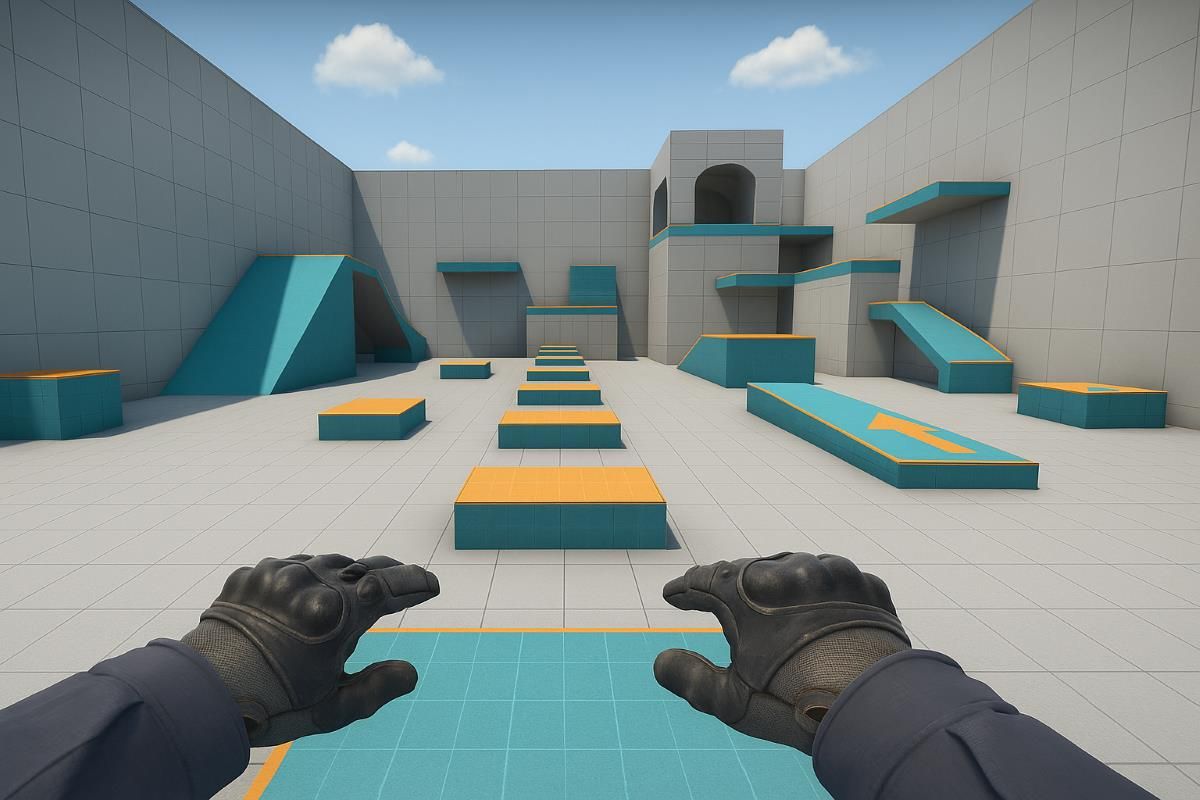
The CS2 Steam Workshop offers extensive collections of bunny hop maps designed for skill development, though many are ports from CS:GO as the CS2 bhop scene is relatively new. These custom maps feature progressive difficulty levels, from beginner-friendly linear courses to complex multi-level challenges requiring advanced techniques. Popular map series include bhop_* variants specifically designed for bunny hopping practice.
Note that surf_* and kz_* maps represent different movement disciplines - while they develop general movement skills, they focus on surfing ramps and climbing rather than bunny hopping mechanics. These complement bhop training but serve different purposes in movement mastery.
Community servers provide ideal environments for bhop practice with two main types. Auto-bhop servers allow holding the jump key for automatic timing, helping beginners understand strafing mechanics without timing complexity - perfect for learning air movement fundamentals. Manual bhop servers require full technique mastery including frame-perfect timing, more closely simulating competitive conditions where bhop has extremely limited practical application.
Popular server providers include CYBERSHOKE, xplay.gg, and GhostCap, offering various difficulty tiers and community features. However, remember that competitive bhop effectiveness in CS2 is severely limited compared to previous Counter-Strike versions.
Finding quality servers involves checking server browsers, community forums like ServerTilt, and Steam groups. Look for servers with a consistent population, good administration, and appropriate skill levels for your current ability. The CS2 bhop community remains active despite competitive limitations, providing excellent environments for movement skill development.
Advanced Bhop Techniques
Multi-directional bunny hopping involves chaining different strafe directions to navigate complex routes while maintaining speed. This technique requires mastering smooth transitions between left and right strafes without losing momentum or disrupting jump timing. Advanced practitioners can execute serpentine movement patterns and sharp directional changes, though these skills are primarily valuable for community servers and movement training rather than competitive advantages.
Key Advanced Techniques:
- Multi-directional strafing: Seamlessly alternate between A and D keys while matching mouse movements
- Air strafing mastery: Perfect the synchronization of keyboard input with coordinated mouse movement
- Complex route navigation: Use momentum to traverse obstacles and tight map geometry
- Rhythm consistency: Maintain frame-perfect timing across extended sequences
CS2's Source 2 engine significantly restricts bunny hopping effectiveness compared to previous Counter-Strike versions. On competitive servers, success rates hover around 50% even with perfect timing, and velocity caps limit practical speed gains. These limitations make advanced bhop techniques more suitable for skill development and community server enjoyment rather than competitive match applications.
The real value of mastering advanced techniques lies in developing superior movement fundamentals, reaction speed, and mouse coordination that benefit overall gameplay. Understanding momentum physics and developing intuitive timing creates better map navigation and positioning skills, even when perfect bhop chains aren't achievable in competitive scenarios.
Focus on consistency over complexity when practicing. Build solid multi-directional skills on community servers, then adapt simplified movement principles to competitive play where bhop serves as subtle enhancement rather than dramatic advantage.
Competitive vs Community Server Differences
Official CS2 servers implement strict movement restrictions that make bunny hopping largely ineffective in competitive play. Valve servers automatically slow players exceeding ~300 units per second, while community servers can achieve 400+ units through server plugins and modified settings.
Server Comparison:
| Aspect | Official Servers | Community Servers |
|---|---|---|
| Max Speed | ~300 units (auto-slowdown) | 400+ units possible |
| Bhop Commands | Don't work/not allowed | Full access (sv_cheats required) |
| Success Rate | ~50% with perfect timing | Much higher with plugins |
| Auto-bhop | Not available | sv_autobunnyhopping 1 available |
In competitive matches, bunny hopping has virtually no practical advantage. Each attempt has only a ~50% success chance even with perfect execution, making it unreliable for tactical situations. The technique exists more for skill development and entertainment value than competitive utility.
Community servers provide excellent practice environments with auto-bhop functionality and removed stamina penalties. However, these enhanced conditions don't translate to official matches. Focus on developing general movement skills and timing precision rather than expecting competitive advantages from bhop techniques.
Common Bhop Mistakes and Solutions
Timing errors represent the most common bunny hop mistakes, typically involving jumping too early or late in relation to landing. Too-early jumping breaks momentum and requires restarting the sequence, while late jumping creates audible landing sounds and speed loss. Practice jumping in place to develop consistent timing before adding strafing elements.
Mouse movement mistakes include inconsistent speed, incorrect angles, or poor synchronization with keyboard input. Jerky or erratic mouse movement disrupts momentum gain and creates unpredictable velocity changes. Focus on smooth, consistent mouse arcs that match your strafe direction and maintain steady input throughout each jump.
Strafing key errors involve holding forward keys during air strafing or using incorrect directional combinations. The forward key (W) should typically be released during air strafing phases, with movement control coming from A/D keys combined with mouse movement. Holding multiple directional keys simultaneously often reduces effectiveness.
Inconsistency problems stem from rushing the learning process or practicing incorrect techniques repeatedly. Building muscle memory requires repetition of correct movements, so focus on proper form over speed initially. Gradually increase pace as accuracy improves to avoid reinforcing bad habits that become difficult to correct later.
FAQ
How do I turn on BHOP in CS2?
sv_cheats 1; sv_enablebunnyhopping 1; sv_autobunnyhopping 1; sv_staminajumpcost 0; sv_staminalandcost 0; sv_staminarecoveryrate 0; sv_staminamax 0; sv_airaccelerate 2000; sv_accelerate_use_weapon_speed 0; sv_maxvelocity 3000. These commands remove movement restrictions and enable optimal bunny hop conditions for practice.What are the essential CS2 bhop commands for practice?
sv_enablebunnyhopping 1 for basic functionality, sv_airaccelerate 2000 for improved air control, and cl_showpos 1 for performance tracking. Additional useful commands are sv_autobunnyhopping 1 for beginners and the stamina-related commands to remove jumping penalties.What's the difference between CS2 and CS:GO bunny hopping?
How do I track my bhop progress in CS2?
cl_showpos 1 to monitor real-time velocity, aiming to maintain speeds above 280-300 units consistently. Track maximum speeds achieved and practice maintaining high velocities over extended distances. Document progress through recordings or screenshots to visualize improvement over time.