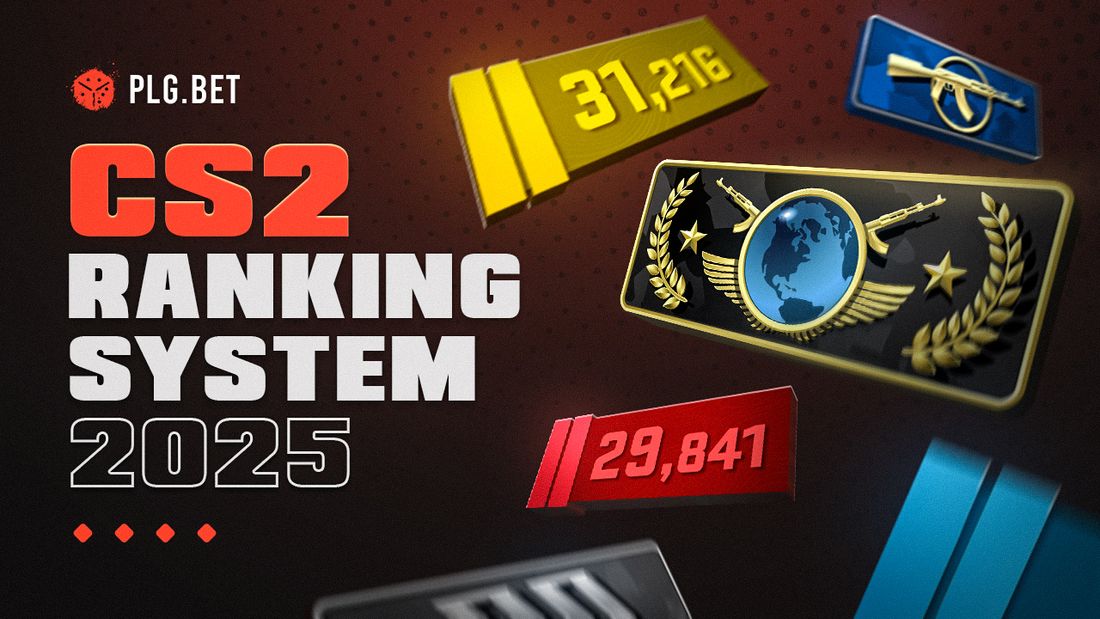
Counter-Strike 2 revolutionized the competitive landscape with its dual ranking system, fundamentally changing how players progress and compete. Unlike the single CS:GO ranking system, CS2 introduces two parallel progression paths: traditional Competitive ranks with map-specific progression and the innovative Premier mode featuring CS Rating. This comprehensive guide explains both systems, helping you understand placement matches, rank distribution, and strategies to rank up fast in Counter-Strike 2's evolved ranking ecosystem.
Two Ranking Systems in CS2: Competitive vs Premier
CS2 introduces a revolutionary dual ranking approach that caters to different player preferences and skill development paths. The Competitive mode maintains the familiar 18-rank structure from Silver I to Global Elite, but now implements map-specific progression. Meanwhile, Premier mode introduces CS Rating, a numerical system ranging from 0 to 30,000+ with color-coded tiers.
Valve designed this dual system to serve both casual and hardcore players. Competitive mode allows players to focus on mastering specific maps, while Premier mode emphasizes overall game knowledge through its pick/ban system. The competitive matchmaking system requires players to queue for specific maps, whereas Premier mode uses a professional-style map selection process that challenges players across the entire map pool.
Each system requires separate placement matches and maintains independent progression. Players can simultaneously hold ranks in both systems, creating multiple goals and pathways for improvement. This flexibility lets you choose between focused map practice in Competitive or comprehensive skill development in Premier mode.
CS2 Competitive Ranks: Map-Specific Progression
The CS2 competitive mode transforms the traditional ranking concept by implementing map-specific ranks. Players now earn individual CS2 ranks for each map in the competitive pool, meaning you could achieve Global Elite on Dust2 while maintaining Silver Elite on Mirage. This system recognizes that map knowledge and crosshair placement vary significantly across different environments.
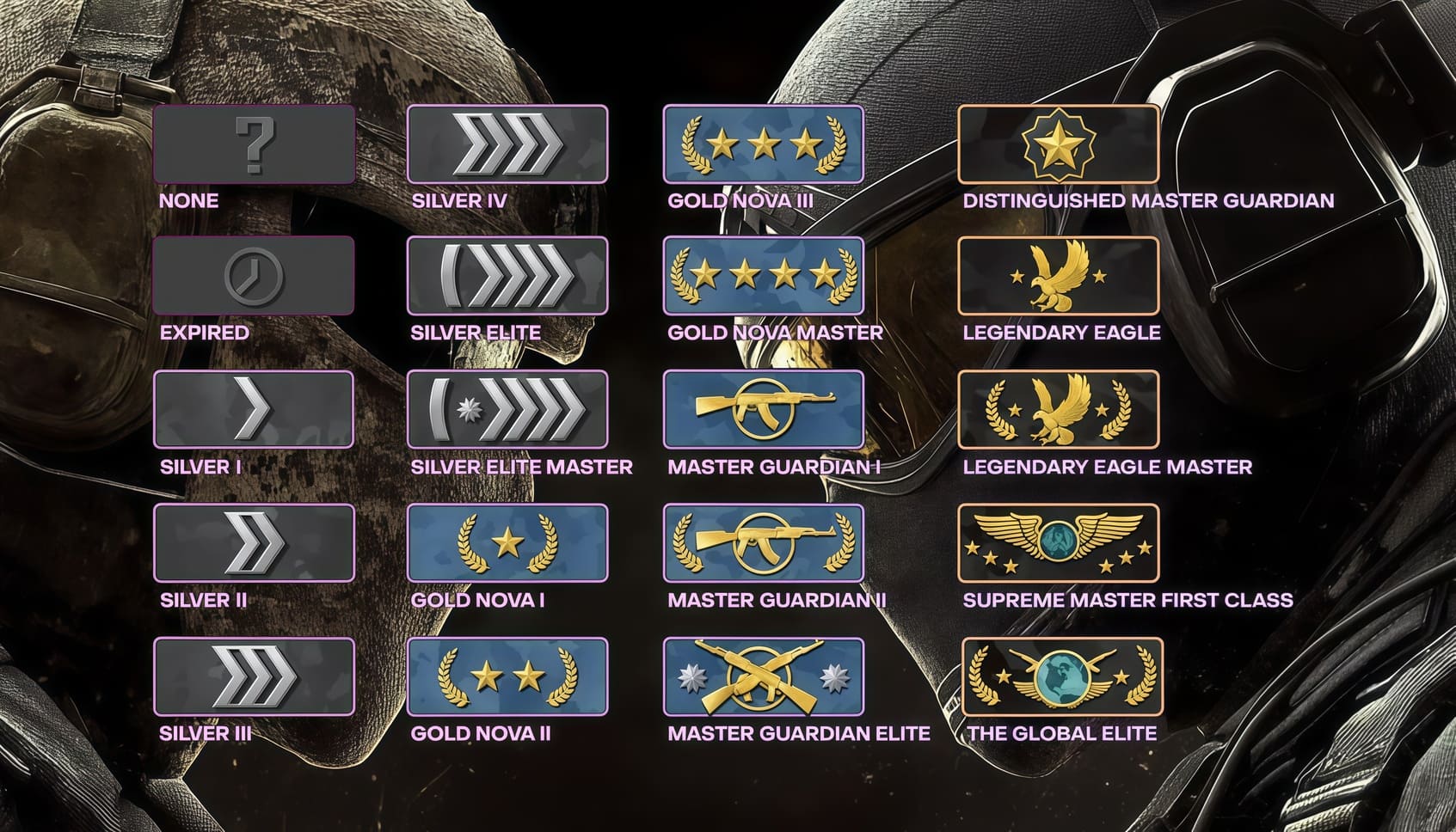
To earn your first rank on any map, you must complete 10 placement matches (10 wins, not just 10 games played). The system evaluates your performance during these matches to determine your initial rank. Most players receive ranks in the silver ranks to Gold Nova range initially, regardless of previous CS:GO experience.
| Rank | Tier | Description |
|---|---|---|
| Silver I - Silver Elite Master | Silver Tier | Entry-level ranks for new players learning fundamentals like crosshair placement and game sense |
| Gold Nova I - Gold Nova Master | Gold Nova Tier | Average skill level with solid game understanding and basic utility usage |
| Master Guardian I - Distinguished Master Guardian | Master Guardian Tier | Above-average players with good aim and developed game sense |
| Legendary Eagle - Global Elite | Elite Tier | Highly skilled players with exceptional abilities across all game aspects |
The map-specific system encourages players to develop well-rounded skills across different environments. Your Global Elite rank on one map doesn't guarantee success on unfamiliar territory, promoting continuous learning and adaptation. This represents a significant improvement over the old CS:GO ranking system works, which applied a single rank across all maps regardless of individual map proficiency.
CS2 Premier Mode and CS Rating System
CS2 premier mode represents CS2's most significant ranking innovation, featuring a numerical CS Rating system that provides precise skill measurement. CS Rating ranges from 1,000 to over 30,000, with color-coded categories indicating skill levels:
- Grey (1,000-4,999)
- Light Blue (5,000-9,999)
- Blue (10,000-14,999),
- Purple (15,000-19,999)
- Pink (20,000-24,999)
- Red (25,000-29,999),
- Exclusive Yellow "Unusual" rating (30,000+)
The CS2 premier mode requires Prime status and implements a professional pick/ban system where teams alternately ban and select maps. This format challenges players to develop competency across the entire map pool rather than specializing in specific environments. The system rewards well-rounded players who adapt to various tactical scenarios, making it superior to platforms like FACEIT for serious competitive development.
CS Rating calculation considers multiple factors including round wins, individual performance, MMR, and opponent strength. The rating system provides more granular progression feedback than traditional ranks, with players seeing exact rating changes after each match. This transparency helps players understand their improvement trajectory and identify areas needing development, particularly in crosshair placement and game sense.
Unlike standard competitive mode's 18 discrete ranks, CS Rating offers continuous progression with meaningful differences between similar ratings. The median Premier rating sits around 8,904, with only 10-15 players worldwide achieving the prestigious Unusual (Yellow) rating, making it CS2's most exclusive achievement. This represents a major evolution from how CS:GO ranking system works.
CS2 Rank Distribution and Statistics 2025

Current CS2 rank distribution data reveals significant changes from CS:GO patterns. In competitive mode, the Gold Nova ranks still contain approximately 37% of the player base, while CS2 premier mode shows a more normalized distribution around the 8,904 median rating. The rank system explained shows that approximately 50% of Premier players fall between 6,000-12,000 rating, with dramatic drop-offs at higher tiers.
The top 1% of Premier players maintain ratings above 20,000, while less than 0.1% achieve ratings exceeding 25,000. These statistics highlight the competitive nature of CS2's ranking system and the dedication required to reach elite levels. The dual system creates multiple benchmarks for success, accommodating different player goals and time commitments across the player base.
According to tracking services like Leetify, CS2's CS2 rank distribution has stabilized since launch, with consistent patterns emerging across regions. The system's algorithm adjustments have created more balanced matchmaking compared to CS:GO's later years, making it easier for dedicated players to rank up fast through consistent performance.
Prime Status and Access Requirements
CS2 premier mode requires Prime status, available for $14.99 as a one-time purchase, creating a barrier that reduces smurfing and improves match quality. Non-Prime players can only access competitive mode with limited features and potentially longer queue times. Prime status unlocks full Premier access, priority matchmaking, exclusive rewards, and access to the complete CS2 ranking system.
The Prime requirement serves multiple purposes: generating revenue for continued development, reducing cheater impact through financial investment, and creating a more serious competitive environment. CS2 premier mode also restricts group queuing to prevent rating manipulation, allowing only solo or duo queues to maintain competitive integrity.
These restrictions maintain Premier mode's integrity as CS2's premier competitive experience. Players serious about climbing the CS Rating leaderboards and wanting to rank up fast must invest in Prime status and commit to individual skill development rather than relying on coordinated team strategies. This creates a more balanced matchmaking rating environment across the player base.
Placement Matches and Initial Ranking
Both CS2 ranking systems require placement matches before assigning initial CS2 ranks. competitive mode needs 10 wins on each map, while CS2 premier mode requires 10 wins in the pick/ban format. These aren't simply 10 matches played – you must achieve 10 victories, which can take significantly longer for new players.
During placement matches, the system evaluates multiple performance metrics including round wins, individual frags, objective completions, and opponent difficulty. Most players receive conservative initial CS2 ranks, typically in the silver ranks or low Gold Nova in competitive mode, or 4,000-7,000 CS Rating in Premier. Understanding how the rank system explained works helps set realistic expectations during this calibration period.
Placement match performance significantly impacts your initial rank, but the system favors gradual progression over immediate high placement. This approach prevents rank inflation and ensures players develop fundamental skills like crosshair placement and game sense before advancing to higher tiers. Expect several dozen matches across both systems to complete all placement requirements and begin your journey to rank up fast.
Rank Decay and Inactivity System
CS2 implements rank decay after periods of inactivity in either ranking system. In Competitive mode, inactive players lose visible ranks after 30 days of not playing competitive matches. Premier mode has a more aggressive decay system, with ranks becoming hidden after 17-30 days of inactivity, depending on various factors.
Decay affects both systems differently: Competitive ranks become hidden but maintain underlying MMR, while Premier CS Rating may decrease more significantly. Returning players typically need 1-3 matches to restore their visible rank, though extended inactivity may require additional games to reach previous levels.
To maintain ranks, players should complete at least one competitive match every 30 days for Competitive mode, or every 17-30 days for Premier mode. Regular activity prevents decay and maintains matchmaking accuracy, ensuring fair competition for all participants.
How to Rank Up Really Fast
Accelerating rank progression in CS2 requires understanding both systems' unique characteristics. For competitive mode, focus on mastering specific maps through dedicated practice, learning common angles, grenade lineups, and positioning. Watch professional demos for your preferred maps and practice crosshair placement on aim maps daily to improve your ability to aim consistently.
CS2 premier mode demands broader skills: develop competency across all active duty maps, practice counter-stratting different team compositions, and improve your adaptability to various tactical scenarios. Use utility effectively, maintain consistent crosshair placement, and focus on game sense development over individual fragging. Understanding different maps and developing map knowledge is crucial for success.
Technical optimization significantly impacts performance: maintain stable 300+ FPS, use appropriate graphics settings for visibility, and ensure low input lag through proper hardware configuration. These factors affect your ability to execute precise movements and reactions crucial for higher CS2 ranks. Many best players prioritize these technical aspects alongside skill development.
Avoid solo queuing when possible – duo queuing with a reliable teammate improves communication and coordination. However, don't rely solely on premade advantages; develop individual skills that translate to any team environment for sustainable rank growth. Focus on games you win through superior teamwork and individual performance rather than hoping to rank up in CS:GO-style carry performances.
Competitive vs Premier: Which Mode to Choose?
Choosing between Competitive and Premier depends on your goals and playstyle preferences. Competitive mode suits players wanting to master specific maps, practice particular strategies, or gradually build confidence across familiar environments. The map-specific ranking system allows focused improvement without broader game knowledge pressure.
Premier mode benefits players seeking comprehensive skill development, professional-style gameplay, and the most accurate skill measurement. The pick/ban system forces adaptation and prevents one-trick strategies, creating more well-rounded players but requiring greater time investment and map knowledge.
Consider your available time and commitment level: Competitive mode allows casual progression with focused practice sessions, while Premier mode demands serious dedication to developing skills across all maps and tactical scenarios. Both systems offer unique rewards and challenges for different player types.
CS2 vs CS:GO Ranking: What Changed?
CS2's ranking overhaul addresses many CS:GO ranking system limitations. The introduction of map-specific competitive ranks eliminates the frustration of losing rank on unfamiliar maps, while CS2 premier mode provides the precision and transparency that CS:GO's hidden system lacked. Players can now see exactly how their CS2 ranks progress through the new rating system.
The migration from CS:GO preserved some player progress but reset many ranks to ensure fair competition in the new systems. Players generally started lower than their CS:GO equivalents, requiring re-climbing but with improved systems that better reflect actual skill levels. The CS:GO rankings were often criticized for their opacity, while CS2's system explained progression clearly.
CS2's dual approach accommodates different player preferences that CS:GO's single system couldn't address. The new ranking systems provide clearer progression feedback, reduced smurfing through Prime requirements, and more balanced matchmaking through improved algorithms and separate progression paths. Understanding how CS:GO ranking system works versus CS2 helps players appreciate the improvements in competitive integrity and player experience.
Common CS2 Ranking Myths Debunked
Several persistent myths surround CS2's ranking systems that can mislead players seeking to rank up fast. First, individual kills and K/D ratio have minimal impact compared to round wins and match victories. The CS2 ranking system prioritizes team success over individual statistics, encouraging cooperative gameplay over selfish fragging across the player base.
MVP stars influence CS2 ranks but aren't the determining factor many believe. Consistent round contributions through utility usage, objective completions, and team support often matter more than spectacular individual plays. Focus on winning rounds through team coordination rather than chasing MVP awards, as the system explained rewards consistent team-oriented performance.
Map selection in competitive mode doesn't guarantee easier ranking despite what some players believe about silver ranks progression. While some maps may have different skill distributions, the system adjusts for these variations through MMR calculations. Instead of seeking "easy" maps, develop genuine skill improvements in crosshair placement and game sense that translate across all environments for sustainable rank growth. This approach works better than trying to exploit perceived weaknesses in how CS:GO ranking system works.